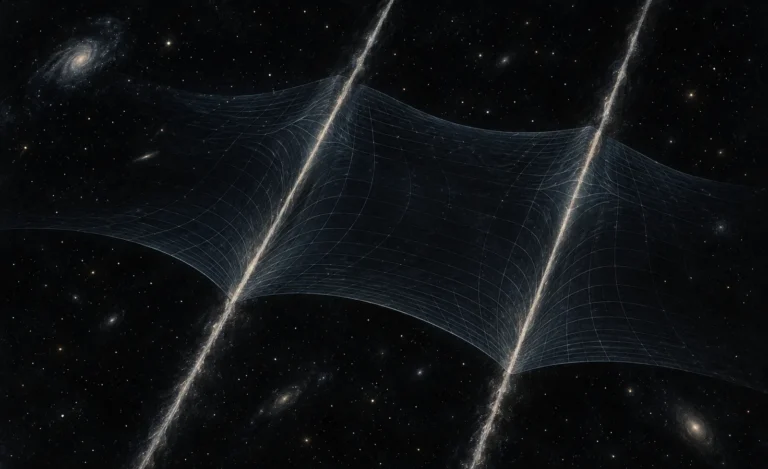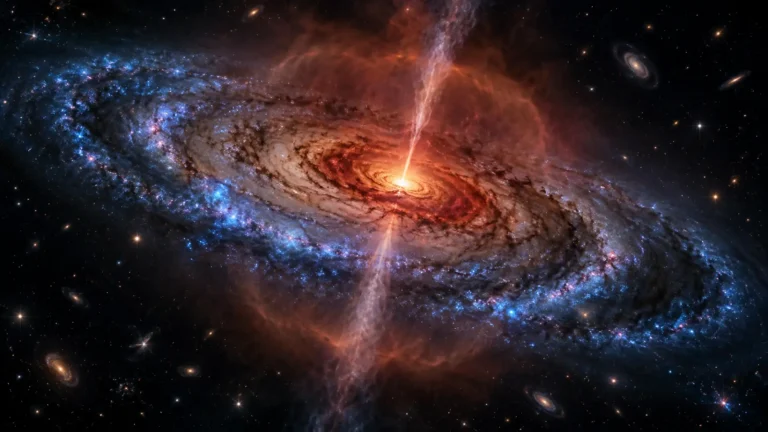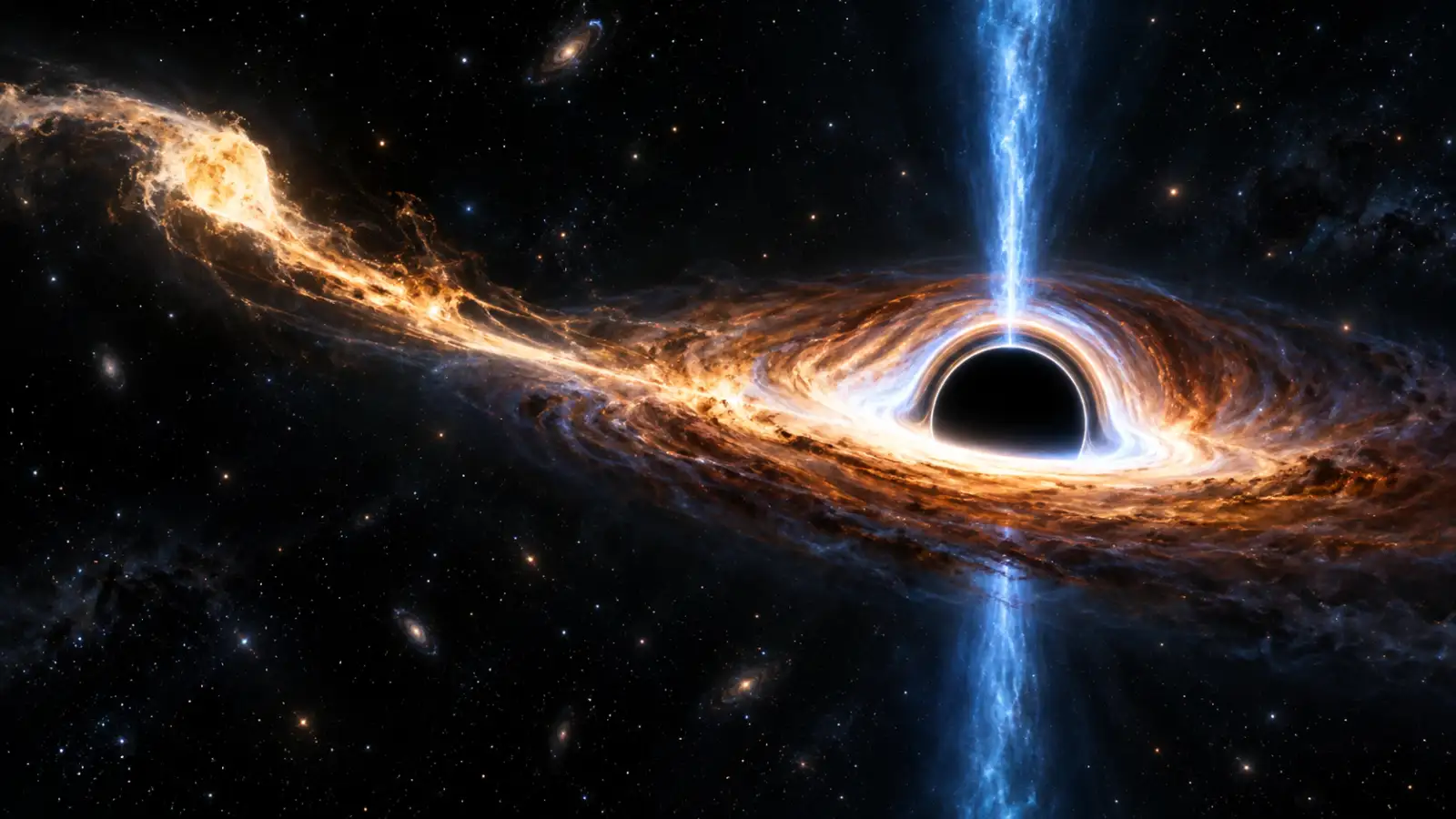
A black hole is often pictured as a permanent engine, pulling in gas and firing a jet into space. The reality is more changeable. Some black holes shine strongly for a time and then fade. Others remain almost invisible until a star wanders too close and turns a quiet system into a flash of light.
That change has left astronomers with a deceptively simple question: what makes a black hole launch a jet?
A new study in Nature Astronomy points to a possible answer. The researchers find that black holes separated by enormous differences in mass may begin launching a second, delayed outflow when the material falling toward them drops to about 2 percent of the Eddington luminosity—the theoretical limit at which outward radiation pressure balances gravity for a given object.
The result does not mean every black hole fires a perfectly timed beam at one exact number. It suggests that the relationship between feeding and outflow may be governed by the same underlying physics across a remarkable range of scales.
The star-shredding events that reveal the timing
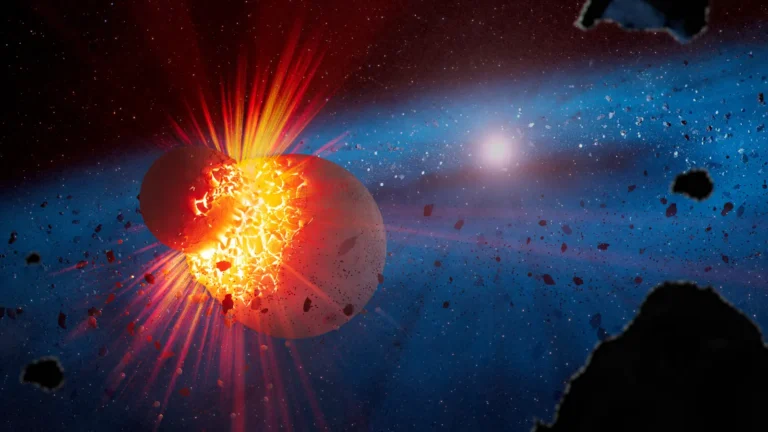
The clue comes from tidal disruption events. When a star passes too close to a supermassive black hole, the black hole’s tidal force can overcome the star’s own gravity. The star is stretched into a stream of gas, some of which escapes while the rest falls back and forms a hot, rotating flow around the black hole.
Astronomers can follow this process because it unfolds over months or years rather than the thousands of years over which an ordinary supermassive black-hole accretion disk changes. A tidal disruption event is therefore a kind of cosmic time-lapse: the feeding rate rises, the debris settles, and the system can be watched as it changes state.
That timing is the key. Stellar-mass black holes in our galaxy can change their accretion state quickly enough for observers to identify when jets appear. Supermassive black holes normally evolve too slowly for the same transition to be measured directly. The disrupted stars provide a bridge between those two regimes.
NASA describes the broader process as a tidal disruption event: the debris can heat to extreme temperatures, form an accretion disk and, in some cases, produce a relativistic jet. Curiosmos has previously explored how astronomers infer the presence of an invisible black hole and how radio jets can brighten long after an X-ray flare.
What the new study measured
Adelle Goodwin and Andrew Mummery combined optical, ultraviolet, X-ray and radio observations of tidal disruption events with models of the accretion flow. The aim was to connect two things that are often studied separately: how quickly the black hole is being fed, and when an outflow becomes visible.
The study identifies two physically different outflow phases. The first can occur while the debris is arriving at a super-Eddington rate, when the flow is far above the level at which a steady system could radiate without driving material away. A second outflow appears later, as the feeding rate falls.
That later transition occurs near a critical luminosity of roughly 0.02 times the Eddington luminosity. The authors compare this value with the threshold at which stellar-mass black holes change state and begin producing jets. The agreement is striking because the objects involved can differ in mass by millions or billions of times.
The important evidence is not simply that a jet was seen. It is that the observations place the jet in a particular stage of the black hole’s changing feeding cycle. The sequence gives researchers a way to test a physical trigger rather than treating every bright radio source as an isolated mystery.
What “universal” means here
In astronomy, universal rarely means that every object behaves identically in every detail. Here it means that the critical accretion threshold appears to scale with the system’s own Eddington limit rather than with the black hole’s absolute mass.
A stellar-mass black hole and a supermassive black hole have very different temperatures, sizes and timescales. Yet if both change state near the same fraction of their permitted luminosity, the comparison suggests that the switch may depend on the structure of the accretion flow itself. Magnetic fields, the thickness of the disk and the way energy moves through the gas still matter, but the threshold offers a common reference point.
That is useful because jets are among the most powerful ways black holes affect their surroundings. They can carry energy far beyond the accretion disk, influence gas in a host galaxy and, in the case of a jet aimed toward Earth, make a transient event appear dramatically brighter.
The finding also helps explain why a black hole can seem dormant and then become active without requiring a new object or a sudden change in its mass. The flow can cross a physical boundary as it fades, and the outflow can respond.
What remains uncertain
The study does not show that the 2 percent threshold is a switch with no exceptions. The observations are assembled from rare events, and the radio signal used to identify an outflow depends on viewing angle, magnetic conditions and the surrounding gas. A jet pointing away from Earth may be difficult to detect, while a changing environment can delay or reshape the signal.
The authors’ interpretation is also a prediction. If the threshold is truly scale-invariant, new tidal disruption events should produce delayed outflows at comparable accretion fractions. Future radio surveys can test that prediction by finding more star-shredding flares and returning to them at the right time.
That is where the result becomes more than a neat number. It gives observers a schedule. Instead of waiting for a black hole to surprise them, they can estimate when a fading event is most likely to produce a new jet and direct scarce telescope time toward that window.
A black hole still keeps its deepest secrets behind an event horizon. But by watching a star come apart outside that boundary, astronomers can learn when the surrounding flow changes character—and perhaps why the universe’s most extreme engines know when to turn on.
Sources and further reading
- Goodwin and Mummery, “A universal critical accretion rate for black hole jet formation,” Nature Astronomy (2026)
- Goodwin and Mummery, open preprint, arXiv:2602.14838
- Curtin University / EurekAlert research release
- NASA: Swift sees a black hole shredding a star
- Curiosmos: What NASA’s Roman Telescope may reveal about distant black holes