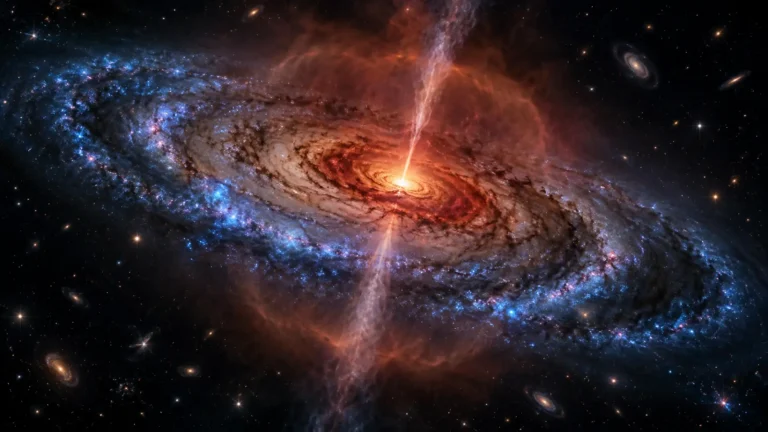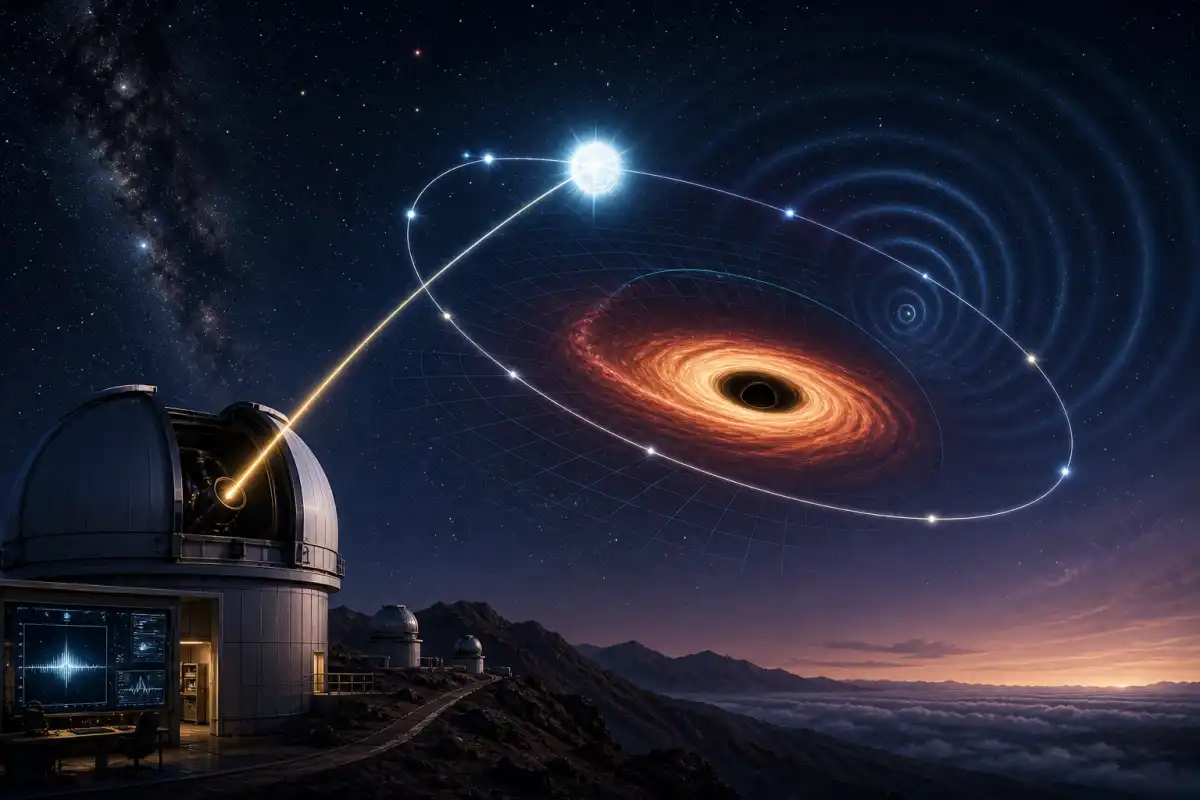
A black hole’s event horizon is invisible. Light that crosses it cannot return to a telescope, so astronomers do not photograph the black hole itself in the usual sense. They find black holes by measuring what their gravity does to nearby stars, gas and even the path of light.
This is a case where absence of light is not absence of evidence. A compact object that weighs several times more than the Sun can reveal itself through the orbit of a companion star. A supermassive black hole can announce its presence through a galaxy’s central stars, a hot disk of gas or a jet extending across space.
Stars moving around something unseen
The cleanest evidence often comes from motion. If a star accelerates around an invisible companion, astronomers can measure the orbit and calculate the unseen object’s mass. When the mass is packed into a region too small for a normal star cluster or another known object, a black hole becomes the best explanation.
The stars near the centre of the Milky Way provide a famous example. By tracking their fast, tight orbits around Sagittarius A*, researchers measured a concentration of about four million solar masses in a very small volume. The stars are visible; the object controlling their motion is not.
Hot gas gives off X-rays
A black hole can pull gas from a companion star. The gas spirals into an accretion disk, where friction and rapid motion heat it to millions of degrees. That disk emits X-rays that space telescopes can detect. The X-rays come from material outside the event horizon, before it crosses the point of no return.
The pattern of the X-rays can reveal how fast the gas is moving and how the system changes with time. Some black holes also launch narrow jets of particles travelling close to the speed of light. Those jets can shine in radio, visible, ultraviolet and X-ray wavelengths.
When a black hole tears apart a star
Sometimes the evidence arrives as a sudden flare. If a star passes too close to a supermassive black hole, tidal forces stretch it into a stream. The debris forms a bright, temporary disk and can outshine the host galaxy. Astronomers call this a tidal disruption event.
These events are useful because they can expose black holes that are otherwise quiet. NASA’s Swift observatory recently used one such flare to study a possible supermassive black hole far from the centre of its galaxy.
Ripples in space-time
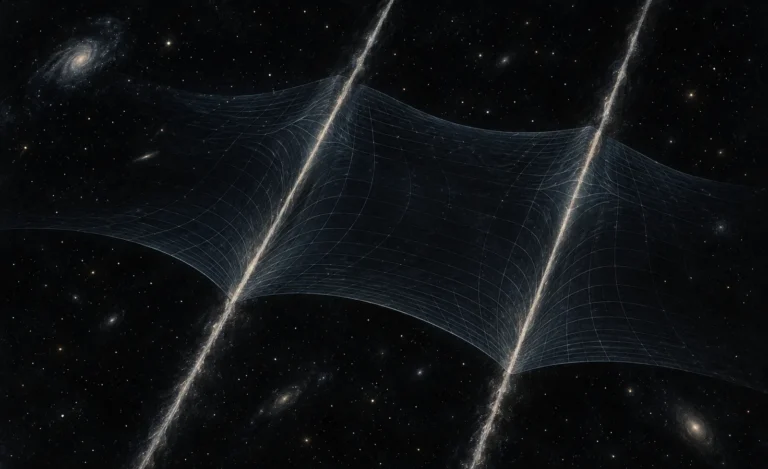
Merging black holes do not need to produce a bright flash. As two massive objects spiral together, they send gravitational waves through space-time. LIGO, Virgo and KAGRA measure the tiny changes those waves make in the lengths of their detectors.
The shape of the signal reveals the masses and spins of the objects that merged. This method can find black holes even when there is little or no visible matter around them.
Gravity can bend light
A lone black hole can also be found through gravitational lensing. Its gravity bends and briefly magnifies the light from a more distant star. The foreground black hole may remain dark, but the change in the background star’s brightness and position can betray its passage.
In 2019, the Event Horizon Telescope produced a radio image of the glowing material around the black hole in galaxy M87. The dark centre in that image is a shadow cast by the black hole against the light of the surrounding plasma—not a picture of the event horizon emitting light.
A dark object with a visible influence
Each method answers a slightly different question. Orbits measure mass, accretion disks reveal heated matter, tidal disruption events expose quiet supermassive black holes, gravitational waves record mergers and lensing can find isolated objects. Together they form a strong case without requiring anyone to see inside the event horizon.
Astronomers are not looking for a glowing black surface. They are reading the disturbance left by an object whose defining feature is that light cannot escape.
For a visual history of the evidence, see Curiosmos’ guide to the black-hole photographs and measurements that made these objects visible to science.