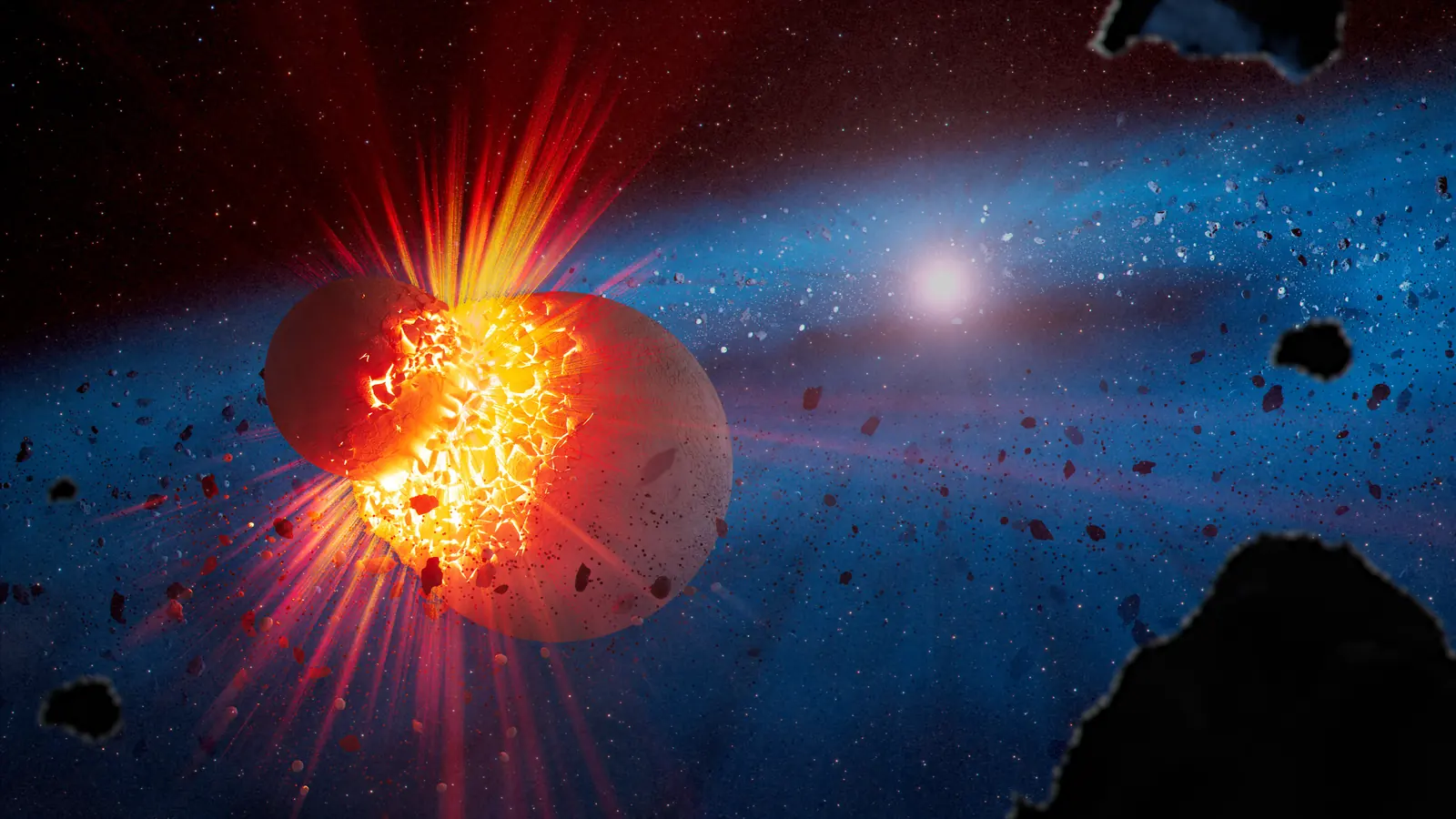
A collision between two growing worlds can leave more than a crater. With enough energy, rock turns to vapor, spreads through space and cools into fine dust. Around distant stars, that dust may survive as a clue long after the impact itself has passed.
A study highlighted by NASA and ESA on October 1 uses the James Webb Space Telescope to read those clues in 21 unusually dusty stellar systems. The researchers link differences in the minerals to different kinds of impacts, from less energetic encounters between smaller bodies to violent collisions involving planetary embryos roughly the size of Mars.
These are places where rocky worlds may be growing, breaking apart or being rearranged. They offer a comparison with our own planet’s early history.
The warm dust close to a star
Young stars begin with disks of gas and dust. As the gas disperses and planets take shape, collisions among the remaining bodies keep producing fresh debris. Astronomers call the later structures debris disks.
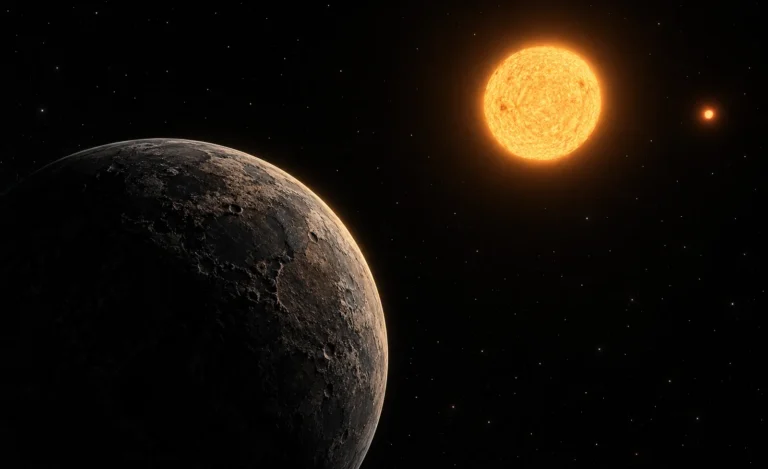
The systems in this study belong to a rarer group called extreme debris disks. They contain conspicuous amounts of warm dust near their stars, at distances comparable to the region occupied by rocky planets in our Solar System. Their infrared brightness can also change irregularly.
Kate Su of the Space Science Institute led the research. The team combined spectra from 16 systems observed with Webb with five others from the retired Spitzer telescope’s archive. Twelve of the Webb targets received their first mid-infrared spectra; four had earlier Spitzer observations. NASA’s account explains how the larger sample helped the team compare this unusual class of disks.
Reading minerals from light
Webb’s Mid-Infrared Instrument, MIRI, includes a spectrograph. It separates incoming light by wavelength, allowing astronomers to measure where an object emits more or less strongly. Warm dust radiates in this part of the spectrum, and its minerals leave recognizable features.
Think of a spectrum as a row of measurements rather than a photograph. A peak at a particular wavelength can help identify a material, even when the grains producing it are too distant to collect. Several minerals can contribute to the same feature, so the interpretation depends on comparisons and models.
In the accepted paper available on arXiv, the authors describe subtracting the star’s contribution and comparing the dust emission with an estimated smooth background. They focused their mineral analysis around the 10-micron feature and checked their measures against laboratory materials.
Two kinds of collision debris
The team divided the sample into disks relatively rich in silica and those relatively poor in it. Silica-rich material is familiar on Earth in volcanic glass such as obsidian; forsterite, a crystalline silicate, occurs in some green sands.
The ESA/Webb release describes the silica-rich group as consistent with highly energetic collisions between Mars-sized bodies, energetic enough to vaporize a substantial amount of rock. The silica-poor group is linked to less energetic impacts involving smaller, roughly Moon-sized bodies, including grazing encounters.
Those sizes are interpretations of the debris chemistry. The colliding bodies themselves are too small to study directly in these observations. And the two labels describe relative enrichment: real dust contains mixtures, rather than two perfectly separate recipes.
A comparison with the Moon’s beginnings
Our Moon provides a nearby reason to care about such distant collisions. The leading explanation for its origin involves a giant impact between the young Earth and another large body.
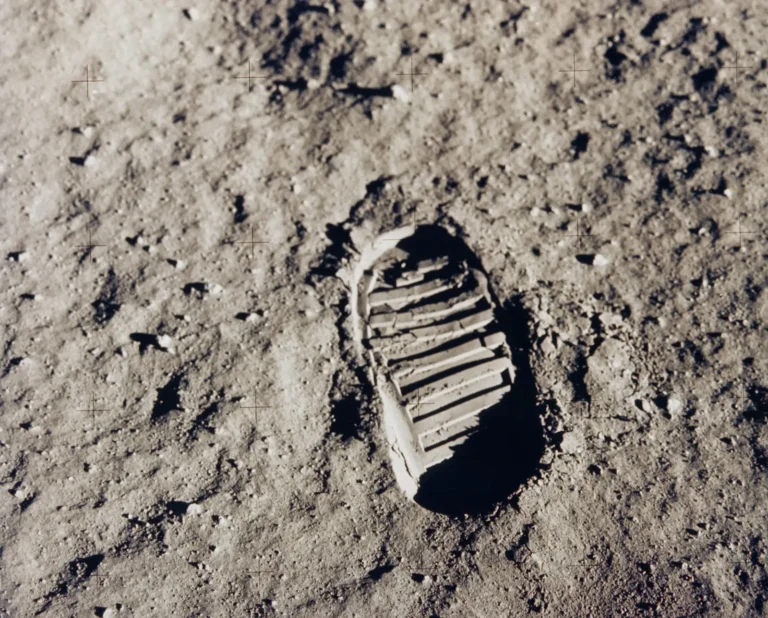
NASA’s review of lunar formation describes how Apollo samples helped establish that case. Lunar rocks preserve evidence of an early molten Moon and similarities with Earth’s rocks. Scientists use those samples, orbital measurements and simulations to work out how the encounter could have unfolded.
We can examine the mineral records preserved in meteorites too. Webb adds another perspective: the debris around other stars can reveal processes whose traces we study in ancient rocks at home.
The researchers found silica-rich disks only around stars younger than about 300 million years. That fits a period of vigorous rocky-planet assembly. But only three systems in the sample were older than that, leaving a small basis for judging what happens later. The authors also acknowledge that mixed minerals and grain structure complicate the spectral interpretation.
The paper was already available as an accepted preprint in July, before this week’s agency releases. Its findings give astronomers a way to compare collision aftermaths across systems, while a larger sample will help test the proposed age pattern. Somewhere in those dusty surroundings, the next rocky world may be taking shape from the wreckage of earlier ones.