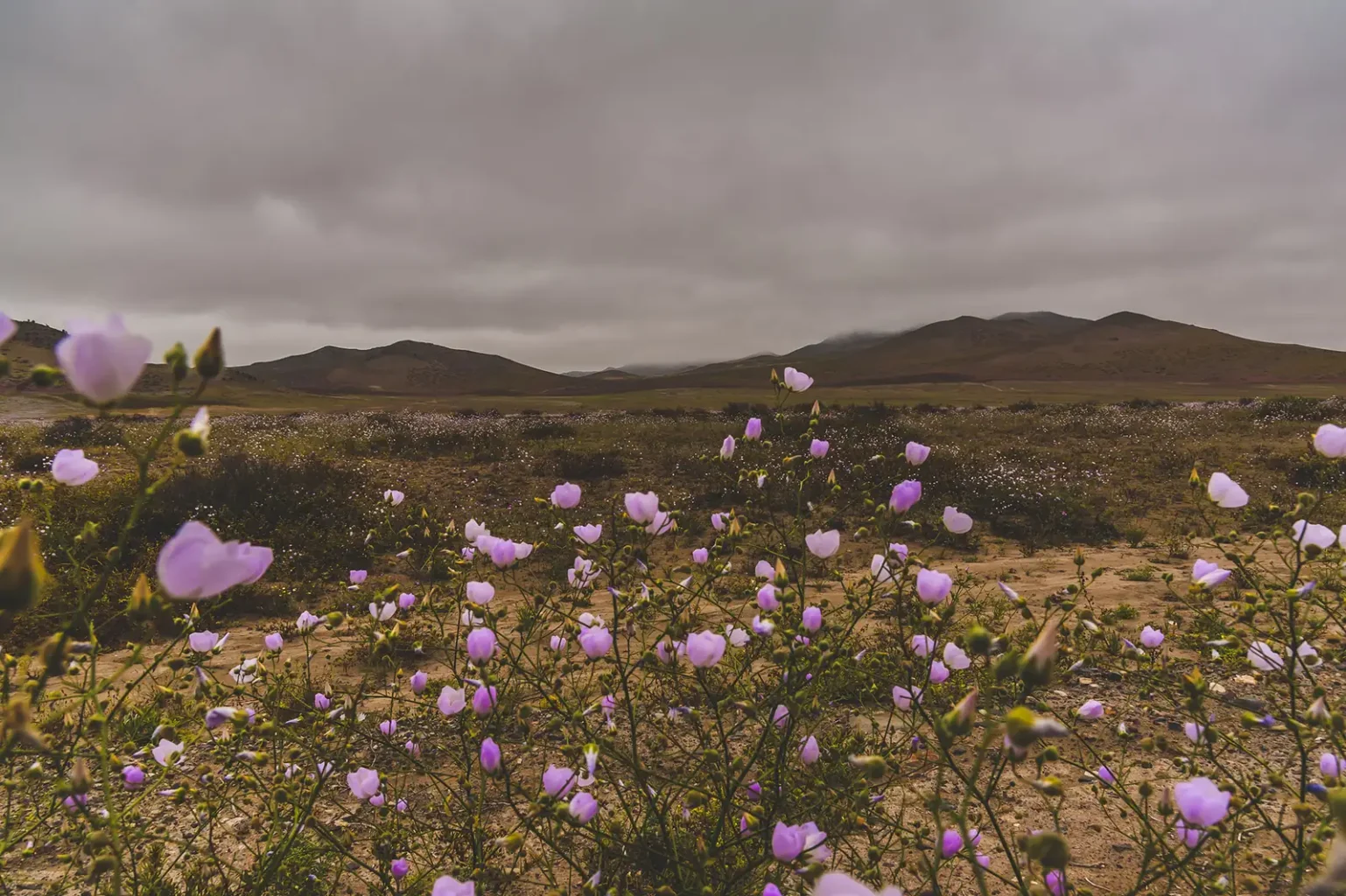
A dry patch of ground can look almost empty until rain reaches it. Then shoots rise through the soil, buds open and colour spreads across parts of Chile’s Atacama. Ground that looked barren can become a field of flowers.
Much of that life survives below the surface between flowering seasons. Seeds and underground plant structures can persist through dry conditions, while suitable rainfall allows plants to resume growth. The Atacama flowering desert is therefore a glimpse of life that was already there, including life a visitor could easily walk past without seeing.
Chile’s Desierto Florido National Park, established in 2023, protects a landscape associated with this phenomenon. CONAF’s description includes seeds, bulbs and invertebrates among the living components sheltered by the soil.
A flowering season has several stages
A bloom is often pictured as one moment: the desert becomes a carpet of flowers. Field research shows a sequence. In a study of vegetation in the southern coastal desert, researchers followed changes from September 1989 to January 1990 after rainfall in August.
The account records succession through the season, rather than all plants appearing at once. That helps explain why photographs taken in different weeks can show very different landscapes even within the same flowering event.
For someone watching from afar, a photograph gives the impression of a finished display. For the plants, flowering is a stage in reproduction. Germination, growth, pollination and seed development each have their own timing. A field of petals is still a field of organisms trying to complete a life cycle before favourable conditions disappear.
Why a rainfall figure cannot promise flowers everywhere
The 1989 study followed a season associated with a particular amount of rain at a particular place. That observation cannot supply a universal threshold for the entire Atacama. A few millimetres in one habitat may have different consequences from the same rainfall in another.
The distribution of seeds, soil conditions and the species present all affect what can emerge. Rainfall also has a geography: a shower can reach one valley and miss the next. Any prediction of a bloom has to specify where and when, rather than rely on a single desert-wide number.
This is why local reports are more useful for planning a visit than the expectation that a famous flowering year will make every stretch of desert colourful. A bloom can be abundant and still be uneven.
The work continues after the petals
A Kew account of botanical work in Chile describes the opportunities that rainfall creates for researchers and seed collectors. When otherwise inconspicuous plants emerge, botanists can locate and identify them. Collecting viable seeds requires returning at the appropriate stage.
The account highlights Nolana, a diverse group of flowering plants in this region, and work associated with Chile’s INIA and the Millennium Seed Bank. For a collector, the most photogenic day and the best collecting day may be quite different.
For botanists, the season continues after the flowers fade. A flower draws attention now; a mature seed carries the possibility of a future season. Those seeds may remain in the soil until conditions allow another generation to grow.
Walking carefully through a living seed bank
CONAF warns that picking flowers reduces the production of seeds, while trampling damages the habitat. The advice follows directly from how the bloom works. A flower taken home is removed from the reproductive process, and apparently bare ground may still hold dormant life.
A visitor does not need to see every seed to understand why established paths matter. The visible flowers represent only the surface of the system. Much of the next bloom is developing, or waiting, beneath people’s feet.
The Atacama Giant and its ancient desert routes show another side of this landscape’s history. The Atacama is also famous for archaeology, clear skies and dry landscapes that preserve unusual traces of the past. Between blooms, seeds and bulbs keep part of this living landscape out of sight. Protecting them matters long after the last flowers have faded.