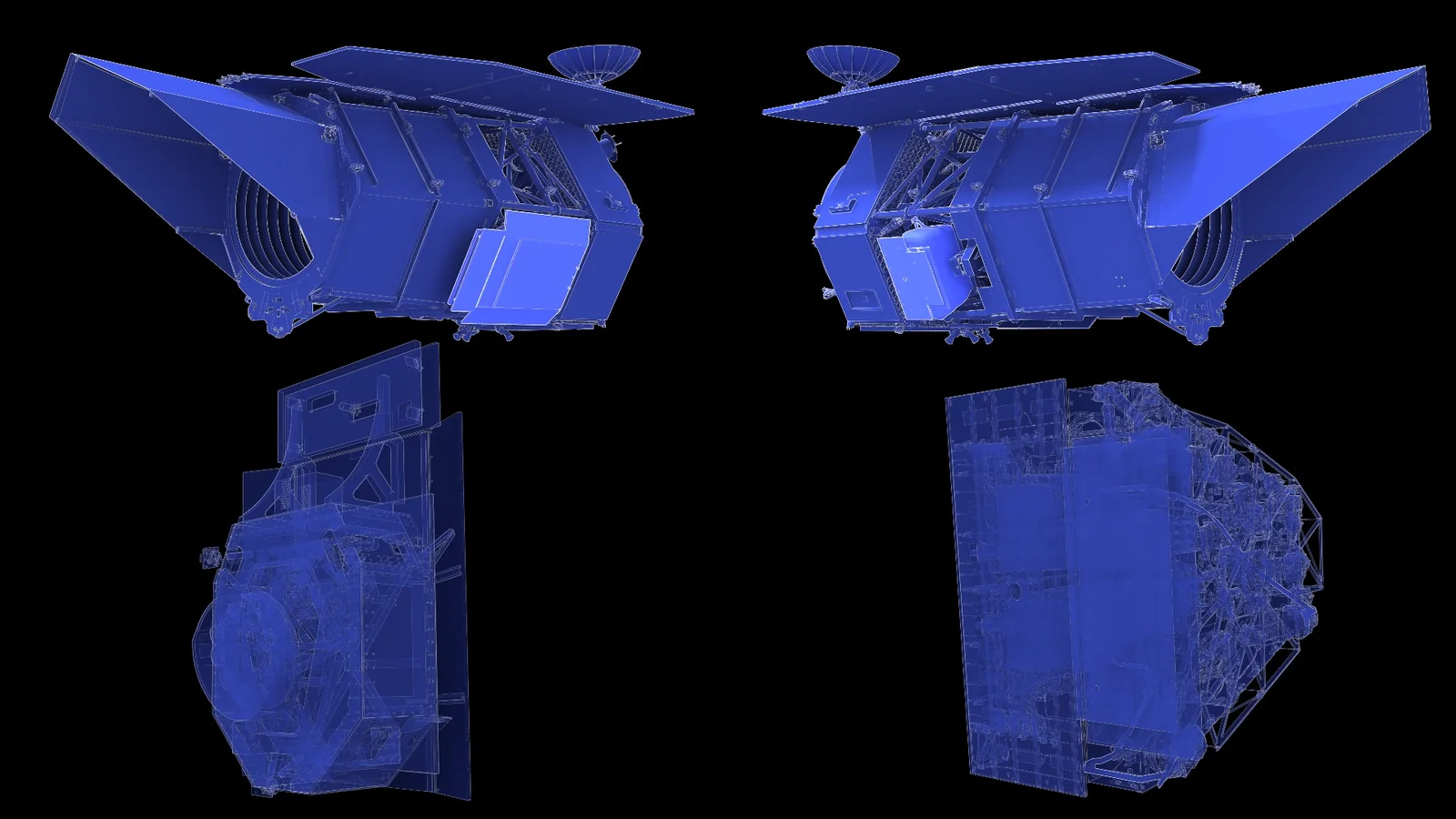
Something remarkable happened on the way to the next great map of the universe. NASA’s Nancy Grace Roman Space Telescope has activated its main science instrument, a 300-megapixel infrared camera designed to survey enormous areas of sky without giving up the detail we expect from a space telescope.
Roman has not taken its first polished science image yet. The telescope is still being commissioned, and the early data look deliberately imperfect. That is part of the story. Before Roman can search for distant worlds and measure the expansion of the universe, engineers have to prove that every part of its observing system can work in the cold, dark environment of space.
Roman’s wide-field camera is now awake
The Wide Field Instrument, or WFI, is built around 18 infrared detectors. Together they will record a patch of sky larger than the apparent size of the full Moon in a single exposure, with a sharpness comparable to that of Hubble. The combination is what makes the telescope different: Roman is designed to see both broadly and precisely.
That matters because some of astronomy’s hardest questions are spread across huge distances. A wide survey can reveal how galaxies are arranged, how their shapes changed over cosmic time and how invisible matter bends their light. The same data can also catch the small, repeated dimmings that betray planets crossing in front of their stars.
Why a larger view changes the search
Imagine trying to understand a forest by studying one tree at a time. Hubble has given us extraordinary close looks, but its narrow field means that a large survey takes many separate pointings. Roman will cover far more sky per exposure while keeping enough resolution to measure the faint differences that matter.
Those measurements could help astronomers investigate dark energy, the still-unidentified influence associated with the universe’s accelerating expansion. Roman will also build a census of galaxies and transient events, giving researchers a way to compare what the cosmos looks like in different places and at different moments.
Curiosmos has previously looked at how Roman’s antenna and sunshade were deployed during its journey. The next stage is less dramatic to watch, but just as important: turning a spacecraft into a calibrated observatory.
The coronagraph is a different kind of eye
NASA also tested Roman’s Coronagraph Instrument, which is meant to demonstrate technology for directly imaging planets around other stars. Masks and deformable mirrors will suppress the glare of a star so that a much fainter planet can become visible beside it.
This is a technology demonstration, not a promise that Roman will immediately photograph an Earth twin. The team first has to show that the software, optics, mechanisms, detectors and thermal controls respond correctly to commands from Earth. If they do, future observatories can build on the technique.
What happens before the first survey?
The WFI had to cool from its launch condition before its detectors could be activated. NASA reports that the instrument reached about minus 143 degrees Celsius, then continued toward an operating temperature near minus 183 C. Engineers tested the calibration system, the filter and prism wheel, and the focusing mechanism while the detectors settled into their working environment.
The first test exposure is expected to look blurred. The detector array was still stowed and far from its final focus, so stars appeared spread over many thousands of pixels. That image is useful precisely because it gives the team a baseline. As the optics are aligned, the same field should tighten into sharp points.
A telescope still becoming itself
Roman is continuing its roughly million-mile journey to the second Sun–Earth Lagrange point, known as L2. NASA expects the mission’s first science images in early 2027, after months of calibration and checks.
What will Roman see when that work is finished? The honest answer is a question. It may find planets no other survey could catch, map structures hidden in the distant universe and test the story we tell about cosmic expansion. The telescope’s first “image” is therefore more than a blurry beginning. It is evidence that the instrument built to search those vast questions is starting to work.