What is Yggdrasil? In the surviving Norse poems and prose, it is more than a tree at the edge of a fantasy map. It is the living structure that links gods, humans, giants and the dead. The sources give us roots, wells and creatures, but they do not provide one perfectly labelled diagram of nine worlds; that modern picture must be tested against the texts.
The sources do not present one neat diagram. The Poetic Edda and Snorri Sturluson’s Prose Edda name places, wells and beings associated with Yggdrasil, but they do not always agree on how every realm fits together. Modern images of nine perfectly arranged worlds are useful teaching devices, not an ancient map preserved without gaps.
What Do the Roots and Wells Tell Us?
The tree is associated with three great roots. One reaches toward the gods and the well of Urðr, where the Norns shape fate. Another extends toward the giants and the well of Mímir, a source of wisdom. A third reaches toward Niflheim and the spring Hvergelmir. These descriptions make Yggdrasil a meeting point between time, memory, danger and the divine order.
Keep exploring
Continue with Curiosmos
The creatures in the branches
A great eagle is said to sit near the top of the tree, while a hawk rests between its eyes. The dragon or serpent Níðhöggr gnaws at the roots below. A squirrel named Ratatoskr carries messages between the eagle and the serpent, turning the tree into a place of conflict as well as connection. Deer feed among the branches, and their movement helps make Yggdrasil feel alive rather than architectural.
Where the gods meet
The gods travel to the well of Urðr and hold their assembly there. The Norns water the tree, and the accounts describe the tree as suffering damage even while it remains central to the cosmos. That tension is important. Yggdrasil is not an immortal object untouched by time; it survives through care, struggle and renewal.
What are the nine worlds of Yggdrasil?
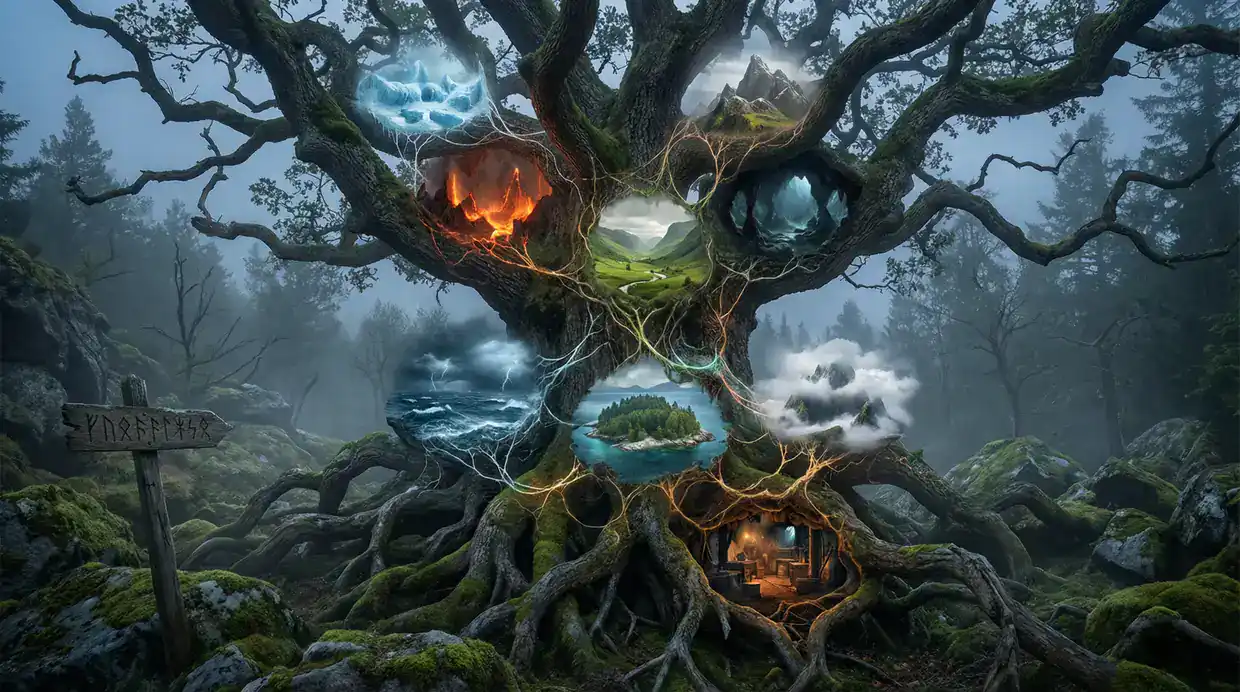
Modern summaries commonly name Asgard, Vanaheim, Midgard, Jötunheim, Alfheim, Svartalfheim, Niflheim, Muspelheim and Hel. The names are not presented as a single numbered diagram in the surviving Eddas. The Swedish History Museum describes nine worlds linked by Yggdrasil, while Encyclopaedia Britannica describes the tree as connecting those worlds. Some identifications, including whether Niðavellir and Svartalfheim are distinct, remain debated.
Why is the nine-world map uncertain?
Readers often encounter a list of Asgard, Midgard, Vanaheim, Jötunheim, Alfheim, Svartalfheim, Niflheim, Muspelheim and Hel. Several of these names and relationships are supported by the sources, but the Eddas do not supply a single complete diagram. Some names may refer to peoples or regions rather than separate planets. The safest reading is to treat the nine worlds as a modern synthesis built from a more fragmentary mythic record.
That uncertainty does not make the story less meaningful. Yggdrasil expresses a Norse imagination in which no realm is isolated: fate, weather, ancestry, conflict and death remain connected. It is a cosmology told through a living organism, not a technical description of space.
Yggdrasil, death and renewal
Yggdrasil is also tied to the end of the world. In the accounts of Ragnarök, the tree shakes as the old order breaks apart, yet the myths also imagine life continuing after the destruction. The tree therefore holds two ideas at once: the cosmos is vulnerable, and it can still shelter renewal. That tension is more important than any modern diagram of its branches. Curiosmos has also compared the mythic underworlds of Hades, Hel and Xibalba, which helps place Hel beside other traditions without treating them as the same story.
How the story reached us
The main written sources were recorded in medieval Iceland, centuries after the pre-Christian religions they describe. Earlier oral traditions may have changed as they travelled, and Snorri wrote with a Christian audience in mind. Archaeology, place names and later folklore can add context, but they cannot recreate an original Norse system word for word. The surviving texts are valuable because they preserve fragments, not because they remove every uncertainty.
A tree rather than a machine
Yggdrasil gives the Norse cosmos a sense of growth and dependency. Its worlds are connected by movement, water, messages and fate, not by a mechanical grid. That is why the image has lasted: it describes relationships between beings and places more powerfully than a list of names could.
Further reading: Encyclopaedia Britannica, Yggdrasill; Poetic Edda, Völuspá translation.