Long before Sumerian writing was clearly in use after about 3200 BCE, people in parts of Africa and Eurasia were already arranging stone in circles, lines and enclosed plans that tied recurring events in the sky to fixed points on the ground. These monuments do not belong to one culture or one belief system, and they do not all serve the same purpose. But taken together, they show that the work of recording time and structuring ritual began well before written records.
Before writing, durable markers
It is tempting to treat every stone ring as an ancient observatory, but the evidence is stronger when it stays local and specific. Some alignments are persuasive because excavation, dating and orientation point in the same direction. Others are weaker and collapse when broader claims outrun the data. What matters here is not a single global theory. It is the repeated decision, in very different places, to use durable architecture to mark recurrence: a sunrise, a season, a burial, a gathering, a return.
A circle made practical sense as well. It creates a center, organizes movement, defines an inside and an outside, and can be approached from any side. None of that proves a shared symbolic code across continents. It does help explain why unrelated communities could arrive at similar forms without contact. The shape was useful long before anyone tried to explain it in text.
Nabta Playa: a calendar in stone
The clearest early example in this story is Nabta Playa, in the Nubian Desert of southern Egypt. Its later Neolithic megalithic complex dates to roughly 7,000 years ago. Researchers linked the small stone circle there to the June solstice sunrise, and longer megalithic alignments have been interpreted as pointing toward Sirius and stars in Orion’s Belt. Nearby cattle burials and ceremonial structures suggest that observation of the sky was bound to pastoral life, season and ritual.
That combination matters. Nabta Playa was not built by a literate state leaving behind inscriptions to explain itself. Its builders worked through horizon, repetition and monumentality. A ring of stones could preserve a rule without a written sentence. Stand here at the right time of year, and the sky does the rest.
Arkaim: a planned circle of life and defense
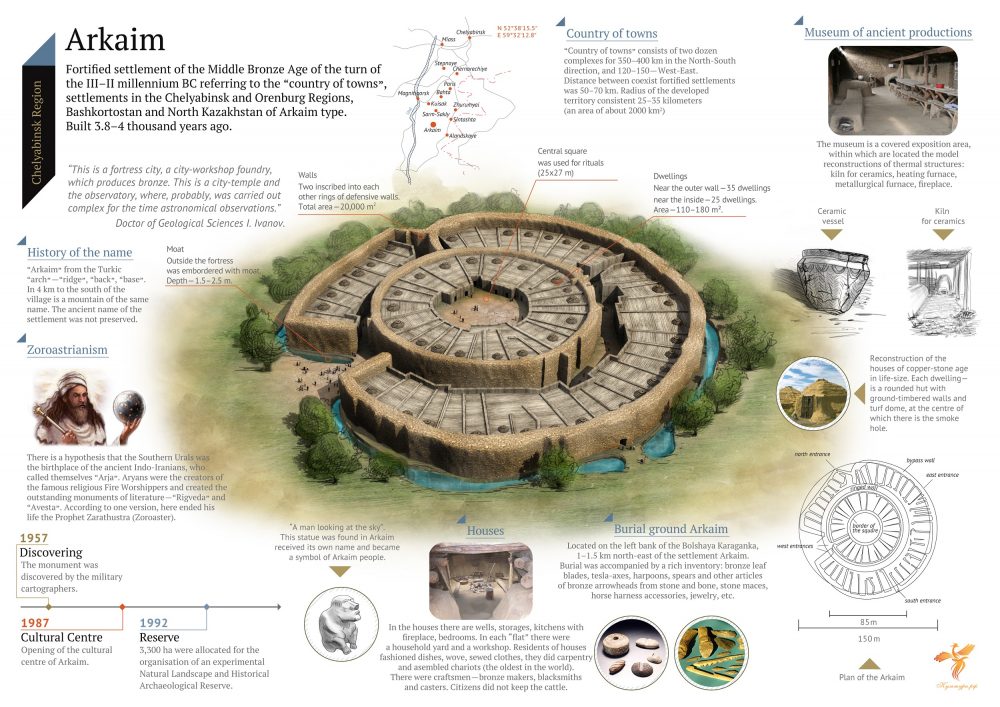
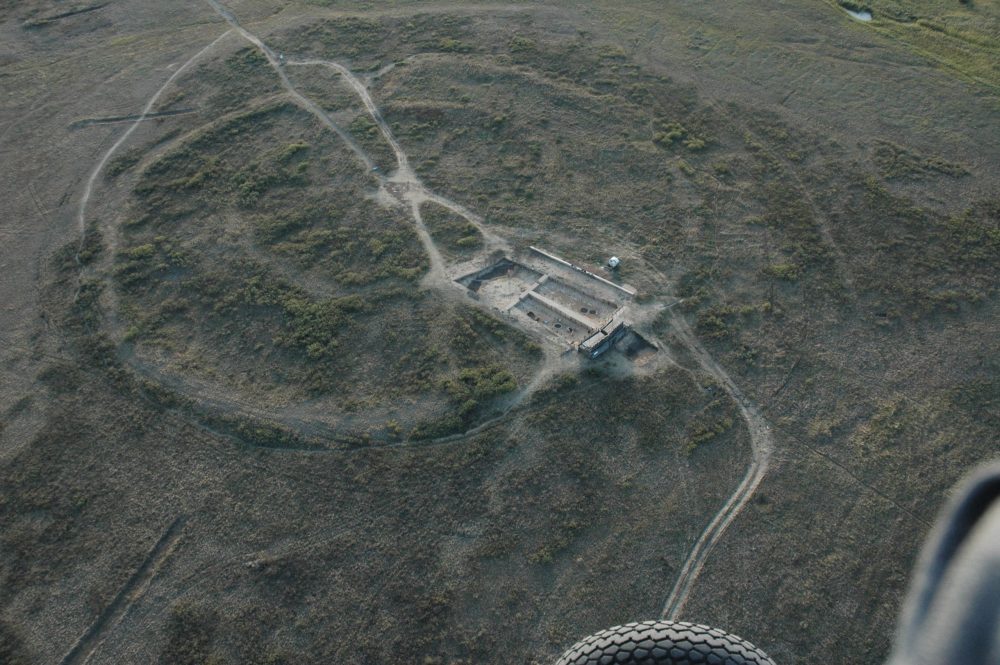
A different kind of circle appeared about 4,000 years ago at Arkaim, in the southern Urals. This was not an isolated ceremonial ring in the desert. It was a fortified settlement of the Sintashta cultural horizon, laid out with two concentric walls, dozens of dwellings, an internal circular street and gates oriented to the cardinal directions. Archaeologists have long noted how deliberate the plan is, which is why the site attracts cosmological and astronomical readings.
Even so, Arkaim does not need to be turned into a pure observatory to be important. Its value is that it shows how circular design could organize daily life as well as belief. Defense, craft production, traffic, storage and public space were folded into one ordered plan. In that sense, the circle was not only a marker of the sky. It was a way to impose pattern on a settlement and make that pattern visible.
The Senegambian circles: monumentality and burial
The Stone Circles of Senegambia belong to a much later period, after writing had already emerged elsewhere, but they show how persistent the form remained. Across Senegal and The Gambia, the wider megalithic landscape includes more than 1,000 circles and nearly 29,000 carefully shaped laterite monoliths. At the best-studied clusters, excavated burials date many of the monuments between 927 and 1305 CE. Here the strongest evidence points first to funerary use, not to a sky map.
That correction matters because it sharpens the larger point instead of weakening it. Stone circles were never one thing. Some registered celestial events. Some organized burial and remembrance. Some did both. In Senegambia, the sheer regularity of the pillars, the quarrying effort behind them and the repeated circular plans still show a society determined to make memory durable in stone.
What the circles were for
Put side by side, these monuments suggest a pattern without forcing a single answer. At Nabta Playa, the case for seasonal and celestial orientation is strong enough to treat the stones as a practical and ceremonial calendar. At Senegambia, the funerary evidence is stronger than any astronomical reading. At Arkaim, the circle becomes urban planning as much as symbolism. The safest conclusion is that stone circles were tools for permanence. They fixed relationships that speech alone could not reliably hold across generations.
That does not make them primitive science projects or encrypted theology. It makes them architecture with purpose. A community that depends on seasonal return needs ways to remember when return is due. A burial ground needs a form that gathers the living around the dead. A fortified settlement needs a plan that orders movement and authority. The circle solved different problems in different places, which is one reason it kept reappearing.
The stones do not tell us everything. Archaeology can date a monument, trace its quarrying, map its layout and test whether an alignment is plausible. It cannot recover every story once told inside the ring. That limit should keep interpretation disciplined. But the central fact remains solid enough on its own: long before written records, people were already using stone to organize time, ritual and collective memory, and the circle was one of the forms they trusted most