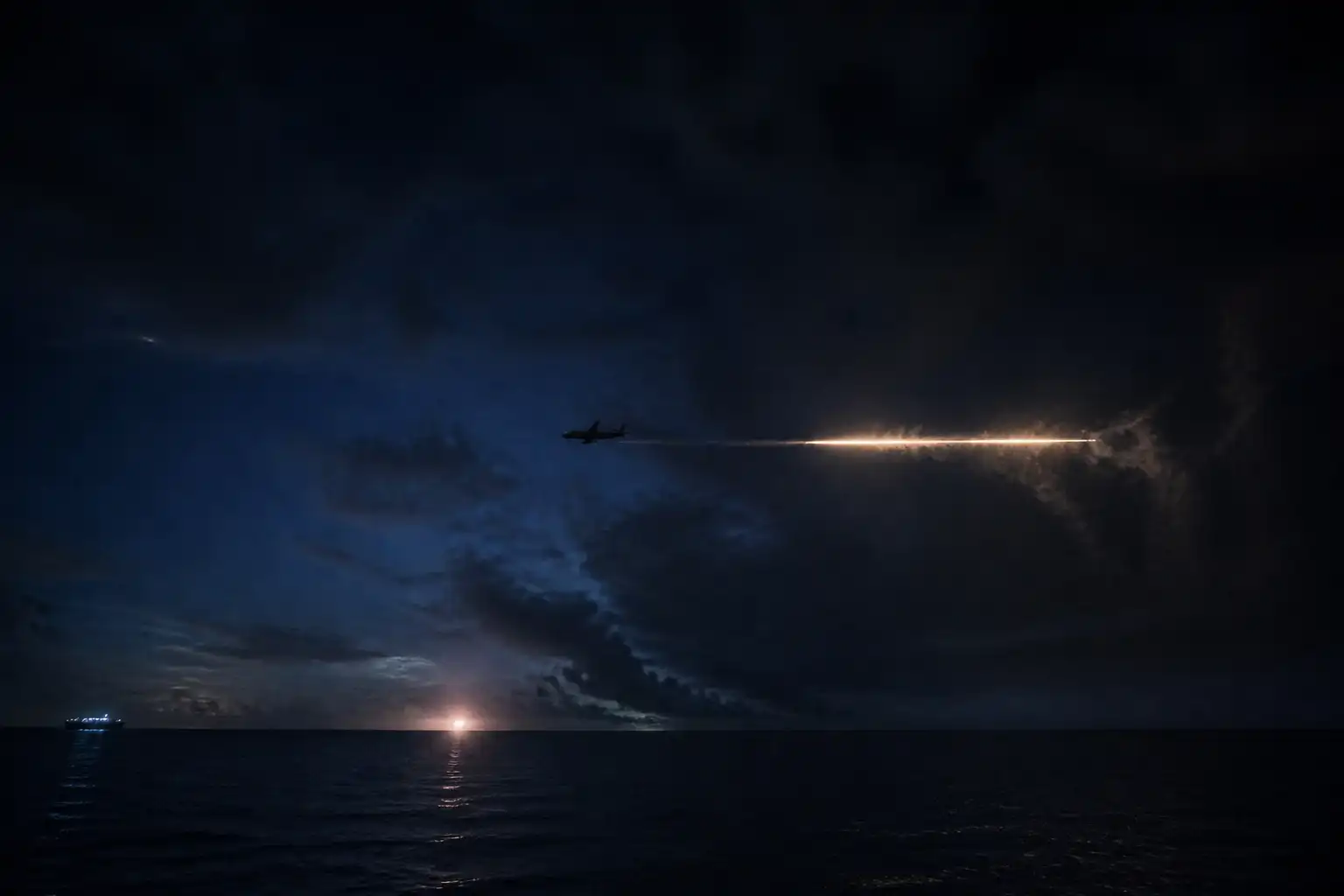
The idea that some UAP might be glowing plasma rather than solid craft has been around for years. Avi Loeb has now applied that possibility to one of the best-known cases in the modern UAP record: the 2004 encounter involving Navy pilots from the USS Nimitz Carrier Strike Group.
Loeb is not claiming that the case has been solved. His recent analysis asks a narrower question: could a powerful laser create a luminous structure that looks like a compact object, appears on infrared sensors and is mistaken for a craft? The answer is that the underlying physics is real. Whether it can explain what the Nimitz pilots and radar operators reported is a much harder question.
That distinction matters. A plausible mechanism is not the same thing as evidence that the mechanism was used in a particular encounter.
The Nimitz reports involve more than a bright spot
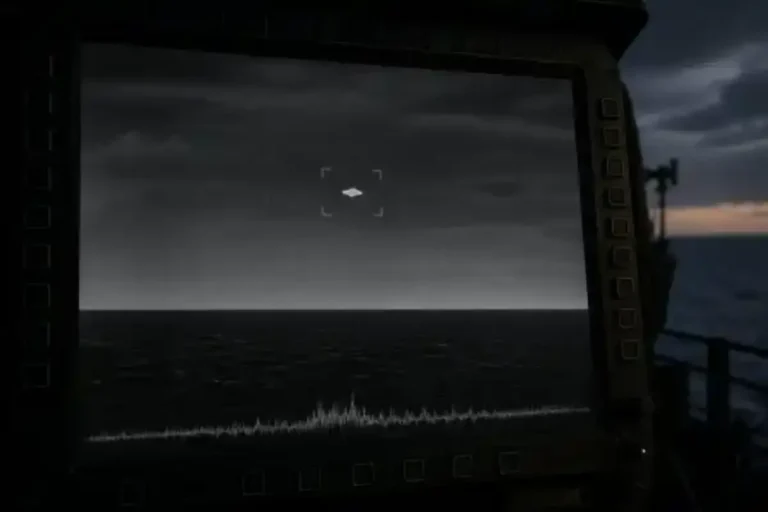
The Nimitz case is usually discussed through the “Tic-Tac” description given by pilot David Fravor and other witnesses. The reports describe a smooth, white object without visible wings, rotors or an engine. The object was seen above the Pacific near the USS Princeton in November 2004, and the encounter has been discussed alongside radar data and later-released infrared video.
The most dramatic descriptions involve rapid movement over a large distance. But the case is not a single photograph with a ruler beside it. The public record combines testimony, radar accounts, video and later interpretations, while leaving important details about the sensors and geometry unavailable. That makes the distance, apparent speed and shape of the object central to any serious explanation.
Curiosmos has previously examined why a UAP label describes an observation rather than an origin. A case can remain unidentified because the data are incomplete without demonstrating that the object was non-human. The Nimitz encounter belongs in that unresolved space.
What is a laser-induced plasma filament?
When an intense laser pulse travels through air, it can ionize molecules along its path and create a narrow channel of plasma. Plasma is an electrically charged gas. It can glow, emit infrared radiation and interact with radar in ways that make it visible to more than one type of sensor.
The U.S. Navy has a patent describing a laser-induced plasma filament for an infrared missile countermeasure. The concept is a decoy: instead of placing a solid object in the air, a system would create a hot, detectable signature that could draw a heat-seeking missile away from an aircraft. The patent is genuine, but a patent describes an intended design; it does not prove that a finished system was deployed or used in 2004.
Open research has also demonstrated that long-wavelength lasers can produce what researchers call a “megafilament” in air. A 2018 *Nature Photonics* paper reported an ionized channel about five metres long and an infrared-luminous channel extending about 30 metres. That is an impressive laboratory result, but it is not a tens-of-kilometres aerial decoy.
Where the explanation fits—and where it does not
Loeb’s proposal is interesting because it offers a known physical process that could produce a glowing, apparently three-dimensional signature. A plasma filament could also explain why an image might look like an object while lacking the hard surfaces, wings or engine that an aircraft would normally show.
The limits are just as important. The publicly described experiments remain far shorter than the distances associated with the Nimitz reports. A filament is elongated along the laser’s path, not naturally a small, smooth capsule. It would also require a powerful source, precise beam control and a geometry that places the laser and the observer in the right relationship.
There is a timeline problem as well. The Navy patent was published years after the 2004 encounter. That does not rule out earlier classified research, but it gives us no public evidence that the technology existed in the required form at the time, much less that it was used near the Nimitz group.
The hypothesis also cannot explain every UAP report. Similar-looking observations stretch across decades, locations and sensor systems. One terrestrial mechanism may account for some reports without accounting for the entire category.
The useful conclusion is narrower than the headline
The laser-plasma idea is worth reporting because it connects a real defence technology to a famous unresolved case. It is not a verdict on the Nimitz encounter, and it is not evidence of a secret hologram operation.
The responsible next step would be better data: synchronized optical, infrared, radar and acoustic records; a measured distance; and enough information to compare the apparent object with the performance of a laser system. Until that information exists, the Nimitz Tic-Tac remains an unresolved case with several competing explanations.
That is a more useful result than declaring the mystery solved. It tells us exactly what a future investigation would have to measure.
Sources and further reading
• Avi Loeb’s analysis of laser-produced plasma filaments and the Nimitz case
• Nature Photonics study of a laser megafilament in air
• U.S. patent for a laser-induced plasma infrared countermeasure
What are UAPs?, the fifth U.S. UAP release, 3I/ATLAS and the anomalies we cannot ignore.