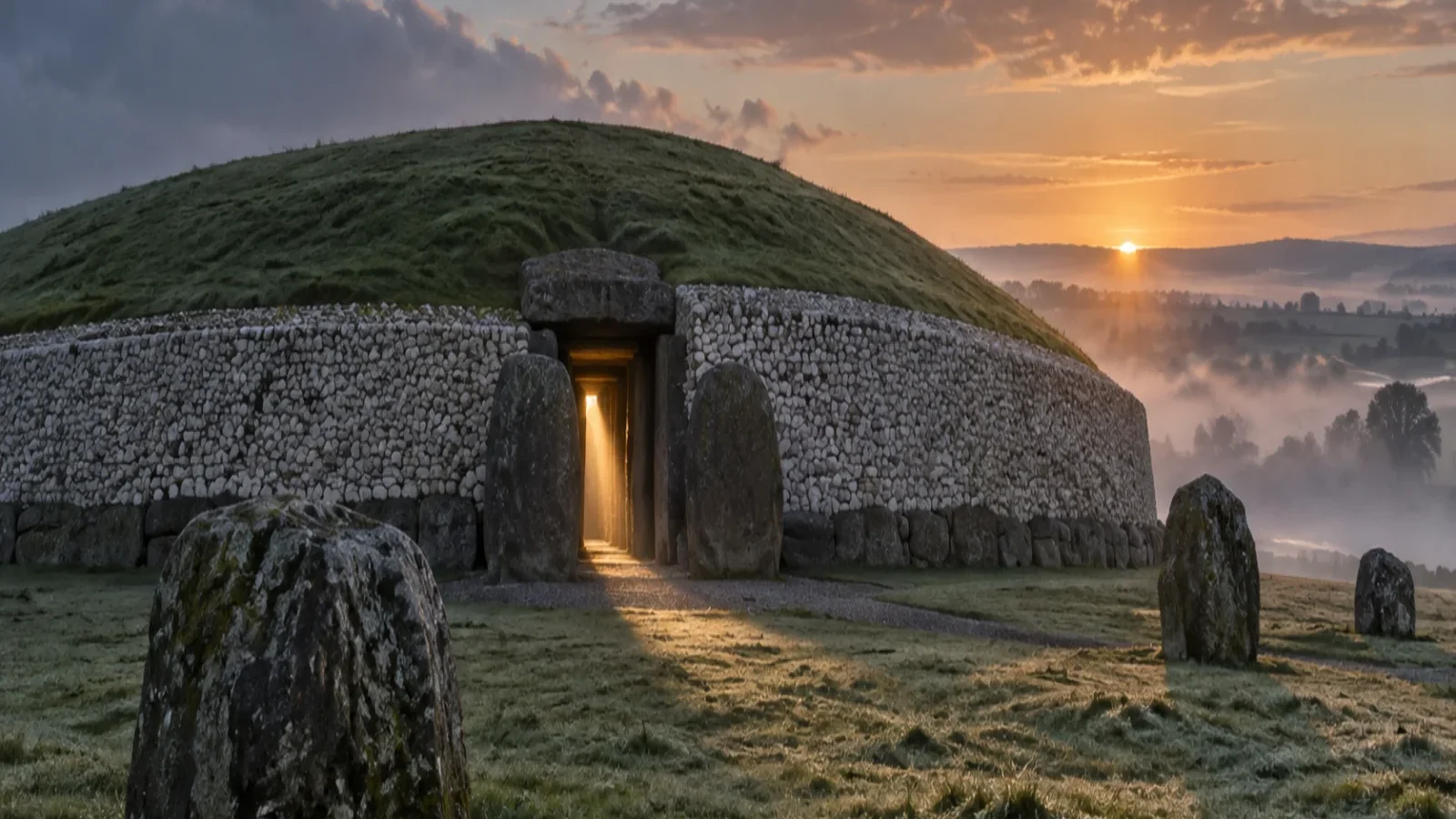
On a few mornings around the winter solstice, sunlight slips through a small opening above Newgrange’s entrance and travels down the passage into the chamber. The beam lasts only a short time, yet it reaches a room deep inside a mound built more than 5,000 years ago.
Newgrange is a passage tomb in Ireland’s Boyne Valley. Its builders shaped the entrance, passage and roof box so the low midwinter sun could reach the chamber. The effect is easy to picture today; what the light meant to the people who built the tomb is harder to know.
The roof box catches the low sun
The entrance itself does not face directly toward the rising sun. Above it sits a narrow opening known as the roof box. At the right time of year, the sun’s low rays enter there, cross the passage and reach the chamber at the mound’s centre.
Keep exploring
Continue with Curiosmos
The National Monuments Service documented the illumination in a 2024 research report, using high-resolution photographs and video from inside the chamber. The light travels along the passage and reaches the rear of the room. Weather and the exact sunrise affect what visitors see, but the beam is concentrated around the winter solstice rather than appearing throughout the year.
For the builders, the alignment required planning at several stages. The passage had to face the right direction, and the opening had to admit a very low sun while keeping the chamber protected beneath the mound.
A solar event inside a burial place
Newgrange belongs to the funerary landscape of Brú na Bóinne. Human remains, passage-tomb architecture, carved stones and the placement of monuments across the valley all point to complex ritual and social life. The roof box is one part of a carefully made burial monument, not an isolated instrument set in a field.
People who watched the horizon each year could recognise the sun’s seasonal turning without describing it in modern astronomical terms. Newgrange shows observation built into architecture. It does not tell us whether the builders thought of the place as an observatory, or how they explained the beam to one another.
What might the midwinter light have meant?
Light entering a dark chamber could have connected the passage tomb with the return of longer days. It may have marked a seasonal gathering or shaped a ceremony linked to ancestors. Those are interpretations, not messages written on the stone. The builders left no text explaining why they wanted the sunlight to reach the chamber.
The broader setting helps. UNESCO describes Brú na Bóinne as a prehistoric funerary landscape, and nearby passage tombs such as Knowth and Dowth also relate architecture to celestial events. Their alignments differ, suggesting that communities made separate choices rather than following one fixed design.
The monument we see today
Newgrange has been excavated, repaired and partly reconstructed, so the site includes both Neolithic masonry and modern conservation work. The roof box, passage geometry and recorded sunlight give researchers ways to study how the alignment functions. Questions remain about the original appearance of some surfaces and how the builders understood what they had made.
Each winter, the beam turns a small architectural detail into a visible event. The sunlight does not need a legend to be striking. It shows that the people who built Newgrange watched the changing horizon closely enough to bring midwinter into the heart of a tomb.