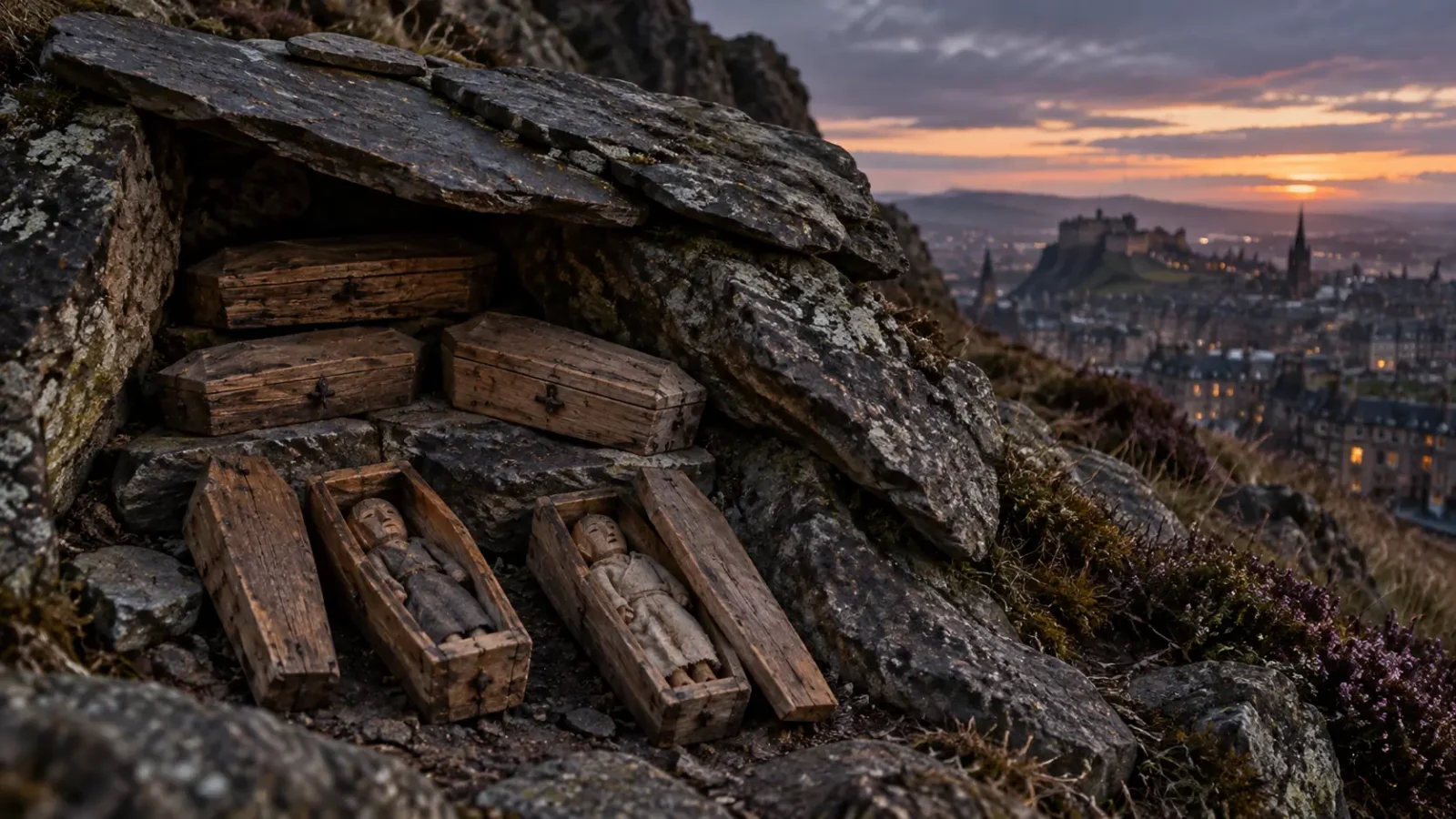
Five boys searching for rabbit burrows on Arthur’s Seat in June 1836 found a rocky hollow hidden behind pieces of slate. Inside lay 17 miniature coffins, arranged in rows. Each held a carved wooden figure.
The surviving coffins are only about four inches long. Eight are now held by National Museums Scotland; the other nine disappeared soon after the discovery. No note was left with them, and no known account identifies the person who made the figures or carried them up the hill.
That silence has given the objects room to gather stories. Some connect them to Edinburgh’s notorious body-snatchers, others to charms, sailors or people lost at sea. The wood, cloth and tiny metal fittings offer a more tangible place to begin.
Keep exploring
Continue with Curiosmos
A set made with care
The boys reportedly found two rows of eight coffins and one set above them. The arrangement suggests someone placed the objects deliberately, although the surviving accounts are brief and later retellings have added details that cannot be checked against an original excavation record.
The eight surviving coffins were carved from single blocks of Scots pine. Small hand-wound pins hold some lids in place; flat pieces of tinned metal appear on several. National Museums Scotland records wood, pine, tin and textiles among the materials. The scraps of fabric on the figures fit broadly with clothing from the early 1830s, close to the year the boys found them.
A 1994 study by Samuel Pyeatt Menefee and Allen Simpson compared the figures and the coffins. The figures share proportions and facial details, as if one person made them as a group. The coffins vary more in their corners and edges, perhaps because they came from two hands or two different approaches to the work.
The figures stand upright, with straight backs, boot-shaped feet and arms that swing at the shoulders. Menefee and Simpson suggested they may have begun as model soldiers, with movable arms that could fit into sleeves or hold a small weapon. That possibility leaves another: perhaps someone later made coffins for figures that already existed.
The small fittings offer a clue to the maker’s trade. Several resemble shoe-making latches, and the figures appear to have been cut with a sharp hooked knife rather than a joiner’s full set of tools. A shoemaker or leatherworker could have handled both materials, but no single tool can identify a person.
The Burke and Hare connection
Edinburgh was a centre of medical teaching in the 1820s and 1830s. Anatomy schools needed bodies for dissection, and legal supply could not meet demand. Grave robbing became a business. Between late 1827 and late 1828, William Burke and William Hare sold the bodies of 17 people to anatomist Robert Knox. Burke was executed in 1829.
The number is hard to ignore: 17 coffins, 17 victims, and a discovery only a few years after the murders. Menefee and Simpson thought someone may have made a symbolic burial for the victims, many of whom had no family able to mourn them. In a city still shaken by the crimes, a hidden memorial on the hillside is easy to imagine.
But no inscription, letter or witness links the coffins to Burke and Hare. None of the figures can be matched to a named victim. The 1994 authors offered the connection as a possible motive, not a documented explanation.
Charms, sailors and a story that grew
Other writers have linked the coffins to sympathetic magic, where an effigy stands in for a person. Some compared them with traditions of burying a figure for someone who died far from home, including sailors whose bodies never returned to shore.
In 1976, Walter Hävernick proposed a link to mandrake roots and protective charms. He suggested the coffins could have been a hidden hoard intended for sale to sailors. National Museums Scotland notes that charms were used in Scotland, though evidence for this particular seafaring custom has not turned up there.
A newspaper story published decades after the discovery added a “daft man” who supposedly drew three coffins and dates associated with family deaths. It makes for an eerie tale, but it appeared about 70 years after the boys found the objects. It tells us how the story grew, not who carved the figures.
Following the coffins after 1836
The surviving objects passed through private collections before reaching the museum. Edinburgh jeweller and antiquarian Robert Frazer owned them; his collection was dispersed in 1845. In 1901, Christina Couper donated eight coffins to the Society of Antiquaries of Scotland. They are now part of National Museums Scotland’s collection.
That chain helps explain why some answers are out of reach. The coffins were collected as curiosities, not excavated with modern recording methods. The first descriptions were copied through surviving newspaper material, and nine objects vanished from view. We can study the eight that remain, but the original find left no full archaeological record.
The wooden figures preserve a real piece of work: someone carved them, dressed them and tucked them into a rocky hollow above Edinburgh. The Burke and Hare connection may explain why, or the maker may have been thinking of sailors, charms or something we have not considered. Which detail would you follow first—the matching number of victims, the shoemaker’s fittings or the care taken with each tiny face?
For a related look at how the place an object is found shapes its interpretation, see Curiosmos’ report on archaeological context. The Arthur’s Seat coffins show what can happen when that first setting is only partly recorded.
Sources and further reading
- National Museums Scotland, “An unsolved mystery: The coffins found on Arthur’s Seat”.
- National Museums Scotland, collection record for an Arthur’s Seat coffin lid.
- Samuel Pyeatt Menefee and Allen Simpson, “The West Port Murders and the Miniature Coffins from Arthur’s Seat”, Book of the Old Edinburgh Club, new series 3 (1994), pp. 63–81.
- For more on how archaeologists distinguish settlements from ritual places, see Curiosmos’ guide to settlement and ritual-complex evidence.