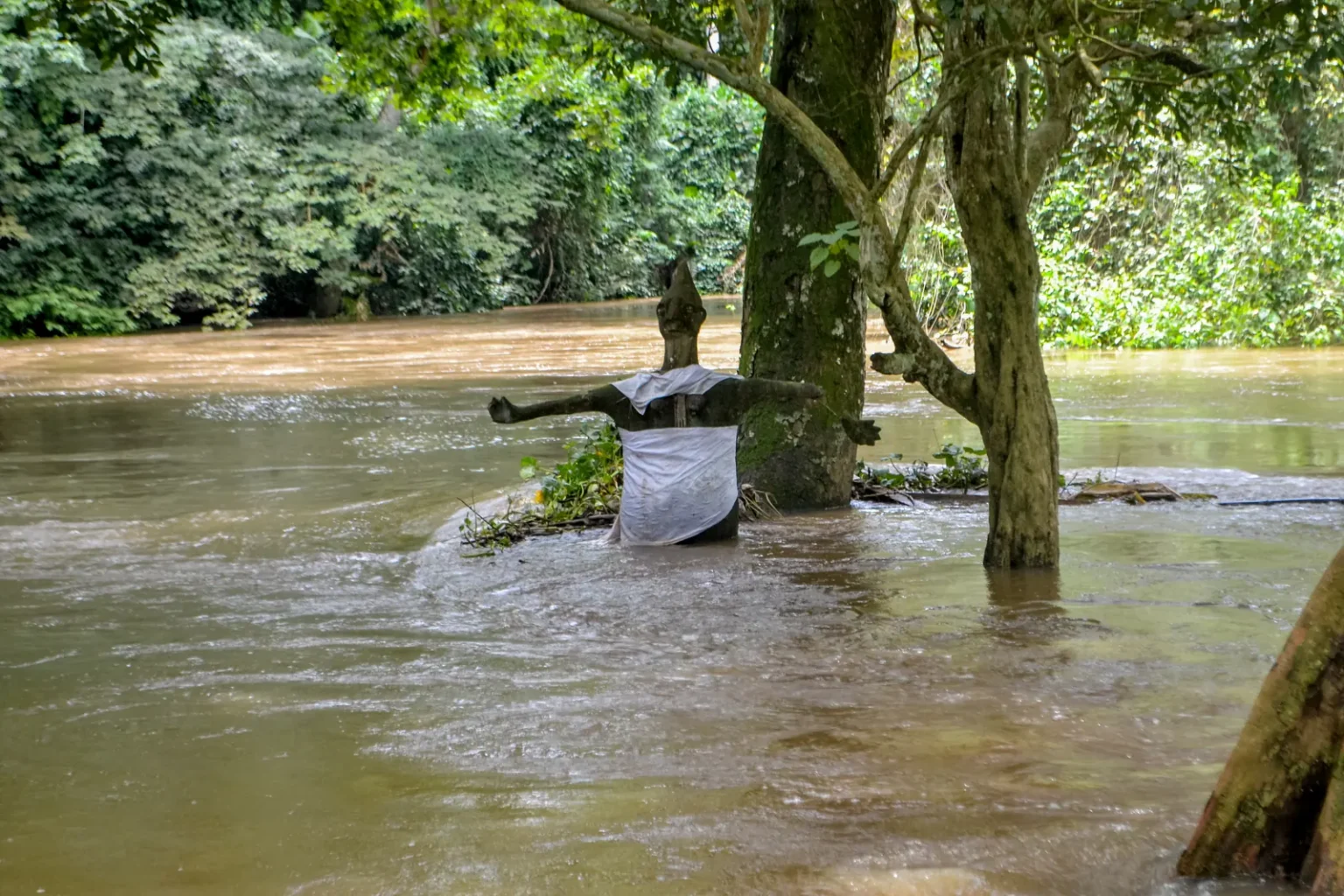
A river runs through the forest at Osun-Osogbo, past shrines, sculptures and places of worship. Beside the growing city of Osogbo, people still follow its sacred paths to worship. For devotees of Osun, the forest is a place to return to, pray and fulfil obligations.
Its artworks can be startling. Walls curve into figures; sculptures rise among trees; entrances mark the passage into particular sacred places. Many of the best-known works are twentieth-century creations. They were made for a sacred place that already had a long history.
How has the grove survived as Osogbo has grown around it? Religious communities, artists and conservation workers have all helped protect it. Their work now includes a pressing concern: the quality of the river water used during festivals.
A forest dedicated to Osun
Nigeria’s heritage ministry identifies the grove as a place dedicated to Osun, the Yoruba deity associated with fertility. Shrines and ceremonial paths run among sculptures dedicated to Osun and other deities.
Osun is an orisha, a deity within Yoruba religious traditions. The name also belongs to the river running through the grove. Ceremonies take place within this forest and beside its water.
The ministry describes continuing rituals and an annual festival in August. Worship continues at the shrines throughout the year.
The trees shelter a religious landscape
The UNESCO World Heritage account places Osun-Osogbo among the surviving remnants of primary high forest in southern Nigeria. The protected property covers 75 hectares and contains shrines, sanctuaries, sculptures and other sacred features.
The sculptures belong to shrines and ceremonial paths within the forest. Their positions matter: a work beside a sacred entrance is encountered differently from one removed to a museum.
UNESCO inscribed the grove in 2005. Its account recognizes both the long religious tradition and the newer art made within it. Conservation has to protect the forest and keep the shrines usable as well as maintain the artworks.
Forests and trees have taken many roles in religion. Some appear in stories as maps of the cosmos, as in the different world-tree traditions. At Osun-Osogbo, sacredness also has a physical location: living trees, a river and ground used for worship.
The artists whose work reshaped the grove
During the twentieth century, the New Sacred Art Movement created monumental works within Osun-Osogbo. Susanne Wenger, an Austrian-born artist who became a Yoruba priestess, was central to the movement. So were the artists and practitioners who worked with her.
The Adunni Olorisha Trust’s account of the artists makes those names visible. Adebisi Akanji, initially a bricklayer, became a leading sculptor and co-creator. Sangodare Gbadegesin Ajala, from a lineage of Ṣàngó priests, led and mentored restoration artists.
Other makers brought experience in carving, carpentry, painting, metalworking and ritual objects. The resulting art came from those skills and from the religious setting in which the artists worked.
Calling the grove simply Wenger’s creation would lose that collaboration. It would also confuse the modern artworks with the older sacred landscape in which they were made.
These artists used new forms and materials within an existing religious tradition. Their work changed how the grove looked without ending its use for worship.
Old photographs guide repairs
Art made outdoors changes. Rain reaches its surfaces; trees grow beside it; floods can damage the ground beneath it. Materials that allowed artists to make large forms can also become difficult to maintain.
In its 2026 conservation decision, the World Heritage Committee specifically recognized the grove’s twentieth-century sculptures. It requested care that respects their forms, materials and techniques, supported by documentary evidence.
It also called for a stronger photographic archive, including images taken when many works were made in the 1960s through the 1980s. An old photograph can show a shape or detail before damage occurred. It can help restorers avoid rebuilding from memory alone.
Without those records, restorers may struggle to distinguish an artist’s intended shape from a feature changed by damage or an earlier repair.
Skills pass from artists to apprentices
The Adunni Olorisha Trust and Adunni Osun Foundation describe training a new generation of restoration artists and artisans, alongside work on shrines, decorative walls and sculptures.
Apprentices learn how to work the materials, shape the surfaces and understand the religious forms. A photograph can record a sculpture’s appearance; it cannot teach all the skills needed to repair it.
The foundation also treats documentation, education and protection of the forest as part of its work. Its records support repairs, and apprentices learn the techniques needed to continue them.
Outdoor structures need continuing inspection and maintenance. A new storm can damage a work while repairs elsewhere in the grove are still under way.
The river cannot be protected by a boundary alone
The 2026 World Heritage decision raised concerns about encroachment around the protected area and the need for regular testing of the Osun River’s water. It called for pollution results to be shared and for steps to ensure safe use by festival participants.
A line on a map cannot prevent water from carrying pollution into the grove. Protecting the river requires attention beyond the shrines, including cooperation among traditional religious leaders and public authorities.
The committee’s requests identify work still needed, particularly around water quality and the expanding town. World Heritage status gives the grove international recognition, but maintenance and protection still depend on decisions made around it.
The grove’s future depends on apprentices learning to repair its sculptures, worshippers continuing to use its shrines and authorities addressing pollution upstream. The forest boundary protects a place; the river crosses it.
Sources
- UNESCO World Heritage Centre: Osun-Osogbo Sacred Grove.
- World Heritage Committee: 2026 decision 48 COM 7B.59.
- Nigeria’s Federal Ministry of Art, Culture and the Creative Economy: heritage-site account.
- Adunni Olorisha Trust: The New Sacred Art Movement.
- Adunni Olorisha Trust and Adunni Osun Foundation: conservation and training.