A tree can hold several worlds in one view. Roots vanish below the ground. A trunk stands where people live. Branches spread toward the sky. That simple shape has given storytellers and religious thinkers a way to picture connections they could not see.
World-tree images appear in traditions separated by distance and time, but they do not all tell the same story. Norse poetry makes Yggdrasil the structure of a perilous cosmos. The Bhagavad Gita turns an upside-down fig tree into a lesson about attachment. Maya art places trees within an ordered universe, while Egyptian funerary scenes show a sycamore nourishing the dead.
Yggdrasil, a living structure under strain
In the surviving Norse poems, Yggdrasil is a great ash whose roots reach toward different realms and whose branches shelter the world. Völuspá describes its scale; Snorri Sturluson’s Gylfaginning later gathers wells, gods and other beings around it.
Keep exploring
Continue with Curiosmos
The tree is alive, but it is far from peaceful. A dragon gnaws at one root, deer feed among its branches and an eagle watches from above. Yggdrasil holds the worlds together while creatures wear it down. That tension is part of the picture.
It is often called a “tree of life,” but that label can smooth over the danger in the old texts. Yggdrasil is a map of relationships between beings and realms, and those relationships are vulnerable. Curiosmos has a closer look at Yggdrasil and the nine worlds.
The Gita’s tree grows from above
Chapter 15 of the Bhagavad Gita describes an ashvattha, a sacred fig, with roots above and branches below. Its leaves are associated with the Vedic hymns. The image turns an ordinary tree upside down to describe a world whose source lies beyond what people can see.
The passage then asks the listener to cut through the tree with the “strong axe” of detachment and seek what lies beyond it. Here the branches represent the world of changing experience and desire. The tree is something to understand and, ultimately, move beyond.
That gives it a different role from Yggdrasil. The Norse tree holds the cosmos in place even as it is threatened; the Gita’s tree becomes a figure for attachment and release.
Trees in Maya images and stories
Maya art places trees and plants within depictions of a world organized around directions, rulers, ancestors and the sky. The ceiba is often used today to explain the idea of a vertical axis connecting different realms. That shorthand can be useful, though no single surviving text gives a complete doctrine shared by every Maya community.
The Popol Vuh, a K’iche’ Maya account of creation, follows a world made and remade through the actions of gods, people and animals. It should be read in its own terms, rather than turned into a catalogue of a universal “world tree” belief. Monumental art and inscriptions offer another kind of evidence: trees can sit within scenes about kingship and the structure of the world.
A carved image and a later written story do not necessarily make the same point. Archaeologists compare inscriptions, monuments, burials and settlement patterns to understand how a symbol worked in its particular setting.
The Egyptian sycamore and the dead
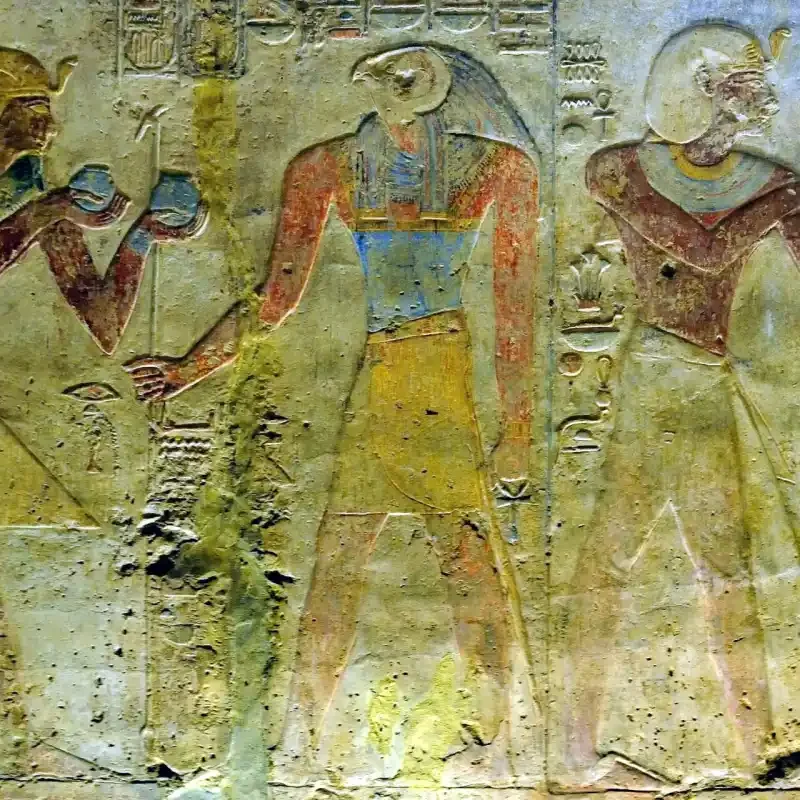
On Egyptian coffins and funerary stelae, a sycamore may appear beside the deceased, sometimes as a source of water or offerings. Museum collections preserve examples of this imagery. The tree offered a visible image of care and renewal in a funerary setting.
Sycamores also grew in Egypt and their wood was used in everyday objects. Their appearance in a coffin does not mean every piece of sycamore had the same sacred meaning. It is the surrounding scene—water, offerings, the deceased or a goddess—that helps explain why the tree is there.
Why the image travels so well
Trees are easy to read as a map. They join ground and sky in a single form, change with the seasons, provide shade and food, and can outlive generations. Those shared experiences may help explain why different cultures turned to the image without needing to share one original religion.
The details matter. Yggdrasil is gnawed at by creatures. The Gita’s tree is inverted and must be cut through. Maya images place trees in a political and cosmic landscape. Egyptian funerary scenes connect them with sustenance after death. The familiar shape does not make the beliefs interchangeable.
Across these traditions, the world tree is less a single ancient doctrine than a flexible way to think about connection. One story uses roots and branches to hold a threatened cosmos together; another asks how a person can leave the branches behind. The image keeps inviting new questions because it can make the invisible feel close enough to touch.
Sources
- The Poetic Edda and Prose Edda, including Völuspá and Gylfaginning.
- Bhagavad Gita, Chapter 15, verse 1, IIT Kanpur Gita Supersite.
- Popol Vuh, University of Oklahoma Press translation and scholarly edition.
- Metropolitan Museum of Art, Middle Kingdom coffin and Coffin Text context.
- National Research Council of Italy, research on wood identification in Egyptian funerary objects.