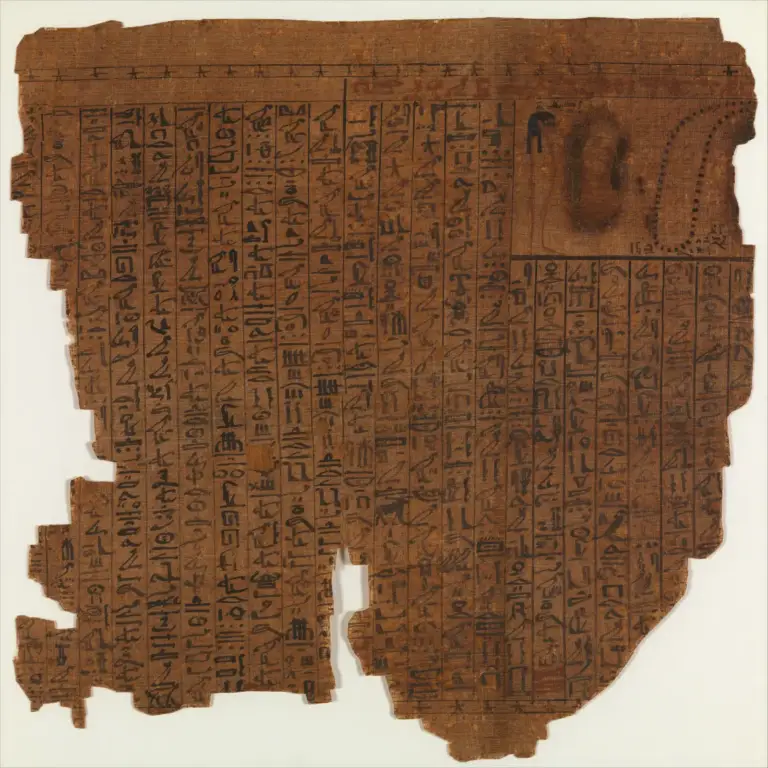
The map is illustrated in the form of engravings that were discovered inside a 4,000-year-old sarcophagus. The “map of the underworld” illustrates the path that the souls of the dead must make to reach eternal life. The map was revealed in a new study published in the Journal of Egyptian Archaeology by Harco Willems.
The research suggests that the ancient illustrations are, in fact, the oldest copy of The Book of Two Ways. The Book of Two Ways was conceived as a guide that helped the deceased overcome the underworld’s dangers. It is meant to show how the deceased could get past the lake of fire and past demons armed with knives to reach the kingdom of Osiris.
The Book of Two Ways: A Map of the Ancient Egyptian Underworld
The map to the underworld was discovered etched on an ancient Egyptian sarcophagus. The sarcophagus was discovered in 2012, but experts could not date it until now, finding it dates back around 4,000 years. “The Book of Two Ways” refers to two paths that zig-zag a hazardous journey through barriers and demonic entities towards “Rostau” and the abode of the ancient Egyptian god Osiris.
In ancient Egypt, it was maintained that anyone who laid on the body of Osiris would attain immortality. Experts have recently discovered that the engravings on the side of the sarcophagus are the oldest known examples to have ever been discovered.

The Map was Found on Two Wooden Panels
The ancient sarcophagus was discovered inside a tomb at the ancient Egyptian necropolis of Dayr al-Barsha. Experts. The “map” was discovered on two wooden panels inscribed with a mixture of ancient Egyptian hieroglyphs and symbols. The map illustrates two lines representing the two routes the deceased can use to reach Osiris in the afterlife. In addition to the map, the ancient engravings feature several spells the deceased could use to ward off demons along the journey.
The first illustrated book in history
“In many ways, the Book of Two Ways can be described as the first illustrated book in history,” Ancient Egypt expert Dr. Foy Scalf of the University of Chicago said in an interview with The Times. “It offers the first illustrated guide to sacred geography.” Although several examples of the “Book of the Two Ways” have been found before, this one is the oldest, 500 years older than any other. These engravings were usually reserved for high-ranking officials of ancient Egypt.
Part of the Coffin Texts
The “Book of the Two Ways” is part of the Coffin Texts, a collection of more than 1,000 spells and wirings meant to help the deceased in the afterlife. Details about the “Book of the Two Ways” are scarce. Archeologists and scholars have still been unable to explain when it was written and by whom. Nonetheless, scientists hope to come across similar examples in the future. Details of the discovery have been published in the Journal of Egyptian Archaeology and are available here.
Join the discussion and participate in awesome giveaways in our mobile Telegram group. Join Curiosmos on Telegram Today. t.me/Curiosmos