The first warning came during a children’s game. Boys were pinching one another’s hands and arms, and the young Baldwin did not react as the others did. His tutor, William of Tyre, initially took it for unusual endurance. Then he realised that part of the boy’s right hand and arm seemed unable to feel pain.
William reported his concern to Baldwin’s father, King Amalric of Jerusalem. Physicians were consulted. Their efforts, according to the tutor, did not resolve the condition.
Baldwin IV would inherit the throne in 1174, while still a teenager. The illness identified in William’s account as leprosy made his future uncertain. The kingdom nevertheless needed a ruler, and eventually someone who could govern when its king could no longer carry the burden himself.
The boy in his tutor’s account
William’s surviving account gives Baldwin qualities rarely captured by his later nickname, the “Leper King.” The tutor remembered his intelligence, memory, conversation and ability on horseback. This was someone he had taught and watched closely.
William knew the child before he knew the king. His affection is plain in the account, and the details of Baldwin’s education survive because his tutor chose to record them.
The account cannot supply a modern clinical examination. It does, however, describe a boy learning, riding and growing up in a royal household while the adults around him struggled to understand his illness.
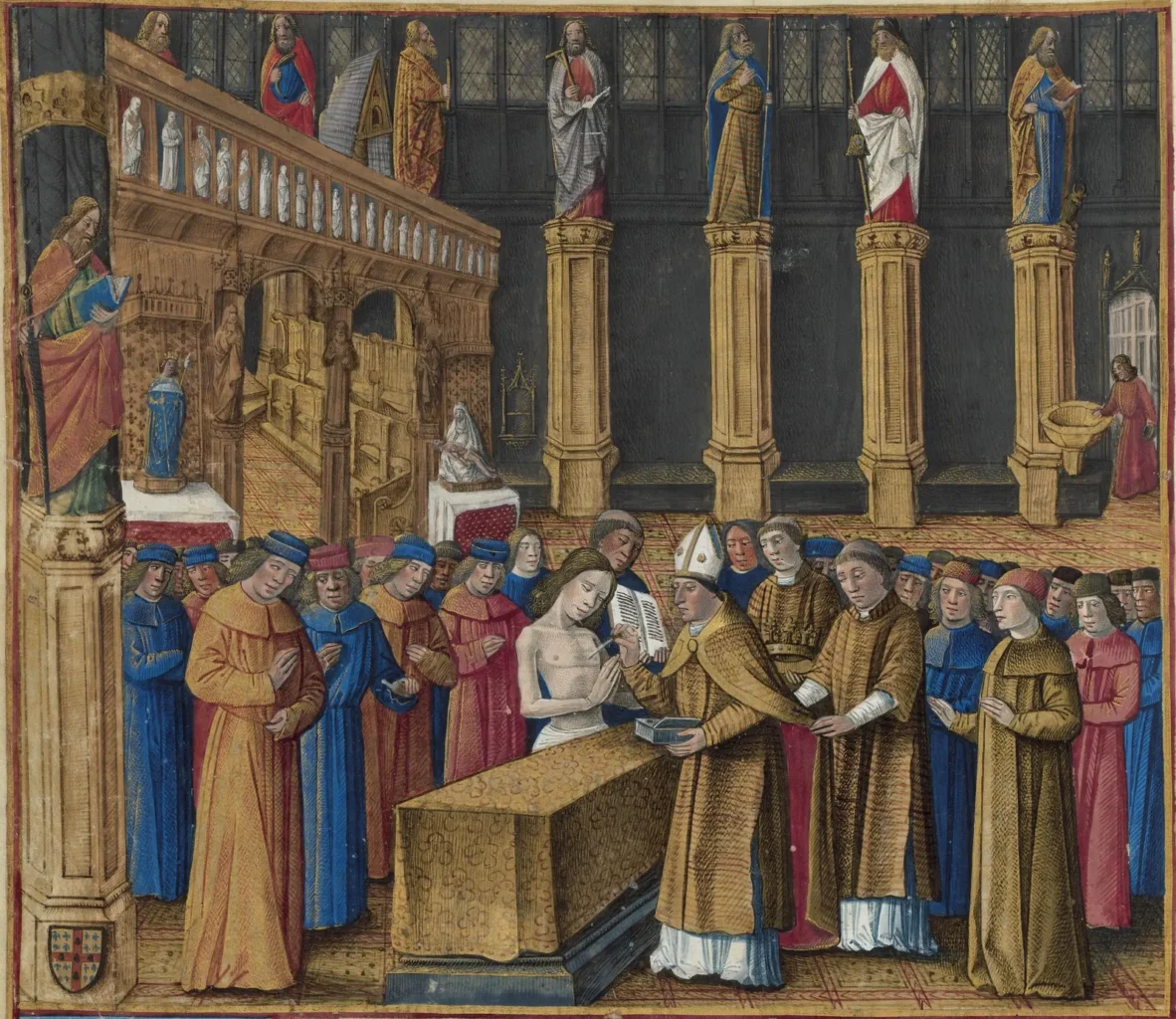
When Amalric died, William put Baldwin’s age at thirteen. He records the coronation at the Church of the Holy Sepulchre on 15 July 1174, four days after his father’s death. The speed of that transition is striking: the crown could not wait for an answer about the boy’s health.
Victory did not settle the future
Baldwin is closely associated with the victory over Saladin at Montgisard in 1177. Yet a reign built around that one battle misses the years of pressure that followed.
The chronology in historian Helena P. Schrader’s The Powerful Women of Outremer sets that victory alongside later reversals, truces and renewed invasions. In 1179, Saladin, whose citadel rose above Cairo, defeated Baldwin’s forces at Marj Ayun and destroyed the unfinished castle at Jacob’s Ford.
Montgisard bought no permanent safety. Fortifications still needed defending, armies had to be assembled and truces negotiated. At court, preparations for the king’s eventual death ran alongside the demands of the next campaign.
Who could govern in the king’s place?
Baldwin’s sister Sibylla married Guy de Lusignan in 1180. By 1183, Guy had been appointed baillie: a role involving the exercise of government on the king’s behalf. Baldwin retained the crown.
Guy’s tenure was brief. Later that year, he lost the office, and Baldwin’s young nephew was crowned as Baldwin V, co-king with his uncle. Baldwin IV also remained involved in military leadership: a relieving army under his command caused Saladin to abandon the siege of Kerak in December.
The crown, daily government and command of an army could now rest with different people. Baldwin had to choose deputies without surrendering his own authority, while the court had to decide whom it would follow.
A deputy might have allowed Baldwin to retain the loyalty attached to the crown while someone else carried out its work. Guy’s removal shows how fragile that solution was. Naming a replacement did not settle the arguments over who should rule.
The succession outlived him
Baldwin IV died in 1185. Baldwin V died the following year. Sibylla and Guy then took the throne. In 1187, Saladin defeated the kingdom’s army at Hattin; Jerusalem fell later that year.
That sequence should not be treated as an inevitable consequence of Baldwin’s illness. It involved decisions after his death, military conditions and the strength of an opposing ruler. A succession plan could name an heir. It could not guarantee that the heir would live, that the court would remain united or that the next campaign would succeed.
Baldwin’s story is often reduced to the image of a suffering king who kept fighting. The surviving record offers a fuller human problem: how to keep a kingdom functioning while everyone knew that its future had to be arranged, and nobody could make that future secure.