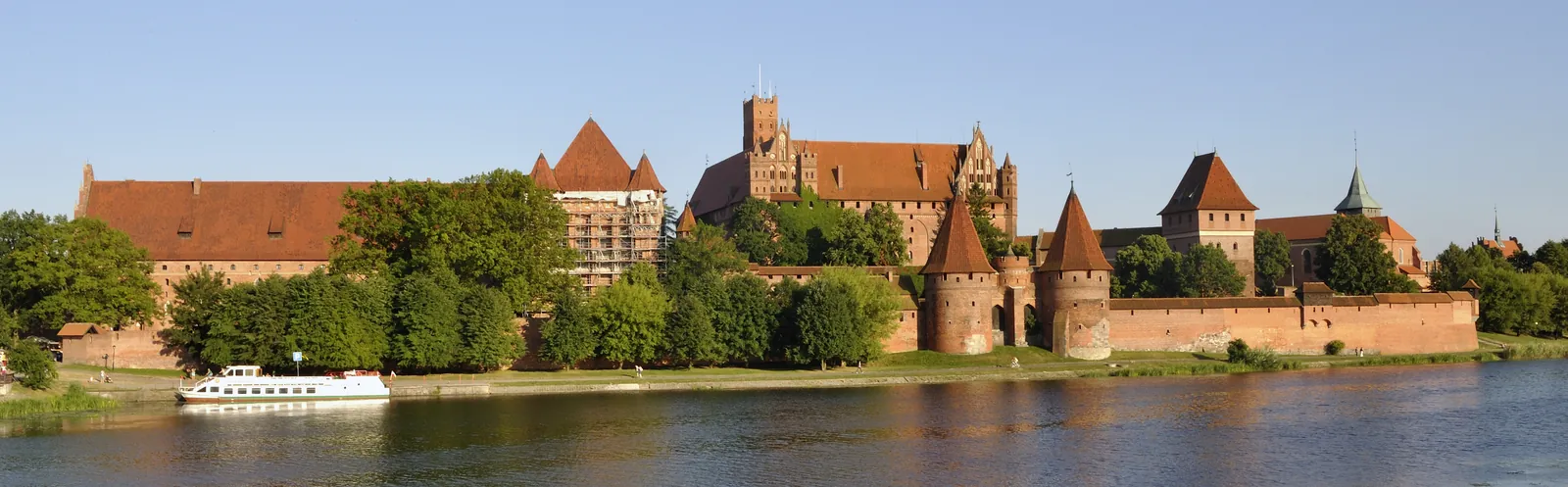
At Malbork in northern Poland, a chapel, a grand master’s residence, an infirmary and an armoury belonged to one vast castle complex. The Teutonic Knights needed places to pray, govern, treat the sick and prepare for war. Walking through those different spaces offers a way to follow the transformation of their order.
Its origins lay far from the Baltic. A hospital established at Acre during the Third Crusade became the beginning of a brotherhood that would later hold territory, build towns and castles, and wage campaigns against neighbouring peoples.
How did caring for crusaders become a basis for ruling land? The answer runs through the order’s changing duties and the much larger population needed to sustain them.
From Acre to a military order
The order’s own account dates the hospital brotherhood to 1190 and its transformation into a religious military order to 1198. The hospital came first. Military duties followed eight years later; territorial rule in the Baltic was still decades away.
Hospital care continued within an organisation that also took on military obligations. Religious membership and warfare were joined in an institution able to hold property and organise collective activity.
In the Baltic, those duties would extend into the administration of conquered land. The people living around its castles supplied much of the labour and food that made occupation possible.
The foothold in Prussia
The historic assessment prepared for Malbork’s World Heritage nomination follows the order’s move into Prussia. The Polish prince Conrad requested its assistance and granted land on his frontier. The knights established themselves there in 1230, but Prussian resistance continued for decades.
Grand Master Hermann von Salza secured imperial and papal support for the order’s control of conquered territory. That was a crucial step: land taken in war could become the basis of its own territorial government. Castles helped the order occupy and administer what it held.
According to Malbork Castle Museum, Grand Master Siegfried von Feuchtwangen made Malbork his seat in 1309. The castle now stood at the centre of a state, more than a century after the hospital’s foundation.
Malbork housed a government as well as a garrison
UNESCO’s account of Malbork places the castle within the Teutonic Order’s Baltic campaigns and territorial power. Its enemies included Prussian and Lithuanian populations as well as Christian Poland. Religious claims accompanied struggles over territory and political authority.
The architecture helps explain what territorial rule required. The High Castle contained the convent’s religious and communal spaces. The Middle Castle included the grand master’s palace, a great refectory and an infirmary. The Outer Bailey provided room for military and service functions.
Each part answered a different need. An army could not live indefinitely on its weapons. A ruling institution needed stores, places to receive people, rooms for officials and ways to organise the daily work of the community. Farther south, Cairo’s citadel also combined fortification with a seat of government.
The building seen today also carries later history. Extensive restoration and reconstruction, including work after the Second World War, must be considered when reading the standing complex. Some of the fabric visible today belongs to that later work.
The fields outside the walls
The Ecology of Crusading project’s report in Antiquity follows evidence that rarely appears in images of armoured knights. Researchers examined pollen, sediments, timbers and animal remains to investigate how conquest and settlement affected Baltic landscapes.
A peat sequence south of Malbork recorded increased human activity during the thirteenth and fourteenth centuries, including woodland clearance and the expansion of open land. Animal bones from the castle supplied evidence of food consumption and the handling of particular species.
Pollen traces shifts in the surrounding vegetation; cut marks on bones record the processing of animals. Together, such finds bring the castle’s food supply and changing landscape into view, although they rarely identify the people who did the work.
The project examined sites across several regions. Conditions varied from place to place. A peat sample near Malbork describes its surrounding landscape, rather than every territory the order held.
What survives when a castle disappears?
The University of Reading’s castle geoarchaeology research identifies Elbląg in Poland and Karksi in Estonia as sites with limited standing remains but exceptionally preserved waterlogged deposits from the crusading period.
Deposits in damp ground can preserve evidence of occupation that has vanished above it. That makes excavation especially valuable where the visible walls no longer provide a full picture of how a castle functioned.
Begin with a kitchen or a waste deposit and the story changes scale. A garrison needed meals, a cook needed supplies, and those supplies came from farms, pasture and woodland. Conquest could establish a claim to land; keeping people there required this continuing flow of resources.
Malbork’s immense walls make its power obvious. The archaeology outside and beneath the castles shows how much of that power depended on work carried out far from a battlefield.