
Ancient writers placed a colossal maze-like complex beside Amenemhat III’s pyramid, and the ground at Hawara still has not yielded a final answer.
At Hawara, on the edge of Egypt’s Faiyum, the old story has never quite died. Ancient visitors described a building so large and so bewildering that Herodotus’s Histories ranked it above the pyramids themselves, and although no intact monument of that scale stands there now, the site has never stopped producing reasons to look harder.
The building Herodotus said he saw
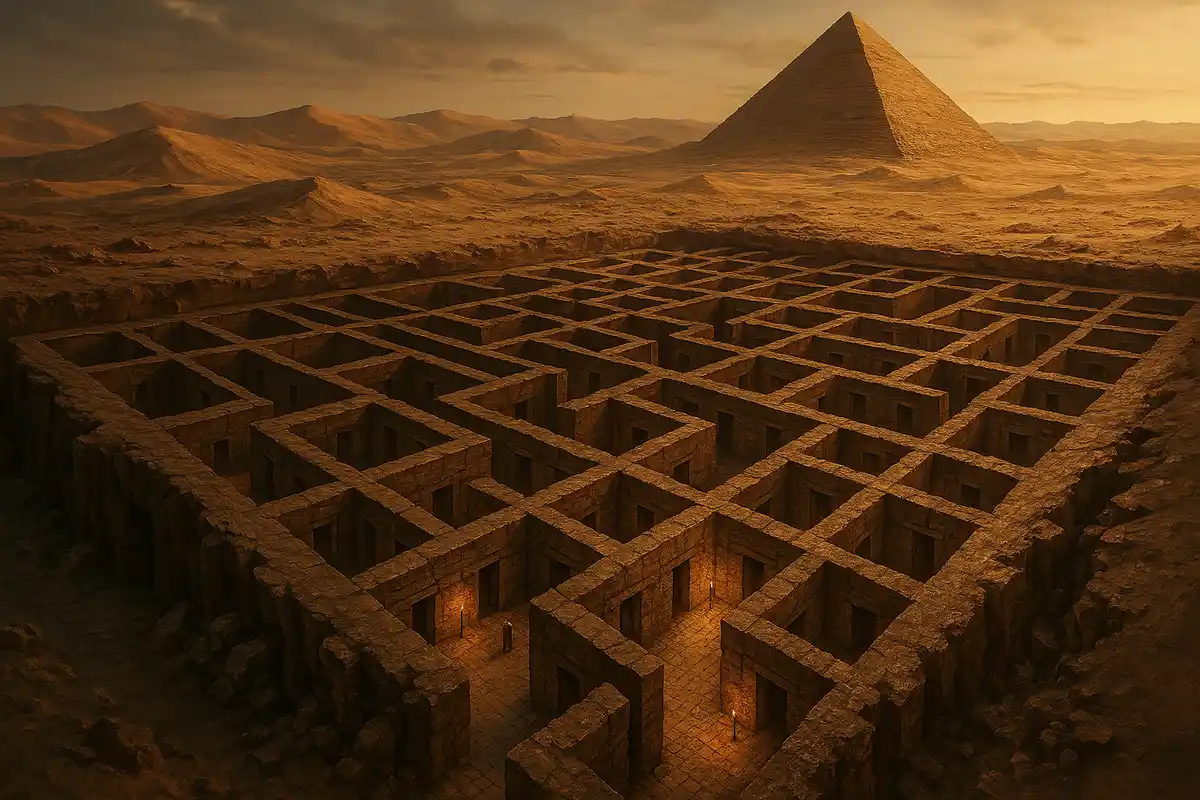
The power of the labyrinth story begins with the force of the description. Herodotus placed it near Lake Moeris, opposite the City of Crocodiles, and wrote that he saw the structure for himself. He described twelve covered courts, a maze of passages, carved walls, white stone columns, and three thousand chambers divided between upper and lower levels. One detail matters more than it usually gets credit for. He said he had walked through the upper rooms, while the underground chambers were described to him by Egyptian keepers who refused to let him enter, saying the kings who built the place and the sacred crocodiles were buried there.
He left the passage that still drives the legend: “Though the pyramids beggar description and each one of them is a match for many great monuments built by Greeks, this maze surpasses even the pyramids. It has twelve roofed courts with doors facing each other: six face north and six south, in two continuous lines, all within one outer wall. There are also double sets of chambers, three thousand altogether, fifteen hundred above and the same number under ground.”
Herodotus was not alone. Strabo later placed the labyrinth beside the king’s tomb near the old canal entrance into the Faiyum, and Pliny treated the Egyptian labyrinth as the giant original from which the Cretan version had borrowed only a fraction. That repetition matters. It does not prove every detail, but it does make the monument harder to dismiss as a stray tale spun out of desert heat.
South of the king’s pyramid
Modern archaeology has long tied the labyrinth to Hawara, where the Twelfth Dynasty pharaoh Amenemhat III built his pyramid complex in the 19th century BCE. The site sits in a landscape that ancient engineering reshaped through water control, canals, embankments, and settlement, which helps explain why classical writers placed such emphasis on the region and why the ground there has become so difficult to read cleanly.
The older image of a single hidden underground maze is probably too simple. The stronger archaeological reading is a vast temple complex associated with Amenemhat III’s pyramid precinct, with lower elements, foundations, and perhaps underground spaces, rather than a fantasy world of endless buried corridors stretching untouched beneath the desert. That shift does not shrink the scale of the problem. It makes it more interesting, because it turns the labyrinth from a mythic hole in the sand into a real architectural question tied to one of Middle Kingdom Egypt’s major royal sites.
What Petrie found in the chips
The first serious modern attempt to pin the place down came from Flinders Petrie’s 1889 report on Hawara. Petrie did not emerge from the sand with an intact palace of columns and courts. What he found was stranger in its own way. South of the pyramid, he traced an immense spread of fine white limestone chips, a debris field so large that he argued it marked the destroyed remains of the labyrinth itself. He wrote that the site was worthy of the fame the ancient monument had acquired, even though the building had been broken up almost beyond recognition.
Petrie also pushed back against earlier misreadings. What some had taken for standing labyrinth walls he identified as much later houses and tombs built over the wreck of the old complex. Even so, he mapped the area of the ruin, noted blocks still in place along the canal cut, and described fragments of architraves and clustered columns inscribed with the names of Amenemhat III and Sobekneferu. The picture he left behind was not of a monument that had never existed. It was of a monument quarried, shattered, reused, and buried under later occupation.
The scans beneath the sand
That is why geophysics keeps dragging Hawara back into the conversation. A 2010 VLF-EM study treated the area explicitly as the “labyrinth mortuary temple complex” at Hawara, and later 2015 GPR research around the Hawara pyramid traced buried anomalies east and south of the pyramid that could reflect architectural remains. Surveys also showed just how badly the site has been complicated by groundwater, overburden, and the canal system that cut through the area and changed the local hydrology.
This is where the story narrows and gets sharper. The published geophysical work does not deliver a neat cinematic verdict. The 2015 GPR paper states plainly that while some anomalies may reflect buried architecture, there was “nothing to support the idea that this was Herodotus’s labyrinth.” That sentence matters, and it deserves to stay attached to the mystery. Hawara has not yielded proof of the classical description in its grandest form. It has yielded a damaged royal complex, significant subsurface irregularities, and a site whose physical condition makes certainty hard to reach.
Why Hawara refuses to go quiet
That unresolved state is exactly why the labyrinth still pulls so hard on the imagination. The ground has been disturbed for centuries. Stone was stripped away in antiquity and after it. Later settlements spread over the ruins. Canal digging sliced through key areas. Water seeped into buried spaces. Reconstruction projects, including UCL’s Lost Labyrinth project, have had to work from fragments, old excavation records, scattered architectural pieces, and the stubborn fact that the site is both famous and physically broken.
That brokenness also explains why Hawara so easily attracts claims that run ahead of the evidence. When a place is half destroyed, half buried, and remembered through ancient descriptions that sound almost excessive, it invites both caution and projection. The mistake is to rush to either extreme. Hawara does not need fantasy to be compelling, and it does not need a sneer to stay respectable. The site already contains a serious historical problem. Ancient authors described a monumental complex beside Amenemhat III’s pyramid. Petrie found the wreckage of something vast in exactly that zone. Modern surveys still register buried features in ground that has never been completely resolved.
The clearest version of the story is also the strongest. A major labyrinthine complex almost certainly stood at Hawara in the pyramid precinct of Amenemhat III. By the time modern archaeology arrived, much of it had already been dismantled, reused, buried, flooded, or cut through. Whether substantial parts of that monument still survive below the battered surface remains unsettled, but the idea that nothing was ever there no longer fits the weight of the ancient descriptions, the excavation record, or the disturbed architecture still hiding in the ground