How was the Great Pyramid of Giza built without a surviving construction manual? The evidence points to a coordinated project: local limestone, granite from Aswan, river transport, skilled crews and lifting systems that changed with height. We can reconstruct much of that chain, but no single ramp model explains every course of stone. That gap is a research question, not an invitation to replace evidence with aliens or lost technology.
What remains uncertain is the exact system used to raise blocks through the upper levels. Archaeologists can identify several parts of the process, but no ancient builder left a complete construction manual. The most honest answer is therefore a detailed outline with one important gap: we do not yet know the final form of the lifting system.
It also helps to compare the construction question with what the finished monument contains. Our guide to the Great Pyramid’s chambers and hidden spaces covers the interior evidence, while our report on the Ramesses II inscription linked to the lost city of Mesen shows how archaeologists test a different Egyptian site by combining inscriptions with architecture.
What Was the Great Pyramid Built For—and What Can We Prove?
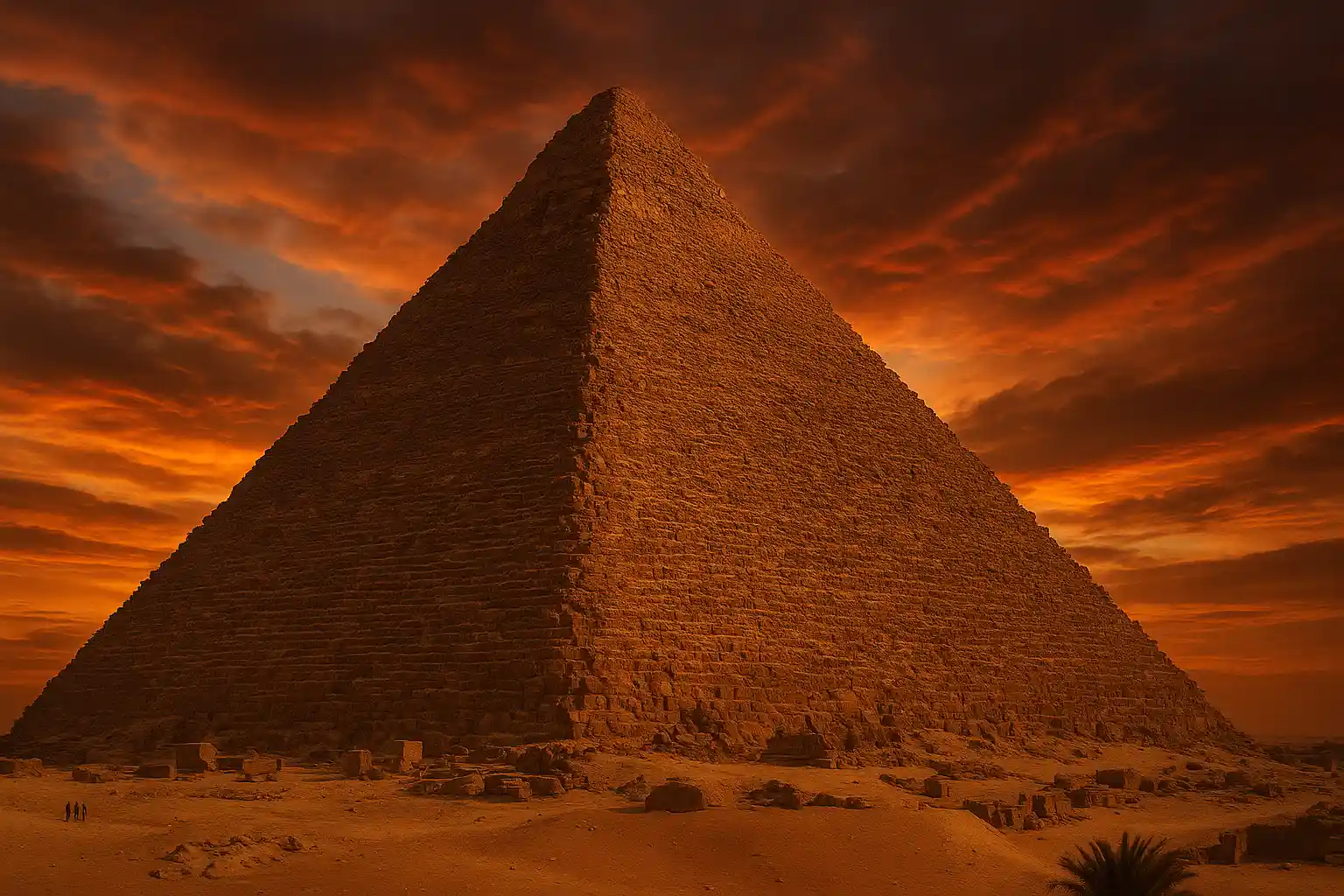
The monument was commissioned for Khufu, the Fourth Dynasty king known to Greek writers as Cheops. Egypt’s Ministry of Tourism and Antiquities gives its original height as about 146.5 metres and says construction probably took between 10 and 20 years.
Khufu’s pyramid stood at the centre of a much larger funerary complex. Temples, causeways, boat pits and smaller pyramids connected the royal monument to the Nile landscape and to the rituals performed for the dead king. It was not an isolated pile of stones; it was the most visible part of a planned religious and administrative project.
Where did the stone come from?
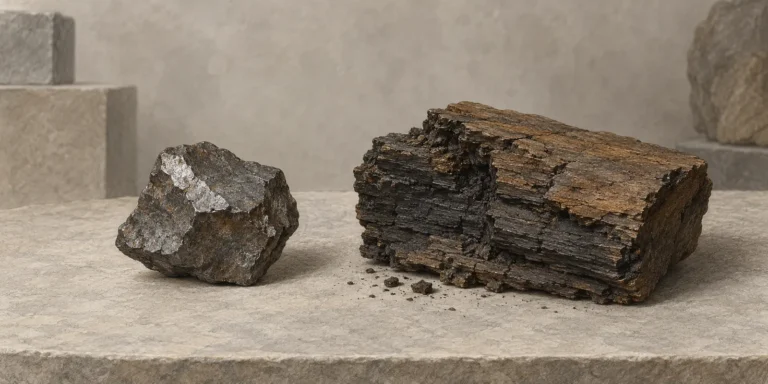
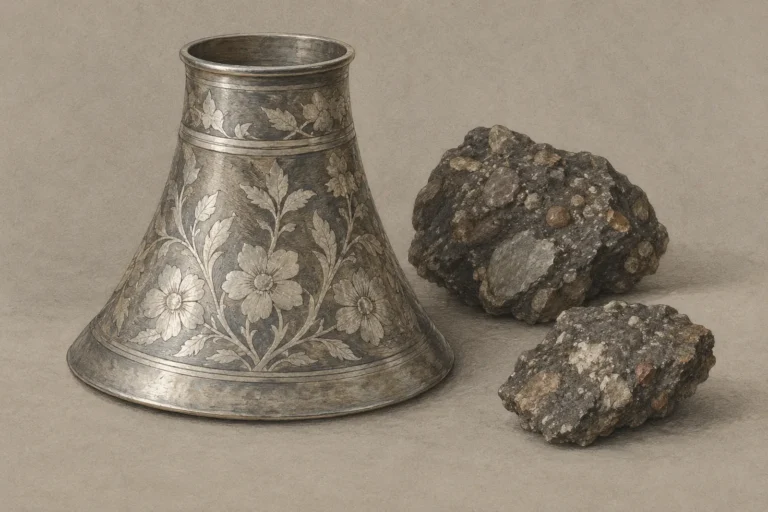
Most of the core limestone was quarried close to the Giza plateau. The builders did not have to drag every block hundreds of kilometres across the desert. Harder stone used in the inner chambers, including granite from Aswan, travelled much farther, while fine limestone from Tura was brought to the site for the outer casing.
The transport problem was partly a river problem. Blocks could be loaded onto boats or barges and moved along the Nile and its waterways before being hauled the final distance to the building site. The ancient Egyptian evidence for water transport is strong, even though the exact route and the condition of the river changed over time.
The old image of a pyramid built by a single mass of slaves also misrepresents the evidence. Excavations at Giza revealed a workers’ settlement with bakeries, animal bones, tools and administrative buildings. The site points to a managed labour force that included skilled specialists, rotating crews and support workers.
How were the blocks cut and moved?
Quarrymen used stone tools and abrasive materials to separate blocks from the bedrock. Once cut, a block could be placed on a wooden sledge and dragged by teams across prepared ground. Experiments and tomb paintings show that wetting the sand in front of a sledge can reduce friction, although the exact methods used at Giza cannot be reconstructed from one image or one experiment.
At the lower levels, a workforce could move blocks along embankments, ramps and the natural contours of the plateau. The difficulty increased as the pyramid rose. A ramp that reached the summit in one straight line would have required a huge amount of additional material, which is why researchers have proposed several alternatives.
What kinds of ramps have been proposed?
The leading possibilities include a straight external ramp, a ramp that changed direction around the pyramid, and systems that used shorter ramps together with levers. Some models place part of the lifting route inside the structure. None has been demonstrated as the single proven blueprint for the whole pyramid.
Archaeological evidence does show that ramps and construction roads were part of Egyptian building practice. A quarry ramp discovered at Hatnub, dating to a later period, demonstrates that Egyptian engineers could combine a steep track with posts, ropes and sledges to move heavy stone. It does not prove that the same design was used at Khufu’s pyramid, but it makes the broader idea of organised hauling entirely plausible.
The absence of a complete ramp does not mean the absence of a method. Temporary structures were dismantled, reused or buried beneath later construction. A ramp might also have been altered as the pyramid grew. That is why competing models can fit parts of the evidence without one yet explaining every stage.
How did the builders keep the pyramid straight?
Surveying was as important as brute force. The builders established a level base, aligned the sides closely with the cardinal directions and maintained a consistent slope as the courses rose. They could use sighting tools, plumb lines, water levels and repeated measurements even though none of those instruments looked like a modern surveyor’s equipment.
The finished pyramid was originally covered with bright Tura limestone casing. Much of that casing was removed in later centuries, leaving the rougher core exposed and making the surviving monument look less precise than it once did.
What does the inside reveal?
The internal layout also records careful planning. The descending passage, Grand Gallery, King’s Chamber and relieving chambers were built into a structure carrying enormous weight. The granite beams above the King’s Chamber were not decorative accidents; they helped distribute pressure and protect the chamber below.
Modern muon scans have also detected a large void above the Grand Gallery. Its exact purpose remains unknown, and the discovery is a reminder that the pyramid still contains unanswered questions. A hidden space is evidence of incomplete knowledge, not evidence that the monument was built by someone other than the Egyptians.
What we can say with confidence
The Great Pyramid was built by people working at a scale that required food, housing, administration, quarrying, transport and specialist craft. The project depended on a state capable of coordinating thousands of tasks across the floodplain and plateau.
We do not need to pretend that every ramp has been identified to recognise the achievement. The evidence explains the workforce, the materials, the river routes and many of the engineering constraints. The remaining debate concerns how those known resources were combined at the highest levels.
That is a real problem in ancient engineering—and a more interesting one than the claim that the pyramid cannot be explained.