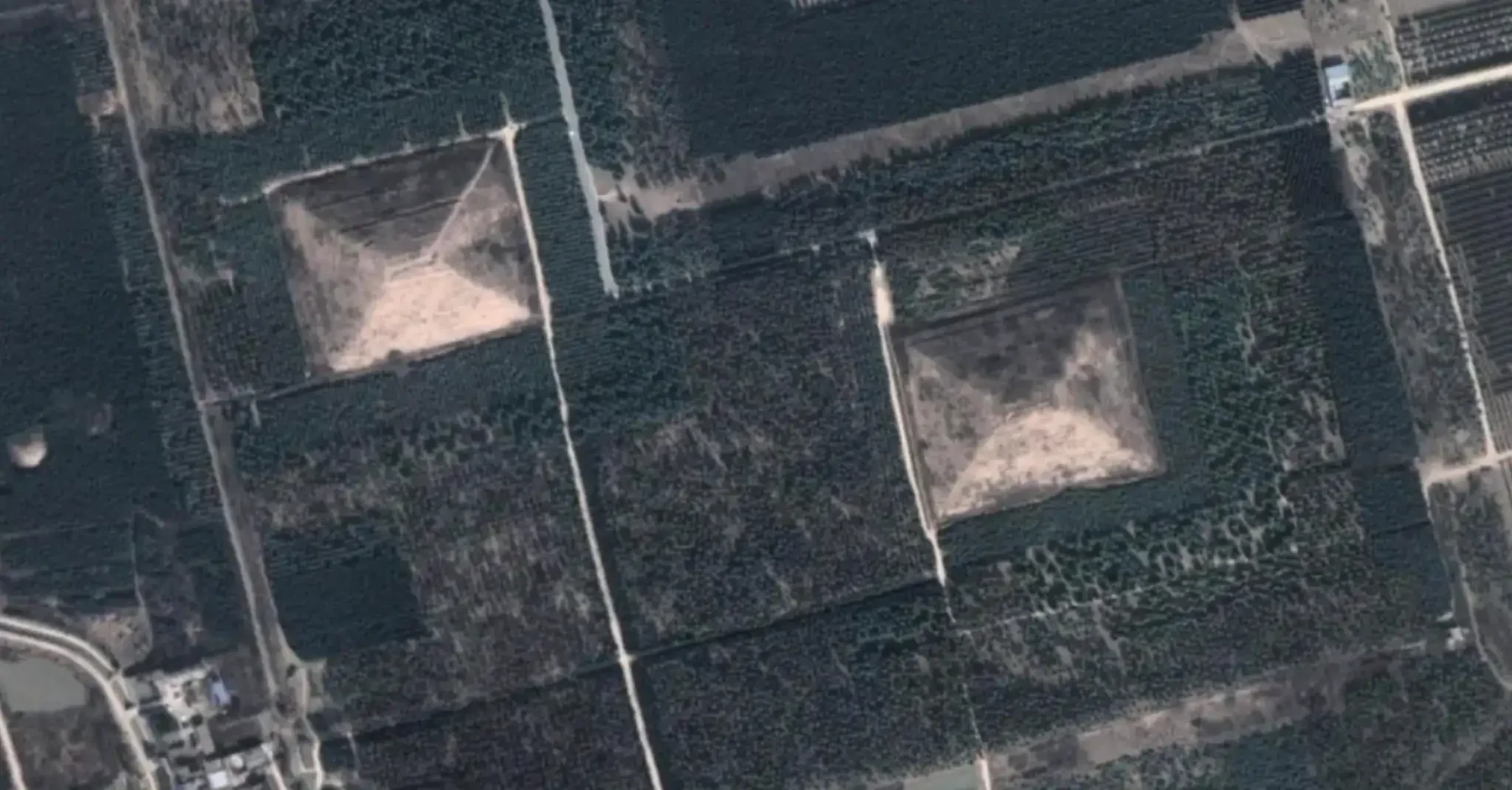
These monuments are earthen burial mounds built for emperors and nobles, often called ‘pyramids’ because of their shape.
China has a collection of pyramid-shaped monuments that are often compared, in broad terms, with the pyramids of Egypt. There are approximately forty of them, built thousands of years ago, and many show careful planning in their placement and orientation.
A key point in the comparison is direction. Like the Egyptian pyramids, these Chinese monuments have drawn attention for how they line up with the sky and the landscape. Many are aligned with the cardinal points. Others are not, and that mismatch has been a lingering problem for researchers trying to understand what the builders intended.
The monuments do not all point the same way. Some show what appears to be a clean alignment to the north. Others have a measurable deviation, rotated off true north by almost 14 degrees.
At first glance, that can look like a mistake, especially because the shift is not subtle. A structure meant to be aligned to the cardinal points would normally be expected to match north-south and east-west with close precision. The presence of two different patterns, however, has kept the question open: whether the deviation is simply error or whether it reflects a different target entirely.
Magli’s argument: not north on Earth, but north in the sky
Italian astronomer Giulio Magli has proposed that the offset was not a failure of planning but a sign of a different kind of alignment. In his hypothesis, some builders were not trying to align these monuments to true north at all. Instead, they were aiming toward the North Star.
Magli’s study examined more than 40 of the structures. He reports that the monuments can be grouped into two “families” based on their orientation. One family aligns with the cardinal points: north, south, east and west. The other does not follow the cardinal grid, and Magli argues that its direction makes sense when treated as an attempt to point toward the North Star rather than toward geographic north.
The implication is simple: what looks like an error under one set of assumptions can look intentional under another. A builder working with a concept of “north” defined by the sky would not necessarily produce the same alignment as one working strictly with the cardinal points on the ground.
Magli’s reasoning relies on the movement of Earth’s axis known as the precession of the equinoxes. Earth rotates on an axis that does not point to one fixed spot in the sky forever. As the planet orbits the Sun, the direction of that axis slowly shifts, tracing out a long cycle that takes about 25,700 years to complete.
That movement matters because it changes the relationship between the celestial pole and any given star near it. If the North Pole and the polar star appear aligned today, they were not in the same position 2,000 years ago. The “north” marked by the sky is not identical across long stretches of time, even if the basic idea of a north celestial pole remains.
In Magli’s view, this helps explain why some of the monuments deviate from true north by a substantial amount. If a builder aimed at a star position associated with the pole in a given era, the resulting structure could be rotated relative to the cardinal points, and the angle of that rotation would depend on where the pole and the pole star region sat in the sky at the time.
Cultural importance of the North Star
The hypothesis is also framed around the significance of the North Star in Chinese tradition. According to scholars, the North Star was an essential celestial object. It was seen as the great emperor of the heavens.
Within that tradition, an alignment toward the North Star would not be a technical flourish. It would be a deliberate choice, with symbolic weight attached to the direction itself. In that context, Magli’s proposal is not that builders suddenly became careless, but that some of them may have stopped treating the cardinal points as the primary target and instead oriented monuments toward a celestial reference point that carried special meaning.
Magli’s study draws on satellite images and field surveys. His work focused on monuments in the northwestern region near Xian, along the Wei River, where a number of these pyramid-shaped structures are concentrated.
Based on those observations, he describes two “families” of monuments. One family is aligned with the cardinal points. The other family is not aligned that way and, according to Magli’s hypothesis, “used to align with the North Star,” in the sense that their orientations are interpreted as aiming at a past sky configuration affected by precession.
The result is a reframing of the problem. Under a strict cardinal-point expectation, the almost 14-degree deviation looks like a failure. Under an astronomical interpretation that takes precession into account, the same deviation is presented as a feature that may preserve the original intent.
The study does not treat the monuments as a single uniform project with one rule applied everywhere. Its central claim is narrower: that within a group of more than 40 structures, there is a pattern consistent with two different alignment practices, and that one of those practices can be interpreted as being oriented toward the North Star rather than toward true north.