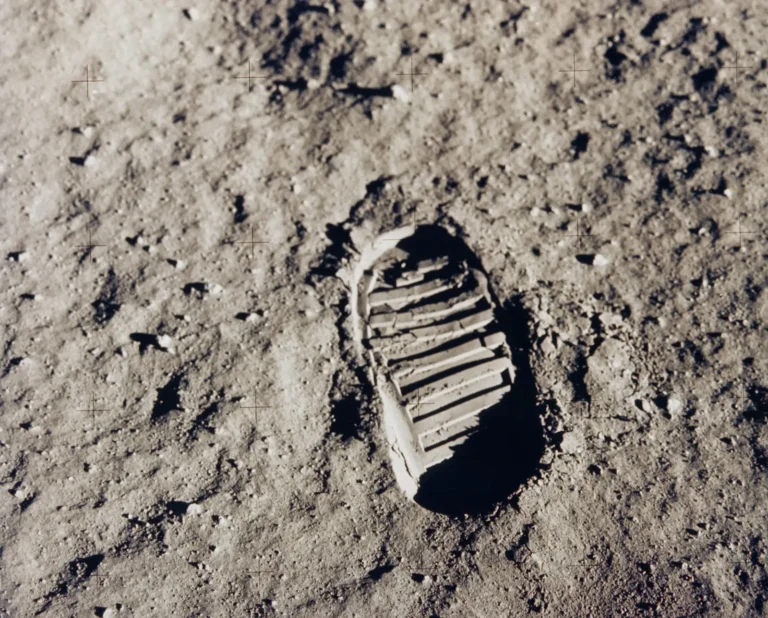
When NASA posts fresh Moon imagery, it rarely lands as just another space photo in some corners of the internet. A familiar cycle kicks in: the images get cropped, contrast-boosted, zoomed until the pixels surrender, and then recirculated as alleged proof of two long-running claims. One says the United States never landed astronauts on the Moon. The other says astronauts did land, but encountered an alien presence and recorded evidence of it in mission photography.
NASA does not treat either claim as credible. The historical record of the Apollo program is extensive, public, and studied in detail by engineers, historians, and independent researchers. Still, the persistence of these theories has made the agency’s imagery an evergreen target, especially as high-resolution lunar photos become easier to access and easier to misread.
What Apollo 11 actually did
The first crewed Moon landing remains Apollo 11, the mission that put Neil Armstrong and Buzz Aldrin on the lunar surface while Michael Collins stayed in lunar orbit.
NASA’s timeline places the lunar module Eagle down at about 20:17 UTC on July 20, 1969. Armstrong stepped onto the surface at 02:56:15 UTC on July 21, 1969, a time documented in multiple mission histories, including a detailed reconstruction by The Planetary Society. The astronauts spent roughly two and a half hours outside during the main EVA and returned with about 47.5 pounds (21.5 kilograms) of lunar material, a figure commonly cited in mission summaries and museums, including the Smithsonian’s Apollo coverage.
Those basic facts have been stable for decades. So has the disbelief.
The hoax claim, and how widespread it is
The “Moon Landing Hoax,” sometimes styled online as the “Great Moon Landing Hoax,” is among the most durable modern conspiracy theories. Its core allegation is that NASA staged the landings, commonly imagined as a studio production, and then maintained the illusion through doctored photographs, film, and falsified records.
Polling suggests the belief is not confined to a tiny fringe, though the exact numbers depend heavily on country, methodology, and how the question is framed.
In Russia, the state polling organization VCIOM reported in 2018 that sizable shares of respondents doubted the 1969 landing. The same VCIOM release also reported a split between those who said the landing was real and those who said it was faked, with demographic differences across age groups.
In Britain, a frequently cited 2016 claim that “52 percent of Brits” believed the landings were a conspiracy traces to a media write-up rather than an official, widely archived public poll release. One example is an article by IFLScience, which attributed the figure to a survey. Other UK polling on conspiracies, including a later YouGov analysis, has found smaller shares endorsing Moon-landing skepticism, underscoring how sensitive the number is to question wording and sampling.
In the United States, skepticism tends to show up at lower levels. A 2021 Economist/YouGov report described “just over one in ten” adults saying it was definitely or probably the case that the 1969 landing was faked.
That backdrop matters because it explains why lunar imagery has become a kind of Rorschach test. The same photo set can be used to argue “it never happened” and “it happened, but they saw aliens.”
The second claim: UFOs hidden in the Apollo archive
The more provocative version accepts that Apollo happened and then adds a twist: astronauts allegedly filmed and photographed “countless UFOs,” and NASA supposedly buried the evidence in plain sight.
The raw material for that claim is huge. Apollo photography is widely available, including through institutional archives such as the Apollo Image Atlas curated by the Lunar and Planetary Institute and mission-specific collections such as NASA’s Apollo 11 image library. Separate efforts, including the Apollo Image Archive, have also made large sets of original frames easy to browse.
Conspiracy communities regularly point to small bright shapes, odd streaks, hard-edged shadows, and high-contrast anomalies as “craft.” In practice, these are often the kinds of artifacts you get from hard lighting, reflective surfaces, film exposure limits, scanning, and the simple fact that cameras capture more than the photographer intends.
Apollo astronauts shot much of their lunar photography in extreme conditions: high contrast, harsh sunlight, no atmospheric diffusion, and reflective dust. Those conditions can make a bright object clip to white, erase faint detail in shadow, and turn a rounded shape into something geometric once you zoom in and amplify contrast. In spaceflight imagery more broadly, small pieces of debris or ice can also look like structured objects when they cross the field of view close to the lens, a problem that has appeared repeatedly in Earth-orbit footage as well.
That does not mean every claimed “UFO” is easily explained from a single screenshot reposted without context. It means the strongest evaluations tend to require original frames, camera metadata, sequence context, and comparison with adjacent images in a magazine or roll.
What modern lunar imaging shows
The continuing argument about whether Apollo happened runs into a practical obstacle: multiple modern spacecraft have imaged Apollo landing sites from lunar orbit.
NASA’s Lunar Reconnaissance Orbiter has photographed Apollo sites, and NASA has published mission imagery and explanatory pages for specific locations, including the Apollo 11 landing site. NASA visual releases have also described how LRO images reveal hardware and surface tracks at later sites, including Apollo 12, 14 and 17, in a 2011 release hosted by NASA’s Scientific Visualization Studio.
For people who start from the hoax premise, those images get folded into the conspiracy as “fabrications.” For everyone else, they are part of a thick, cumulative record: mission documentation, engineering telemetry, physical samples, and later orbital imaging that aligns with known landing coordinates and surface activity.
Why NASA keeps getting pulled into the argument
NASA’s public-facing role makes it a magnet. The agency releases images to educate, document missions, and support research. Conspiracy communities read the same releases as either accidental “slips” or deliberate signaling. That is why some online commentators insist NASA should “look twice” before posting Moon imagery and claim that photos show “Alien, and UFO Activity.”
The argument persists partly because it is modular. The hoax claim needs only a suspicion that photographs can be manipulated. The alien claim needs only a suggestive shape and enough ambiguity to keep a thread alive. Both thrive on the same behavior: aggressive zooming, selective cropping, and re-captioning images without the original sequence context.
NASA’s images, meanwhile, keep arriving. The Moon is one of the most heavily photographed bodies in the solar system, and new missions will add to that archive. The more data there is, the more opportunities there are for honest misunderstanding, motivated interpretation, and the occasional viral screenshot that outruns its source.
In 2018, the then head of Russia’s space agency, Roscosmos, Dmitry Rogozin, added fresh fuel to the hoax conversation when he suggested a future Russian Moon mission could check the American record, saying: “We have set the task of flying there to check whether they [the Americans] were there or not…They say they were, we will check.” The remark was widely reported at the time, including by The Associated Press.
For conspiracy theorists, that line read like validation. For everyone else, it read like a joke that traveled well because it touched a story people already knew: the Moon landing, the argument about the Moon landing, and the way the internet can turn any new lunar image into a courtroom exhibit.

In the UK, on the other hand, a 2016 poll showed that some 52 percent of Brits believed the landings were a conspiracy. In America, around 10 percent of the entire country’s population does not believe NASA ever landed an astronaut on the moon, and that everything was part of a massive conspiracy, filmed inside a Hollywood studio.