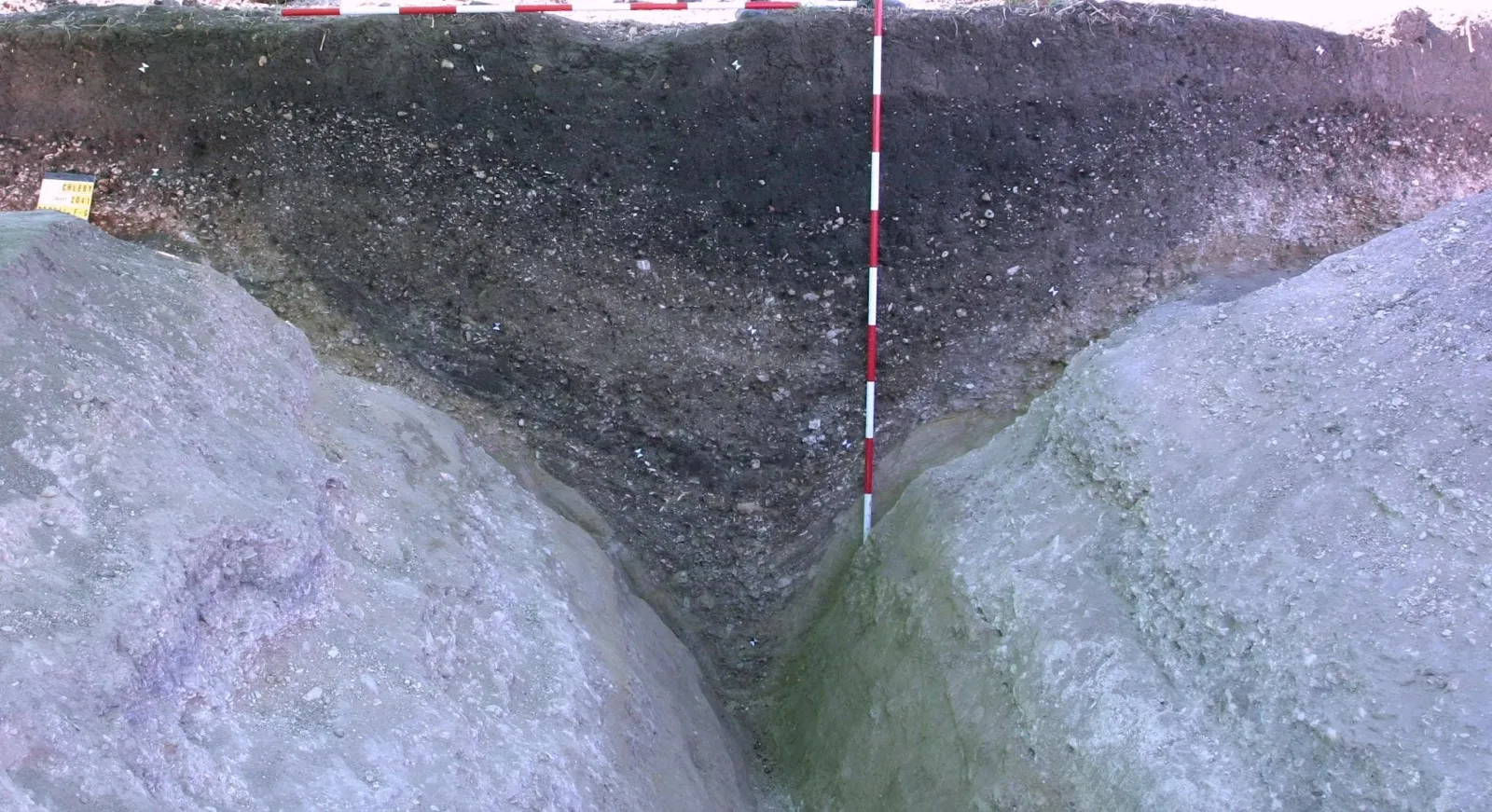
Researchers in the Czech Republic have identified the Chleby Neolithic enclosure, a vast circular monument dated by the excavation team to 4200–4000 BCE. The monument is more than 750 feet across, surrounded by a ditch that the team describes as about four metres wide and up to two metres deep, and divided by twelve openings. Its scale and layout place it among the largest prehistoric monuments known in Central Europe.
The excavation team describes the site as an Eneolithic, or Copper Age, ditched enclosure. From the ground, little of the original structure survives as a standing wall. Archaeologists find it through the shape of buried ditches, entrances, and soil changes, then combine excavation with aerial photography and geophysical survey. At Chleby, the measurements reveal a carefully planned ring rather than an accidental hollow in the landscape.
Petr Krištuf of the University of West Bohemia and colleagues report that several openings line up with key points in the solar and lunar cycles. Two observation positions appear to have been set toward the rising and setting Moon, the summer-solstice sunrise, and the winter-solstice sunset. These alignments suggest that people used parts of the enclosure to watch predictable movements across the horizon, although the evidence does not tell us exactly how ceremonies or gatherings unfolded there.
Animal remains add another layer to the interpretation. Bull skulls and horns were found in the enclosure, finds that may relate to ritual activity or feasting. The monument could have helped organise seasonal events connected to farming, while also providing a place for communities to meet. Archaeologists are right to leave room for several functions: a sightline can show that a direction mattered without proving the precise beliefs attached to it.
The Chleby discovery fits a wider pattern of Neolithic communities building large circular spaces across Central Europe. Curiosmos has looked at how archaeologists date faint enclosures. The Czech monument offers a valuable comparison because its size, openings, and astronomical sightlines can be measured even though its timber and above-ground structures have vanished.
The people who built Chleby were not leaving behind an observatory in the modern sense. They were farmers and craftspeople who could survey a large area, coordinate labour, and return to the same points in the landscape. Building the ditch alone would have required planning and a workforce spread across a community. The repeated alignment of entrances suggests that the horizon and the yearly cycle were part of that planning.
Further excavation should refine the construction sequence, how long the enclosure remained in use, and whether the openings were altered. Soil samples, animal-bone analysis, and radiocarbon dating can test the proposed calendar connections. For now, Chleby shows that monumental architecture and sky-watching were already joined in Central Europe long before Stonehenge.
The word “calendar” should be used carefully. The alignments show that certain directions and dates could have been marked, but they do not reveal a written system of numbered months. A community may have used the sightlines to time planting, gatherings, or rites, or it may have treated the changing light as part of a symbolic landscape. The surviving evidence can establish the geometry more securely than it can reconstruct the beliefs attached to it.
The monument’s size also raises a social question. A 750-foot circle is larger than the needs of one household, and the ditch would have demanded coordinated work. People may have travelled from several nearby settlements, meeting at the enclosure for events that reinforced alliances and shared seasonal obligations. Archaeologists can test that possibility by comparing pottery, animal bones, and raw materials inside the ring with finds from nearby habitation sites.