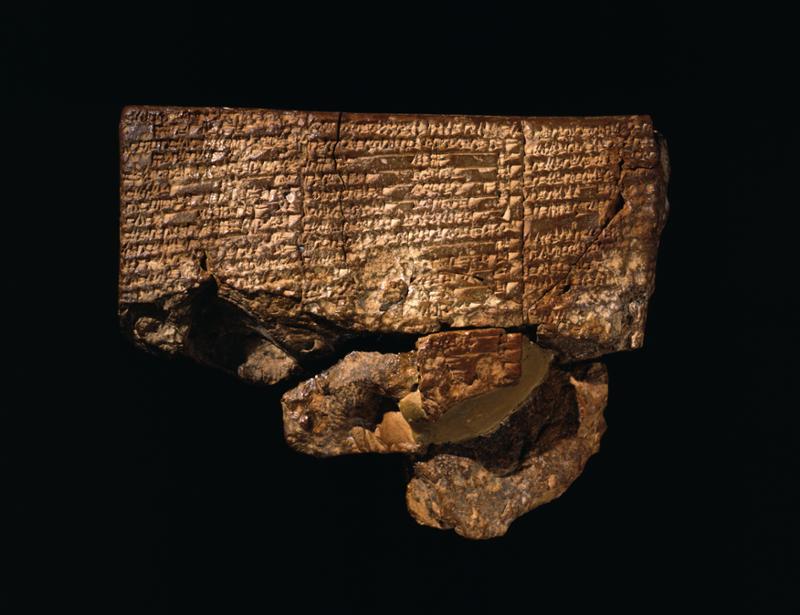
A small, damaged clay tablet in the Penn Museum preserves one of the oldest written flood narratives from Mesopotamia. It is catalogued as CBS 10673, comes from Nippur in modern Iraq and was written in Sumerian during the Old Babylonian period, around 1650 BCE. The text is usually called the Eridu Genesis or the Sumerian Flood Story.
Its importance is not that it proves a worldwide flood. The tablet is a literary and religious composition, and much of it is missing. Its value lies in the way it connects the creation of people, the origin of kingship, the first cities and a divine decision to destroy humanity.
What is the tablet?
CBS 10673 is a baked-clay fragment measuring about 13 centimetres long. The Penn Museum describes it as the lower part of a larger tablet, with six columns of Sumerian text. The complete work may have contained roughly 260 lines, but the surviving sections are broken and several passages are lost.
Keep exploring
Continue with Curiosmos
The tablet was found at Nippur, a major religious and scholarly centre. It joins another fragment, CBS 10867, and is associated with the Electronic Text Corpus of Sumerian Literature’s edition of the Flood story. “Oldest” therefore needs a qualification: this is the oldest surviving Mesopotamian flood composition in the relevant tradition, but the physical tablet is a later copy of stories that may have circulated earlier.
Before the flood: cities and kingship
The story begins with the gods creating humankind and establishing the order of the world. Kingship descends from heaven, and the first cities are assigned to their divine patrons. The text names Eridu, Bad-tibira, Larag, Zimbir and Shuruppag.
This catalogue does more than set a scene. In Mesopotamian literature, a city’s patron god and its place in the transfer of kingship help explain why the city matters. The Flood story places a catastrophe inside that sacred history: the disaster interrupts the sequence of cities and rulers, then forces the world to begin again.
Ziusudra and the warning
The human survivor is Ziusudra, a king and priest associated with Shuruppag. The tablet is too fragmentary to give us every step of the plot, but the surviving text shows the gods deciding to destroy humankind with a flood. Enki, the god of fresh water and wisdom, is connected with the warning that allows Ziusudra to survive.
The later Akkadian Atrahasis epic and the flood episode in the Epic of Gilgamesh preserve fuller versions of a related Mesopotamian tradition. Their hero names differ—Atrahasis and Utnapishtim—but the pattern is familiar: a divine decision, a chosen survivor, a boat, a flood and a sacrifice after the waters recede.
What survives of the flood passage?
In the remaining lines, wind and water overwhelm the cult centres. The flood lasts seven days and seven nights, after which the sun god Utu appears and Ziusudra offers thanks. The conclusion grants the survivor a special destiny rather than returning him to an ordinary human life.
Because the tablet is broken, modern translations rely on parallel passages and careful reconstruction. Scholars mark missing lines and uncertain readings; a smooth retelling can hide how much of the original text is not actually there. The gaps are part of the evidence, not an invitation to fill every silence with a later story.
Is this the story of Noah?
The Eridu Genesis predates the biblical Book of Genesis in its surviving written form, and later Mesopotamian flood narratives contain striking parallels. That makes comparison worthwhile, but “the Sumerians wrote Noah’s story first” is too simple. Flood traditions can develop through contact, shared cultural environments and the reuse of older literary motifs. The texts are related, yet the direction and timing of influence are not answered by one tablet alone.
Nor does the tablet demonstrate that a single global flood occurred. Mesopotamian cities were built beside rivers that could rise catastrophically, and local flood events may have helped shape collective memory. A mythological account is evidence for how people interpreted danger and divine order; it is not, by itself, a geological survey.
Why the Eridu Genesis matters
The tablet preserves a worldview in which civilisation is fragile, kingship is sacred and survival depends on knowledge shared across the boundary between gods and humans. Its damaged surface also gives a rare glimpse of how scholars reconstruct ancient literature: by comparing fragments, script, language and later versions rather than treating a popular translation as a complete original.
That combination of story and material evidence is what makes the object compelling. It is a real tablet with a documented excavation history, a real Sumerian composition and an unfinished text. The mystery is not whether it secretly confirms a modern claim. The mystery is how much of an ancient story can still be recovered from a fragment only a few inches long.
Read the Penn Museum’s catalogue entry for CBS 10673 and the University of Oxford’s translation of the Flood story. For more Mesopotamian context, see our guide to the planned Round City of Baghdad.