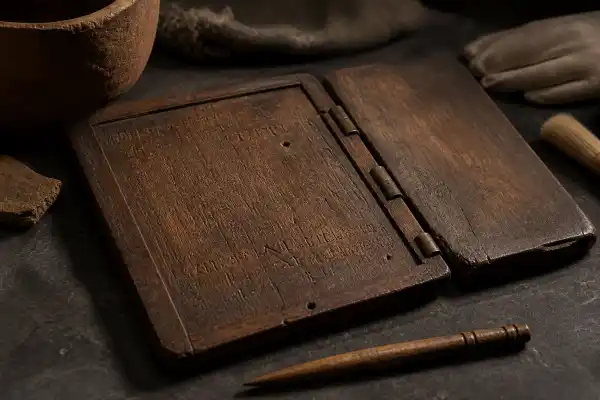
The most revealing Roman documents from Tongeren were never meant to survive. They were notes scratched into thin pieces of wood, used for business, administration and everyday messages, then discarded when their purpose was finished.
Modern analysis of 85 wooden writing tablets from the ancient city is bringing those fragments back into focus. The tablets date from the first to the third century CE and belong to a period when the Roman city of Tongeren—known as Atuatuca Tungrorum—was being woven into the administrative and commercial life of the empire.
The writing is difficult to read. Some tablets are warped, darkened or split. Yet even partial marks can reveal a great deal when the object, its findspot and the surviving letters are studied together.
Keep exploring
Continue with Curiosmos
Paperwork before paper
Roman writing tablets were usually made from thin layers of wood. A scribe could scratch a message into the surface with a stylus, sometimes using a pair of tablets joined like a small notebook. Some were coated with wax, allowing the writing to be erased and reused. Others preserved incised letters directly in the wood.
They were practical objects, not luxury books. A trader could record a delivery. An official could issue an instruction. A household could send a short note. When a tablet was thrown away or lost in a wet layer, an ordinary moment became an archaeological document.
That is why Tongeren’s collection matters. Monumental inscriptions tend to speak in the voice of emperors, donors and civic authorities. A wooden tablet can preserve the vocabulary of a clerk, the name of a supplier or the small complication that forced someone to write a message in the first place.
A city learning to operate in Roman systems
Atuatuca Tungrorum was the administrative centre of the civitas Tungrorum, a community incorporated into the Roman provincial system. Romanisation was not a single event in which local people suddenly became Roman. It was a long process of adopting, adapting and negotiating institutions, language, law and trade.
The tablets offer a way to watch that process at ground level. Names may show local and Roman traditions appearing side by side. Administrative formulas can indicate how official practices reached the city. References to goods and payments may connect Tongeren to routes that crossed northern Gaul and the wider empire.
None of this means that every person in the city wrote Latin fluently or abandoned older identities. A written record usually represents the people and institutions most able to use writing. The value lies in seeing which situations generated paperwork and how that paperwork was handled.
Reading marks that the eye cannot see easily
Conservation and imaging are central to the project. A tablet can look blank to the naked eye while retaining shallow strokes in the grain. Raking light, magnification and digital recording help researchers distinguish a deliberate letter from a crack.
The work also has to respect the object. A wet wooden tablet can shrink or deform when dried. Removing it from its find context can erase information about how it was deposited. Specialists therefore document the condition, wood grain and layers before attempting to read the text.
The result is not always a complete sentence. A few surviving characters can still help identify a name or formula. When several tablets come from the same area, repeated terms can reveal the kinds of activity taking place there.
The social world behind the fragments
The tablets can make Roman Tongeren feel unexpectedly familiar. Someone had to ask for goods, settle a payment, send instructions or explain why an obligation was delayed. The wording may be formal, but the situation is recognisable.
At the same time, the collection can expose the limits of that familiarity. Literacy was uneven. People who could not write might rely on a scribe. Officials and merchants appear more often than labourers whose work left no written record. A responsible history has to include those absences rather than treating the tablets as a complete census of the city.
The documents may also show how far administrative power reached. A small wooden note can connect a local dispute to a provincial office, a military supply chain or a merchant operating across several towns. The empire was held together not only by roads and soldiers, but by millions of small acts of recording.
A better history of the Roman north
Tongeren is sometimes introduced through its walls, baths and public buildings. Those monuments explain the city’s scale. The tablets explain its rhythm.
They show that Roman Belgium was not a passive edge of the empire waiting for culture to arrive from the south. It was a place where local communities used Roman tools for their own purposes, where people negotiated new institutions and where everyday decisions generated written traces.
Further work may recover more words, clarify the tablets’ original locations and compare them with writing tablets from other northern European sites. Even when the text remains fragmentary, the material itself preserves a history of work, literacy and administration.
The greatest value of the collection is its modesty. These are not royal decrees. They are pieces of disposable stationery. Their survival gives us something that grand monuments rarely can: the sound of a city going about its business.