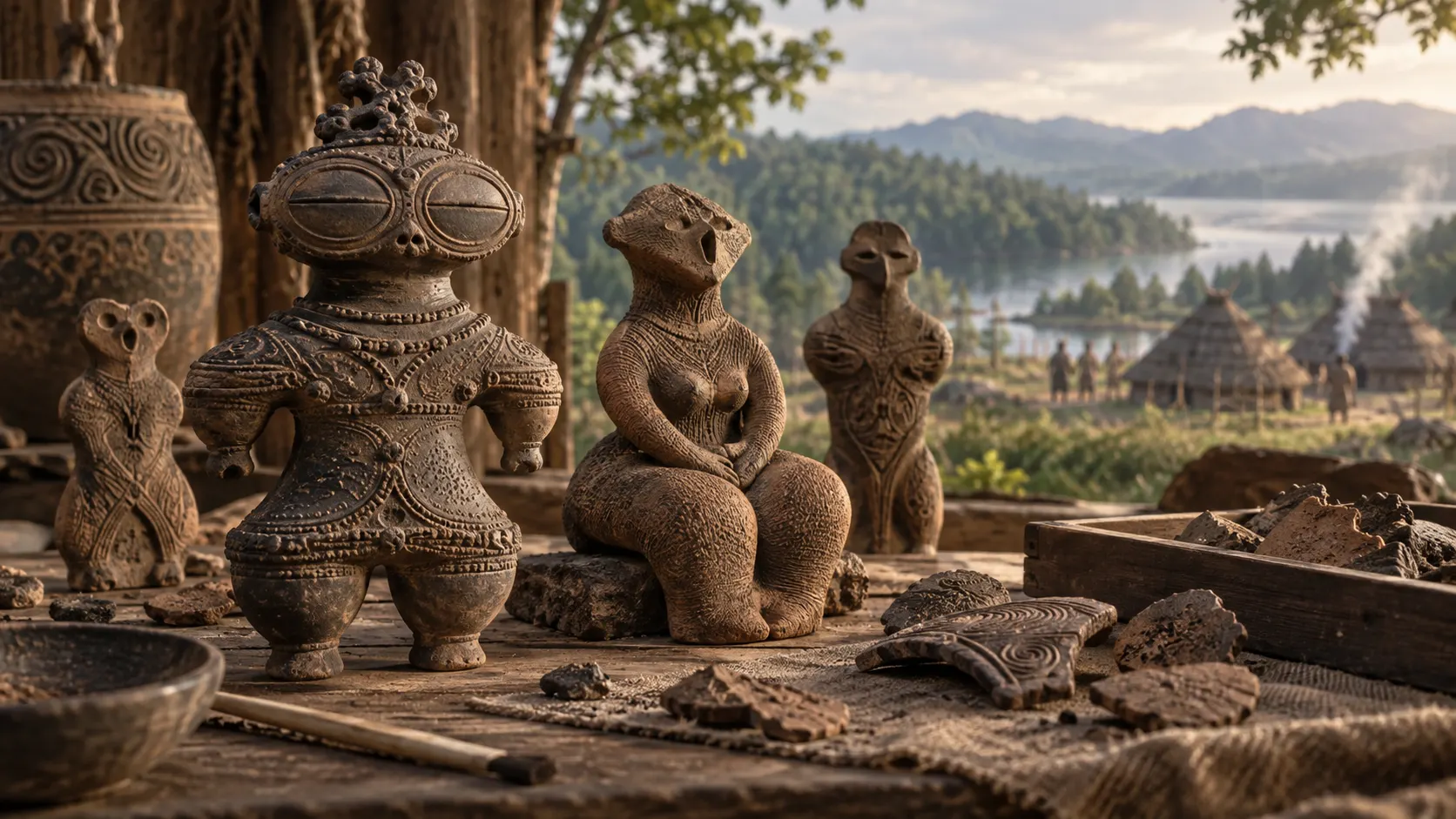
Some Jōmon dogū have wide, goggle-like eyes. Others carry patterned faces, broad shoulders or swollen bellies. Many were found broken, with a head or limb missing. Together, the figures make one of prehistoric Japan’s most distinctive bodies of art—and they still leave their purpose open.
Dogū were made from clay during the Jōmon period, roughly 14,000 to 300 BC. They were not one standard type. Their shapes and decoration changed across regions and through thousands of years, so a single explanation is unlikely to fit them all.
Figures shaped by local traditions
The word dogū means “clay figure.” Jōmon craftspeople built hollow bodies, pressed cord patterns into the surface, added clay details and sometimes painted the finished piece. A figurine in the Tokyo National Museum’s collection belongs to the final Jōmon period and follows a regional form called shakōkidogū.
That style spread from northern Japan into other parts of the archipelago. The movement could reflect travel, exchange or neighbouring communities borrowing ideas. The figures connect people across regions, while their local differences show that the tradition was never frozen in one design.
Those unmistakable eyes
The broad eyes on some dogū are often compared with snow goggles. The nickname describes their shape; it does not tell us what the eyes meant to the people who made them. Tokyo National Museum records place the feature within the visual language of late Jōmon figurines, while the Metropolitan Museum says its meaning remains unknown.
Perhaps the eyes made a face suitable for a ceremony or a story. Perhaps they carried a meaning that is lost to us. The clay preserves the choice to make them that way, not the words that once accompanied it.
Prayer, fertility and care
Many dogū emphasize breasts, hips or a rounded belly. Tokyo National Museum describes them as objects of prayer and suggests a connection with childbirth, fertility and the hope for healthy children. That reading fits some of the forms, though it cannot be applied automatically to every figurine.
Their archaeological settings matter too. A dogū found in a dwelling, pit, grave or stone arrangement may have taken part in different activities. Curiosmos has explored why an object’s findspot matters as much as its appearance; the same care is useful when reading Jōmon figurines.
Why were so many broken?
Many dogū were recovered with missing heads, arms or bodies. Some archaeologists have proposed that people deliberately broke figurines in rituals connected with illness or healing. Accidents, fragile fired clay and later disturbance may also explain some damage. The surviving evidence does not support one rule for every broken figure.
The Nara National Museum holds an unusually complete dogū from the Sugisawa site. Its record says the figurine was found nearly intact inside an arrangement of stones and may have been carefully placed. That rare context gives a glimpse of the attention some figures received. It cannot tell us whether other communities treated theirs in the same way.
People, spirits or something in between?
Some details may represent clothing, hairstyles, jewellery or body decoration. Tokyo National Museum curators note that the modelling can preserve information about Jōmon customs. The figures may draw on bodies people knew while enlarging features important to a ceremony or belief.
Modern viewers sometimes see an alien in the goggle-eyed faces. It is an arresting comparison, but no excavation or museum record identifies the figurines as images of visitors from space. Their value lies in what they reveal about Jōmon makers: skilled people who gave clay a face and placed that face in a meaningful setting.
Without a written explanation, we cannot settle whether a particular dogū represented a person, a spirit, an ancestor or a healing power. The objects leave us with a more intimate puzzle: what did people hope these small figures would do for them?
Sources
- Tokyo National Museum/e-Museum, clay figurine J-36872.
- Tokyo National Museum/e-Museum, mimizuku dogū.
- Nara National Museum, dogū from the Sugisawa site.
- Metropolitan Museum of Art, Dogū (Clay Figurine).
- Metropolitan Museum of Art, Head of a Clay Figure (Dogū).
- Tokyo National Museum, “Dogū: Objects of Prayer in the Jomon Period.”