In 2018, work beneath an olive grove near Ierapetra on Crete’s southeastern coast uncovered a rock-cut tomb. Rubble had blocked its entrance. Inside, archaeologists found two adult burials, two larnakes and more than 20 vessels.
The chamber had been closed for roughly 3,400 years. Its contents offer a rare look at how people in this part of Crete prepared their dead for burial, even though the occupants’ names and relationship are unknown.
Three niches, two coffins
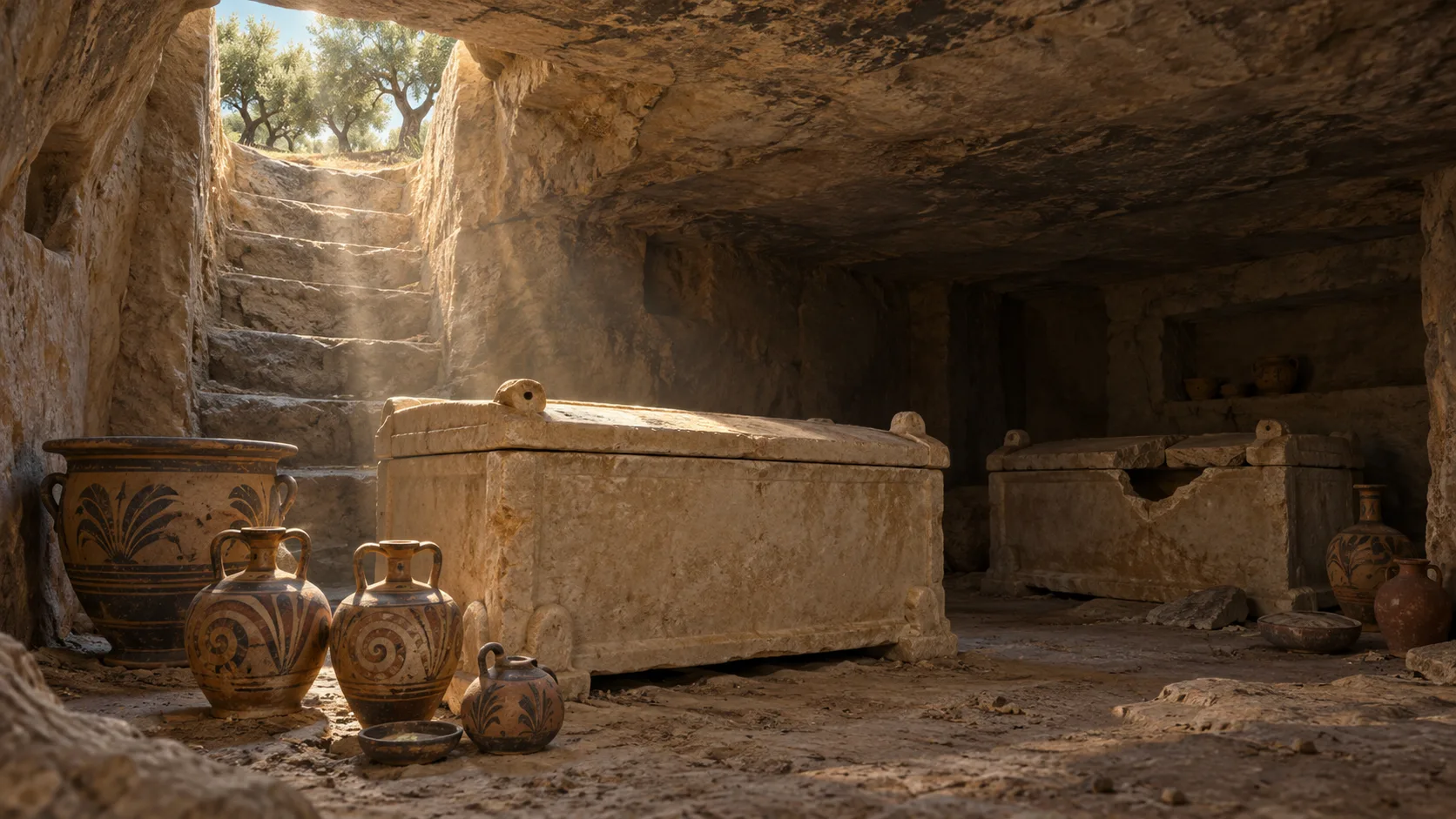
A shaft more than 2.5 metres deep led into a chamber carved from the area’s soft marl limestone. The room had three niches. In the southern one, an intact larnax still had its lid in place. Inside lay a well-preserved adult skeleton in a contracted position. Fourteen stirrup jars, a krater and a cup had been placed in front of the coffin.
A second larnax occupied the northern niche. Its lid was missing and the skeleton had deteriorated, but six small stirrup jars and two jugs remained nearby. The Ministry of Culture’s excavation account does not identify either person by name, rank or occupation.
The chamber was made for more than one burial, though the sequence is not fully known. The two people could have been relatives or members of the same community; the excavation summary does not establish their relationship.
Dating the pottery
The vessels place the tomb in Late Minoan IIIA2–B, roughly 1400 to 1200 BC. Archaeologists date pottery by comparing its shape, fabric, handles and decoration with examples from securely dated contexts.
That gives a broad period, not the exact year the chamber was sealed. The tomb may have been used at different times, and its objects help outline that history without identifying each visit.
Late Minoan III was a period of change across Crete and the wider Aegean. Palaces such as Knossos belonged to a world of movement and exchange. The Ierapetra chamber adds a smaller view: two burials and the vessels their community chose to place with them.
What the grave goods can tell us
Stirrup jars were common containers in Late Bronze Age Crete. Their shape tells archaeologists about the kinds of vessels used and their place in Minoan material culture. Without residue or use-wear tests on the jars from this tomb, their precise contents remain unknown.
The better-preserved skeleton lay in a contracted position inside its larnax. That posture could reflect a local funerary custom, the coffin’s dimensions or the way the body was placed. A full osteological study would be needed before drawing conclusions about the person’s identity or circumstances.
Two coffins and a careful arrangement of jars show that the burial was prepared with attention. They do not tell us whether the people were family or what mourners said as they closed the tomb.
Crete’s myths and its dead
The Minotaur belongs to a later Greek story about King Minos and a labyrinth. The myth is bound to Crete in the popular imagination, but it is not an explanation for this burial. The tomb gives us a different kind of connection to the island’s past: a chamber cut into limestone, two people laid in larnakes, and vessels set nearby.
Curiosmos has also examined the Phaistos Disc, another Cretan object whose surviving evidence invites competing readings. At Ierapetra, the objects are easier to describe than to interpret. We can see how the burials were arranged; we cannot hear the community explain what the arrangement meant.
The discovery brings Minoan history close to the scale of a household or a local community. A palace can show us power; a sealed tomb preserves a quieter decision about who deserved a coffin and what should accompany them.