Abu Ghurab’s sun temple stood on a desert rise south of Cairo, with an open court beneath the sky and a monumental stone structure at its centre. Images online call it a “stargate” or describe its carved basins as parts of a lost machine. Excavations tell a more grounded story: the temple joined sunlight, water, royal ceremony and the Nile in one carefully planned route.
Pharaoh Niuserre built the better-preserved temple during Egypt’s Fifth Dynasty. Abu Ghurab also contains an earlier sun temple built for Userkaf. The two complexes are among the clearest examples of Old Kingdom sun worship.
An open court and a stone obelisk
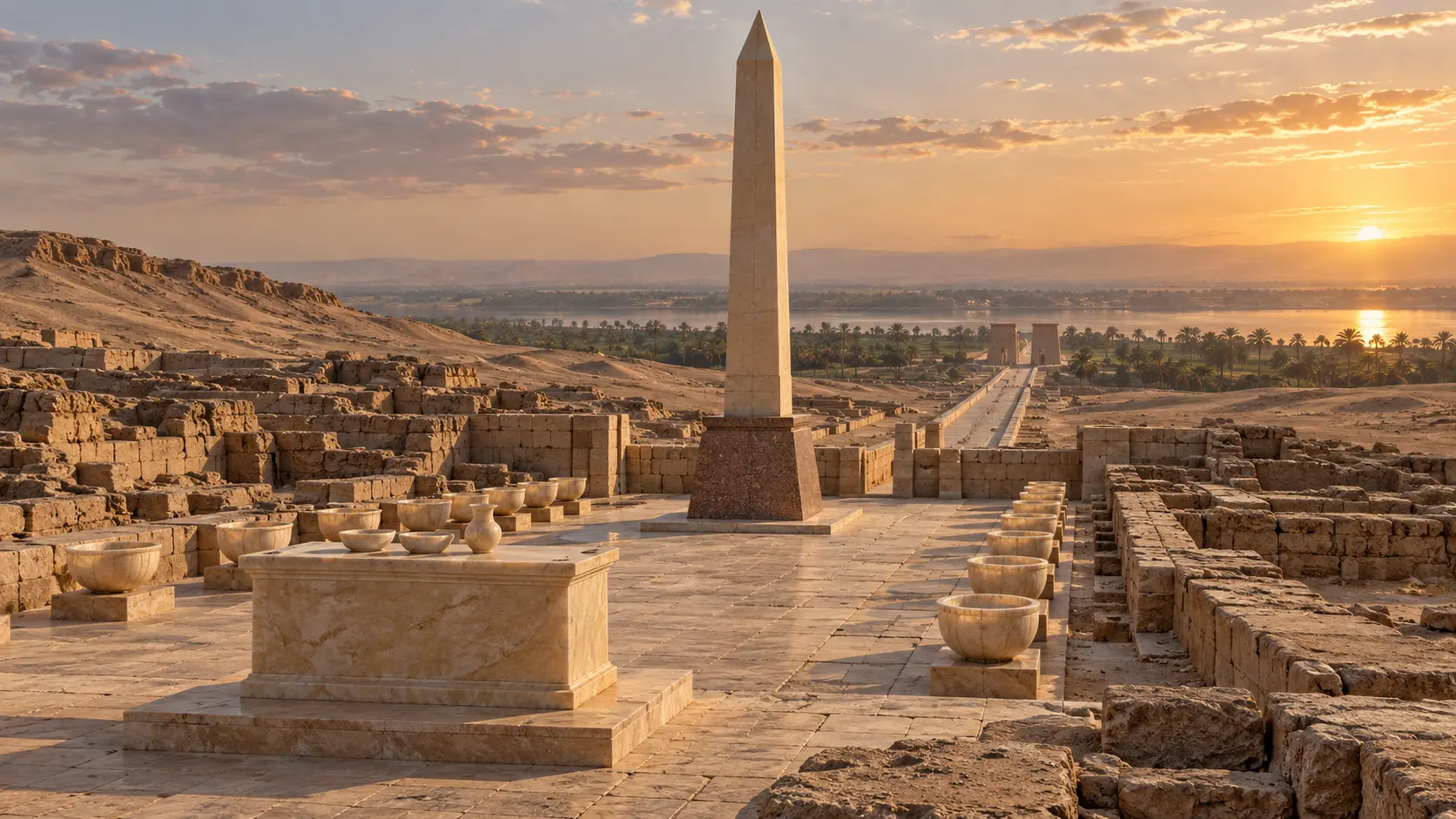
The Niuserre temple followed a route familiar from pyramid complexes. A valley temple near the Nile connected to a raised causeway and an upper sanctuary on the desert plateau. The Sun Temples Project describes the enclosure as about 110 metres long and 70 metres wide. Around half was an open courtyard.
An alabaster altar stood at its centre, with a large limestone-and-granite structure behind it shaped like an obelisk on a plinth. It was not the slender, single-stone obelisk familiar from later Egyptian monuments. The built form belonged to a different period and a different kind of temple.
The design put the open sky at the heart of worship. Reliefs in the Chamber of the Seasons depicted inundation, sowing and harvest; another chapel showed scenes connected with the king’s Sed festival. Solar renewal and the agricultural calendar shared the walls with the renewal of royal power.
The carved basins
A row of alabaster basins and channels along the northern side of the courtyard has helped fuel speculation about hidden technology. A modern museum summary repeats a suggestion that the vessels manipulated water or lifted objects by vibration. No archaeological evidence demonstrates such a mechanism.
The Sun Temples Project places the basins in an area for purification. Their position beside grooved paving and channels fits a ritual use involving water. The exact sequence of actions remains uncertain, but purification was a familiar part of Egyptian temple practice. The stonework belongs to a sanctuary whose other features are clearly religious.
A newly excavated entrance by the Nile
Work in 2024 and 2025 by an Italian archaeological mission uncovered more of the long-buried valley temple first identified by Ludwig Borchardt. In a January 2026 announcement, Italy’s Ministry of Foreign Affairs described an excavated area of more than 1,000 square metres, about half of the sanctuary.
The team reported a monumental entrance, remains of granite and limestone columns, a quartzite doorway and blocks inscribed with Niuserre’s name. Some inscriptions refer to religious festivals and may preserve one of the earliest known calendars displayed on a temple exterior.
The valley temple helps connect the sanctuary to the river. It was part of the approach, not just a second shrine. Boats could land near the Nile before participants travelled along the causeway and up to the open court.
Stone, river and sunlight
Picture the route: a ceremonial boat reaches the valley temple; visitors pass beneath an entrance marked with the king’s name; the causeway carries them toward a court where the altar and obelisk stand under the sun. The architecture joined the river, the desert and the sky in a single approach.
The temple was used for about a century before it was abandoned. Later, parts of the complex became a settlement that lasted more than three centuries. Excavators even found pieces of a senet board from that later occupation. A sanctuary built for Ra, the Egyptian sun god became part of everyday local life.
Nothing in the excavated layout points to a portal or a device that manipulated gravity. The “stargate” label grew from the structure’s dramatic setting, detached from its inscriptions, reliefs and processional route. The evidence instead places it within the Old Kingdom’s solar cult and royal ritual.
Abu Ghurab was built to make those ideas visible. Open sky, carved stone, water and movement through the landscape brought the sun’s cycle into a ceremony centered on the king. Curiosmos has also explored Egyptian solar ships, another way royal and religious journeys were connected with the sun.