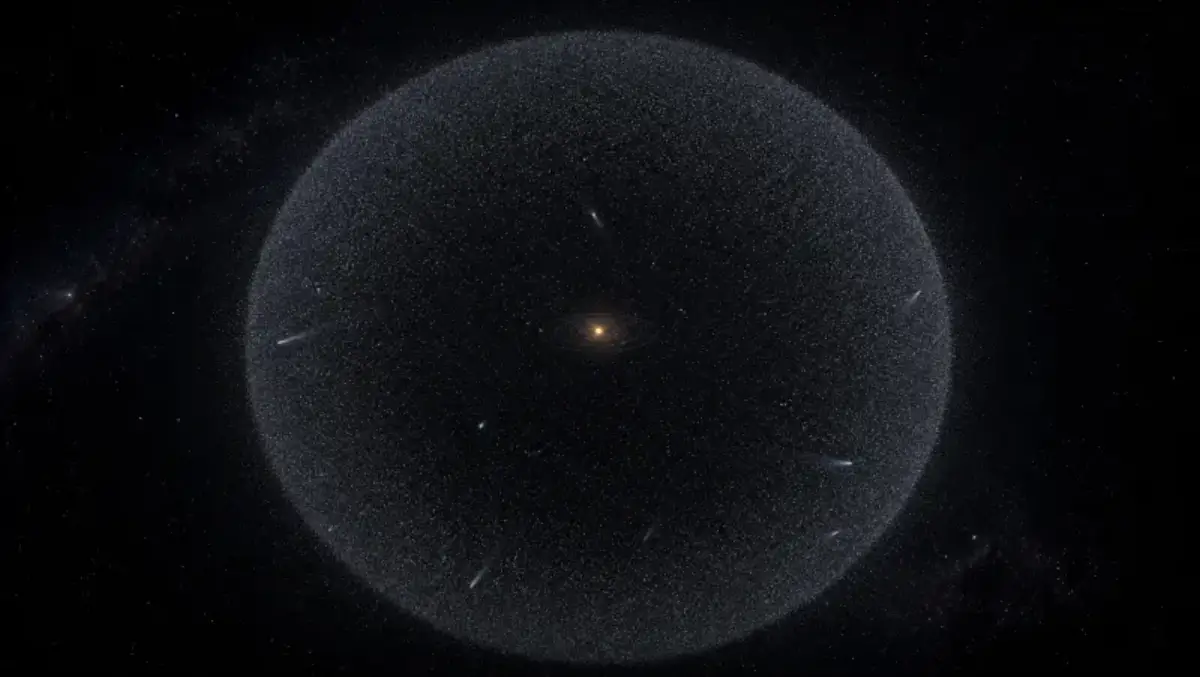
Most comets and asteroids that pass through the Solar System are permanent residents. The Sun’s gravity keeps them on closed orbits, even when those orbits take thousands of years to complete.
An interstellar object is different. It arrives on a path that is not closed around the Sun. The object is passing through, and after its encounter it will continue back into interstellar space.
Astronomers identify that kind of visitor mainly from its orbit. The measurements collected over several nights allow researchers to calculate the object’s path and speed. If the orbit is hyperbolic—open rather than bound—the object is not a long-period comet returning from the distant edge of our own system.
The three visitors known so far
The first was 1I/‘Oumuamua, discovered in 2017. The second was 2I/Borisov, found in 2019. NASA identifies 3I/ATLAS as the third known object from outside the Solar System to pass through our celestial neighbourhood.
The “I” in the designation means interstellar. The number records the order in which these visitors were confirmed. 3I/ATLAS was first reported by the ATLAS survey in July 2025, and older observations were later found in telescope archives.
Those pre-discovery images matter. They extend the observed arc and improve the orbit calculation. The longer an object is tracked, the easier it is to separate a true interstellar path from a measurement error.
Chemistry adds another clue
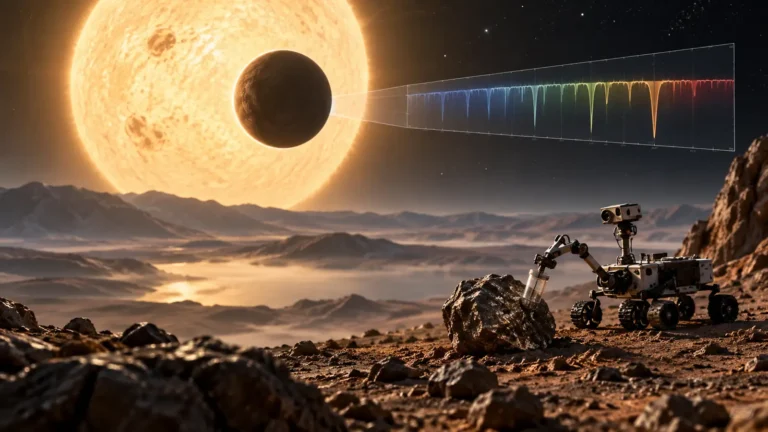
An orbit can show where an object came from dynamically. Spectroscopy can show what it is made of. When sunlight passes through a comet’s gas and dust, molecules leave fingerprints at specific wavelengths.
NASA’s James Webb Space Telescope detected an unusual chemical mix in 3I/ATLAS, including a high carbon-dioxide-to-water ratio and methane in its infrared observations. That chemistry may reflect the colder or otherwise different environment in which the comet formed.
It does not turn the comet into a spacecraft. A strange composition is exactly the kind of result astronomers hope for when they study a visitor from another planetary system. It gives them a glimpse of conditions that cannot be sampled directly.
Why the sample is still tiny
Three objects are not enough to describe the interstellar population. Surveys are more likely to spot an object that is large, bright, active, or close to the Sun. Darker and smaller bodies can pass through without producing a useful detection.
That selection effect is one reason future observatories matter. A larger sample could reveal whether 3I/ATLAS is typical or an outlier. It could also show how often interstellar objects carry gas, dust, ice, or unusual colours.
Curiosmos has explored the idea of interstellar archaeology and the evidence around 3I/ATLAS. The central lesson is straightforward: an object can be rare, ancient, and scientifically surprising without being artificial.
The next visitor may answer questions that the first three cannot. Until then, the combination of an open orbit, a measured trajectory, and a spectrum remains the best way to recognize a traveller from another star.
How astronomers test an interstellar origin
The first clue is an orbit that does not close around the Sun. An object arriving on a hyperbolic path can be moving too quickly to remain a permanent member of the Solar System, even after the Sun’s gravity bends its trajectory. That calculation is based on repeated position measurements, not on a single image.
Speed alone is not enough. Astronomers correct for the pull of the planets, account for observation errors and compare the object’s chemistry or activity with familiar comets and asteroids. A visitor can look unusual and still be a native object on a long, eccentric orbit. The interstellar label is reserved for the cases in which the orbital evidence points back beyond the Sun’s gravitational family.