The Moon has no weather to erase a fresh scar, no rivers to soften its rim and no forests to cover the evidence. Yet a crater 222 metres wide formed there in 2024 and was not recognised until more than a year later.
The newly named McGetchin crater is the largest impact crater formed and discovered during the lifetime of NASA’s Lunar Reconnaissance Orbiter. It is also a reminder that the Moon can look still while its surface is being rewritten by objects arriving from space.
When did the new crater form?
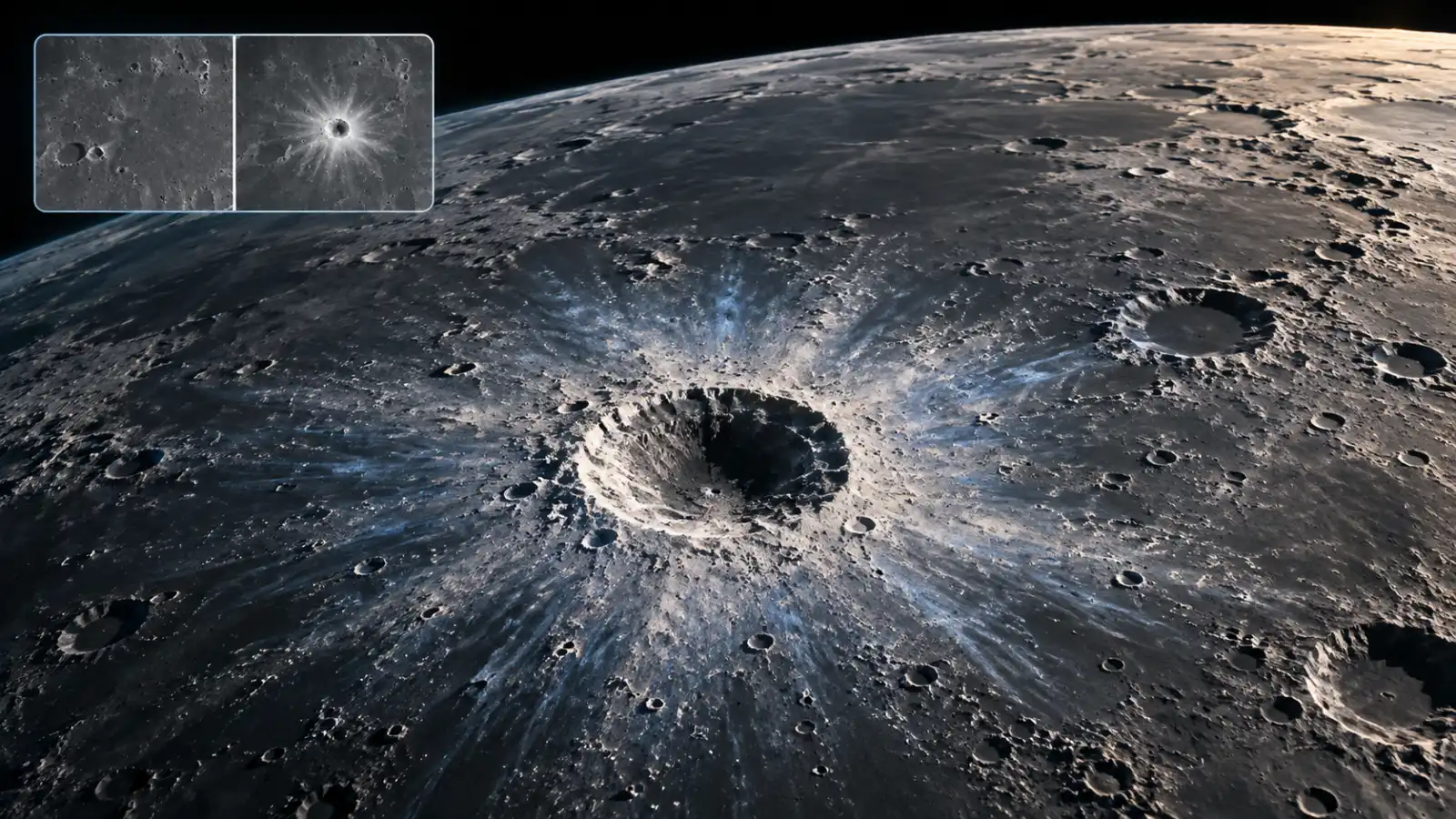
The crater formed sometime between 11 April and 22 May 2024. Researchers can narrow the date because the Lunar Reconnaissance Orbiter Camera has repeatedly photographed the same parts of the lunar surface. One set of images shows the old ground; a later set shows a bright new ejecta blanket and a dark bowl in its centre.
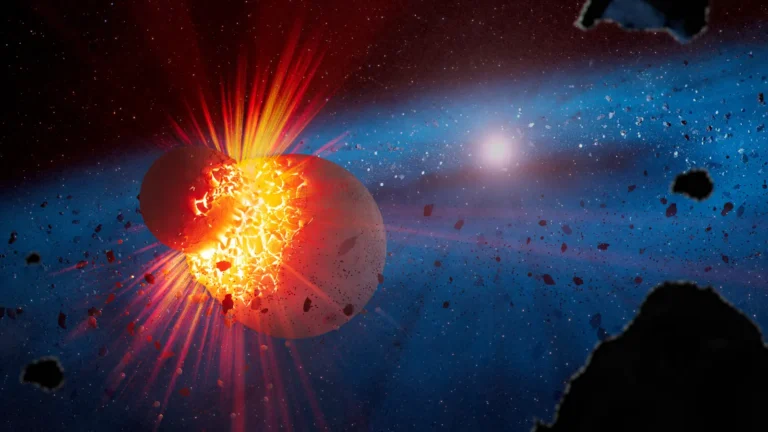
The impactor was probably a small cometary or asteroidal fragment. NASA’s account compares its size with a three- to six-storey building, while the primary study is more careful and models the event without claiming that the object’s size is directly known.
That distinction is useful. The crater’s diameter and depth are measured from spacecraft images and terrain models. The impactor’s size and the roughly once-in-132-years frequency are estimates based on impact models.
Why did it take so long to find?
At first glance, the answer seems strange. NASA’s LRO has been watching the Moon since 2009, and its Wide Angle Camera maps the entire surface every month. But the new crater is only about two wide-angle pixels across. What made it visible was not a giant hole in a giant photograph. It was a small, unusually bright change between two images taken under comparable lighting.
The LRO team found the change during a routine comparison in 2025. Follow-up observations with the Narrow Angle Camera then supplied the detail needed to measure the crater, its rim, the boulders around it and the material thrown across the surrounding ground.
This is a quiet kind of discovery. No one needed to see the impact flash from Earth. The evidence was waiting in a before-and-after sequence, and the right comparison turned a tiny white mark into a new geological event. The same before-and-after approach is also helping NASA and IBM search the Moon’s vast image archive, a related Curiosmos report on that method explains. Read how the archive is being searched.
What does the crater look like up close?
McGetchin is about 222 metres across and roughly 43 metres deep. A bright blanket of rock and dust surrounds it, with the largest measured blocks reaching several metres in length. The crater sits near the boundary between the Moon’s brighter, rough highlands and a darker, flatter mare surface.
The primary Science Advances study used high-resolution LRO images and stereo terrain data to reconstruct the crater’s shape. The researchers found disturbed material extending far beyond the bright rim. The most distant changes reach more than 1,000 crater radii in the image record, showing that an impact can rearrange a surprisingly large neighbourhood.
That spread also gives scientists a new test of how ejecta moves. Material launched at different speeds and angles lands in different patterns, so the fresh crater preserves details that older, weathered surfaces gradually lose.
Why is the ground around it colder at night?
A second study used the LRO’s Diviner instrument to examine the Moon after sunset. It found a cold spot about seven kilometres wide around McGetchin, with temperatures roughly 8 to 9 kelvins lower than the surrounding ground.
The likely explanation is deceptively simple. The impact shook and loosened the upper layer of lunar soil, or regolith. Loose material contains more empty space and changes the way heat moves through the surface, so it cools differently during the long lunar night.
The researchers compared McGetchin with other newly formed craters larger than about 20 metres. Their analysis found detectable cold spots around craters larger than roughly 30 metres, suggesting that fresh impacts alter the shallow regolith more often—and over larger areas—than a crater’s sharp rim alone would reveal.
What can one new crater tell us?
A single impact cannot rewrite the Moon’s entire impact history. The estimate that a crater this size forms about once every 132 years is a model average, not a clock that predicts the next event. Small craters can also remain below the resolution of a survey or hide until two images happen to be compared. For comparison, NASA also photographed a separate crater made when a Falcon 9 stage struck the Moon, giving researchers a useful contrast between a natural impact and a human-made one. See the Falcon 9 crater photographed by NASA.
Even so, McGetchin gives researchers something rare: a large, fresh experiment with the starting conditions recorded by spacecraft. Its ejecta, boulders, terrain and thermal footprint can be measured before micrometeorites and time blur the pattern.
The Moon may therefore be more active, in a geological sense, than its familiar face suggests. What looks like an unchanging landscape is also an archive being updated one impact at a time—and the next new crater may already be present in an image waiting for comparison.
Sources
- A new 222-m diameter lunar crater, Science Advances, 16 September 2026.
- New lunar crater reveals extensive distal regolith modification, Science Advances, 16 September 2026.
- NASA’s Moon Orbiter Spots New, ‘Once-in-Century’ Moon Crater, NASA Science, 16 September 2026.
- NASA’s Lunar Reconnaissance Orbiter Discovers a New 222-m Diameter Lunar Crater, Universities Space Research Association, 16 September 2026.