Planets are far dimmer than the stars they orbit, so taking a normal photograph of an Earth-sized world next to a Sun-like star is extraordinarily difficult. Astronomers usually find exoplanets indirectly. They watch what a planet does to its star, or what the star does in response to the planet’s gravity.
Those signals are small. A transit can dim a star by less than one percent, while a star’s gravitational wobble may shift its spectral lines by only a few metres per second. Repeated measurements turn those tiny changes into evidence for another world.
The transit method: a planet crosses the star
The most productive technique is the transit method. If a planet’s orbit happens to carry it between its star and Earth, the planet blocks a little of the star’s light. A telescope records a shallow dip in brightness. When the dip repeats at regular intervals, it can reveal the planet’s orbital period.
The depth of the dip gives an estimate of the planet’s size compared with its star. The interval between dips tells astronomers how long one orbit takes. The method works best for planets whose orbital plane is aligned with our line of sight, which means many planets are missed simply because they do not cross their star from our perspective.
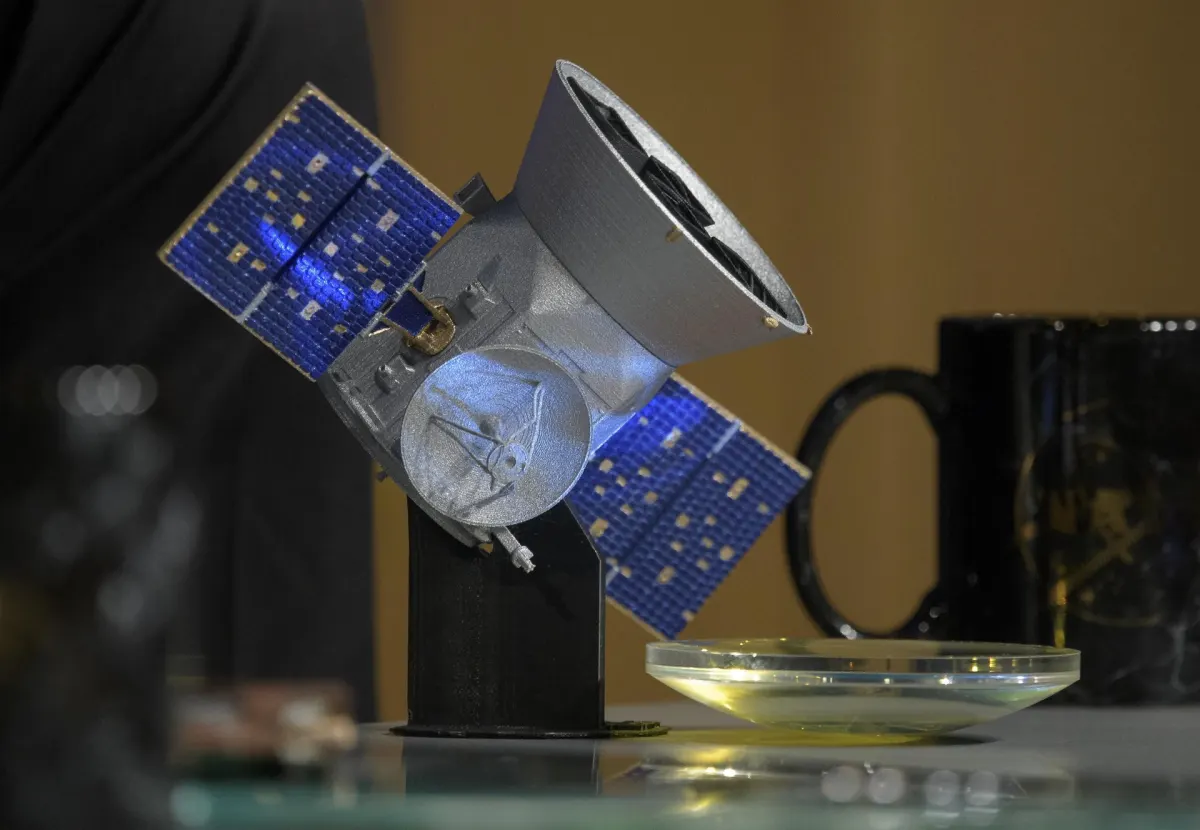
NASA’s Kepler mission and the Transiting Exoplanet Survey Satellite, or TESS, made this approach central to modern exoplanet research. A single candidate is not enough: stellar activity, eclipsing binary stars and instrumental problems can mimic a transit. Follow-up observations are required before a planet is confirmed.
The radial-velocity method: a star wobbles
A planet does not orbit an absolutely motionless star. Both bodies orbit their shared centre of mass. A massive planet can pull its star back and forth, causing the star’s light to shift slightly toward the blue end of the spectrum as it moves toward us and toward red as it moves away.
This radial-velocity signal can reveal a planet even when no transit is visible. It also gives an estimate of the planet’s minimum mass. A combination of transit and radial-velocity measurements is especially useful because the transit supplies a size while the stellar wobble supplies mass.
Gravitational microlensing: gravity makes a natural lens
When a foreground star passes in front of a more distant star, the nearer star’s gravity bends and magnifies the background light. If the foreground star has a planet, the planet can add a short extra spike to the brightening curve.
Microlensing can find planets far from their stars, including some that would be difficult for the transit and radial-velocity methods. The alignment is usually a one-time event, so the technique does not normally allow a second observation of the same planet. It is a rare alignment used to answer a different part of the census.
Direct imaging and the light from an atmosphere
Direct imaging is possible when a planet is large, young, hot or widely separated from its star. Astronomers use coronagraphs and careful image processing to block the star’s glare. The result is still a demanding measurement because scattered starlight can overwhelm the planet.
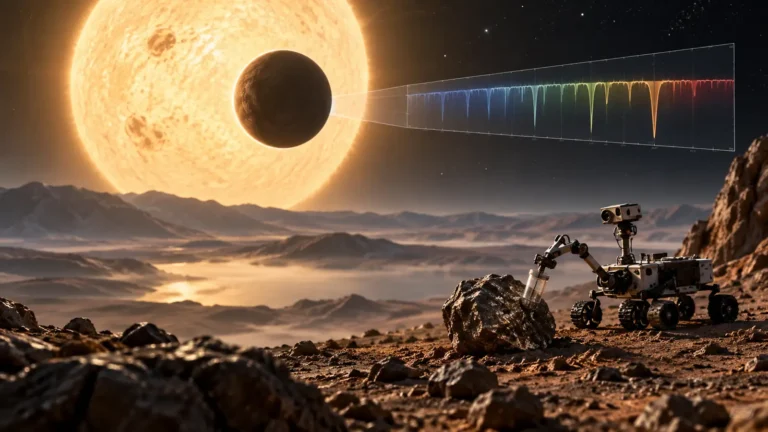
Once a planet is identified, spectroscopy can reveal clues about its atmosphere. As a planet crosses its star, some starlight filters through the atmospheric gases. Different molecules absorb different wavelengths. NASA’s exoplanet guide describes how transit spectroscopy, radial velocity and direct imaging complement one another.
Curiosmos recently reported on Webb’s detection of a hidden planet in Beta Pictoris. That kind of observation shows why finding a planet and studying it are separate stages. A faint companion can first be located, then examined for its atmosphere, temperature and chemistry.
The older class of hot Jupiters helped establish how different other planetary systems can be. They are large and close to their stars, so their transits and gravitational signals are easier to measure than those from a small, cool planet.
What counts as proof?
A convincing exoplanet claim needs more than a promising dip in a graph. Researchers check whether the signal repeats, compare it with stellar activity, use independent instruments and test whether a background eclipsing binary could explain the data. Confirmation is a process of eliminating alternatives.
Each method also has blind spots. Transits favour aligned orbits. Radial velocity favours massive planets close to their stars. Microlensing is fleeting. Direct imaging favours bright, separated worlds. The catalogue of known exoplanets is therefore not a simple inventory of everything in the Galaxy; it is a map shaped by what each technique can detect.
A growing census of other worlds
Combining the methods has changed the question astronomers ask. The existence of planets around other stars is no longer in doubt. The work now involves measuring how common different kinds of worlds are, how they form, and which environments could support complex chemistry.
The next discovery may come from a regular dip in starlight, a barely visible stellar wobble or a spectrum carrying the fingerprint of an atmosphere. Each signal is small. Together, they reveal a crowded galaxy of planets.