The Moon is not motionless. It spins once on its axis in about 27.3 days and completes one orbit around Earth in about 27.3 days. Because those periods match, the same hemisphere remains turned toward us. Astronomers call this synchronous rotation or tidal locking.
The effect can be confusing because the Moon looks as though it is simply travelling around Earth without turning. A short thought experiment clears it up: imagine walking around a chair while keeping your face toward the chair. You must rotate once during the walk, even though your face never leaves the chair.
What tidal locking means
Earth’s gravity pulls unevenly on the Moon. The side closer to Earth feels a slightly stronger pull than the far side, raising a small tidal bulge. The Moon’s interior is not perfectly elastic, so friction over enormous periods of time gradually changed its rotation.
Keep exploring
Continue with Curiosmos
Eventually the Moon reached a state in which one rotation took the same amount of time as one orbit. Once there, the tidal forces no longer had to slow the spin further. The arrangement is stable as long as the Earth–Moon system continues to evolve.
Near side, far side—not light side and dark side
The hemisphere facing Earth is the near side. The opposite hemisphere is the far side. The far side is not permanently dark: it receives sunlight during the lunar day just as the near side does. Calling it the “dark side” confuses a far side with a permanently shadowed place.
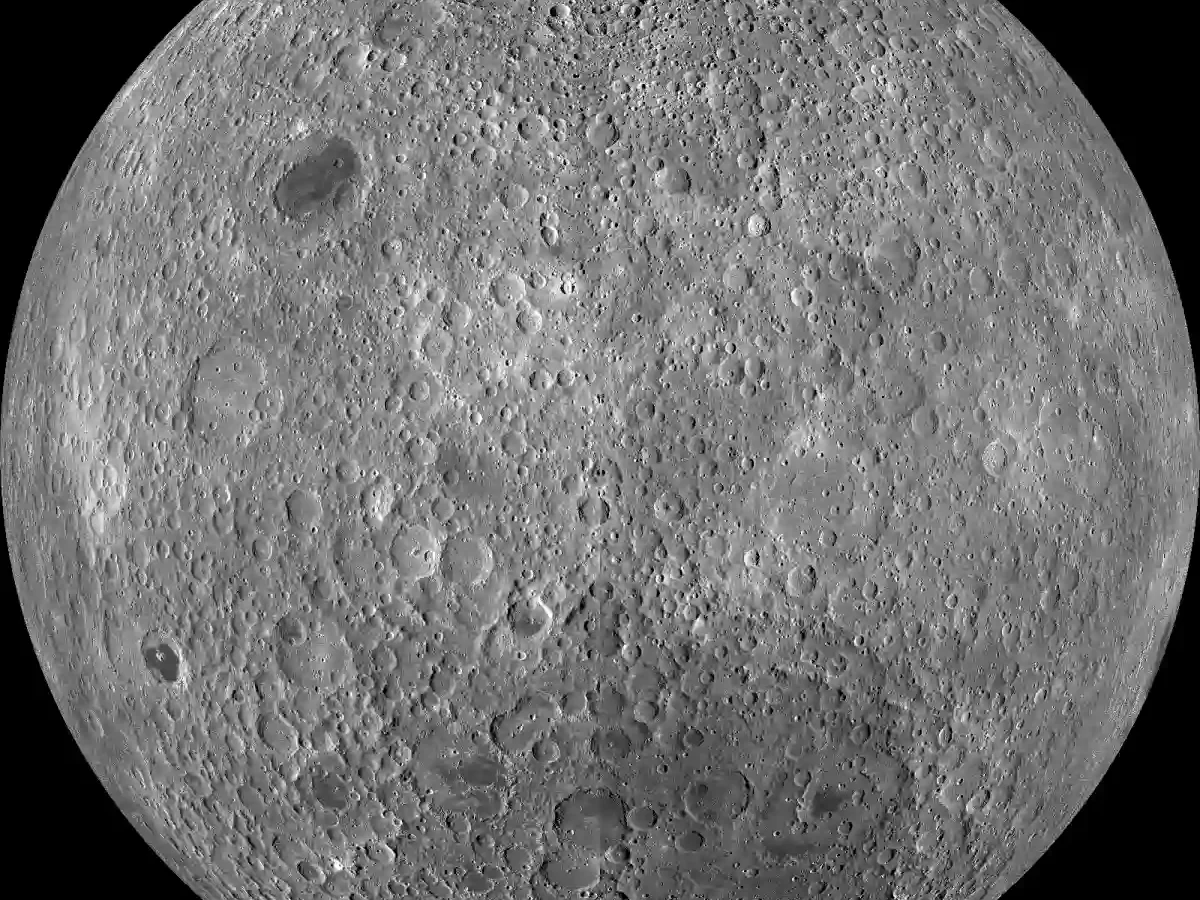
Humans did not see the far side until a Soviet spacecraft photographed it in 1959. NASA’s Lunar Reconnaissance Orbiter has since mapped the surface in detail. The two hemispheres look different: the near side has broad dark maria, while the far side is more heavily cratered and has a thicker crust.
Curiosmos has explored what the sky would look like from the lunar surface. An observer on the far side would still see the Sun and stars, but Earth would remain below the local horizon for much of the time.
We can see a little more than half
The Moon’s orbit is slightly eccentric and its axis is tilted. Those motions create a gentle rocking called libration. Over a month, libration lets observers see a little around the eastern and western edges, as well as near the north and south poles.
Across many months, Earth-based observers can see about 59 percent of the lunar surface. We never see the entire far side from Earth, but libration gives us a wider view of the near side than a perfectly fixed face would provide. The familiar phases of the Moon are a different effect, caused by changing illumination as the Moon orbits Earth; Curiosmos explains that cycle in its Moon-phases guide.
Why the Moon became locked
Tidal locking is common among large moons in the Solar System. The same gravitational friction that slows a moon’s spin can also transfer angular momentum between an orbiting body and its planet. The process takes a long time, but the final state is energetically favoured.
The Moon is slowly moving away from Earth, by roughly 3.8 centimetres per year. That change is tied to the same tidal interaction that locked the Moon’s rotation. The system is not frozen; it is changing so gradually that only precise measurements reveal the movement.
One face does not mean one Moon
The near side changes appearance every night because sunlight moves across it. Craters, maria and mountain ranges remain in the same places, but the terminator—the line between lunar day and night—shows a different portion of the landscape as the Moon follows its orbit. The same geometry produces the phases seen from Earth.
From orbit, a spacecraft can watch the far side turn through its own day and night. It can also see regions that never rise above an Earth-based horizon, including terrain near the far-side poles. Mapping those places has revealed a thicker, more heavily cratered crust and helped mission planners choose safe landing sites.
A simple result with a long history
The fixed face we see is not a sign that the Moon has stopped rotating. It is the visible result of two clocks running together. The Moon turns once while it makes one trip around Earth, and that timing keeps the near side facing home.
The arrangement will continue long after the familiar lunar calendar has changed. Tides are slowly lengthening Earth’s day and widening the Moon’s orbit, but the Moon’s rotation adjusts with its orbit. On human timescales the near side remains a dependable companion; on geological timescales the relationship is still moving.
That is why a photograph of the Moon can be both familiar and scientifically new. The face is the same, but changing illumination, viewing angle and spacecraft altitude expose details that earlier observers could not resolve.