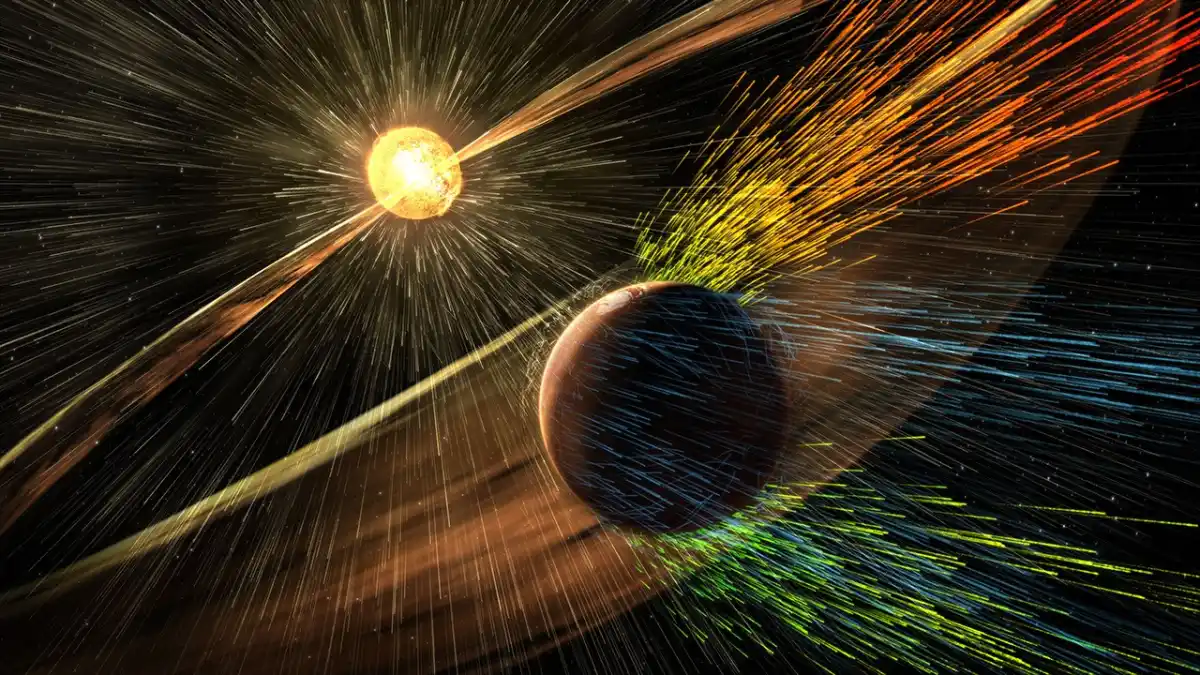
Mars can glow in ultraviolet light when energetic particles strike its upper atmosphere. The planet does not have Earth’s global magnetic field, so scientists have had to work out how those auroras are organised. A new analysis of NASA’s MAVEN data points to a familiar process—magnetic reconnection—but playing out over much smaller patches of Martian crust.
The result comes from observations made while MAVEN was studying the interaction between the solar wind and Mars. The spacecraft lost contact in December 2025 and was declared unrecoverable in June 2026, but its archive still contains years of measurements. The study, published in Nature Communications on July 23, shows why a mission can continue to produce science even after its operational life ends.
Mars has magnetic fields, just not a global one
Early in its history, Mars appears to have lost the planet-wide magnetic dynamo that once protected its atmosphere. What remains are ancient, magnetised sections of the crust. These fields are strong enough to shape charged particles locally, but they do not wrap around the whole planet in the way Earth’s magnetosphere does.
That patchwork creates an unusual auroral environment. Particles from the solar wind can travel along magnetic field lines and enter the atmosphere above the crustal anomalies. The resulting emissions are called discrete aurora. Other Martian auroras spread more broadly and are driven by different conditions in the upper atmosphere.
The magnetic process behind the new result
On Earth, many auroras are linked to the Dungey cycle. Solar-wind magnetic fields connect with Earth’s field on the dayside, energy is carried around the planet and then released when magnetic field lines reconnect on the nightside. That release sends particles down toward the atmosphere, where they produce the familiar curtains of light.
MAVEN’s measurements suggest that a scaled-down version of this cycle can occur between the solar wind and isolated magnetic fields in the Martian crust. Instead of one planet-sized magnetosphere, Mars has a collection of small magnetic environments. Reconnection can still transfer energy and guide particles, but the distances and structures are much smaller.
The word “scaled-down” is doing important work here. The researchers are not saying Mars has an Earth-like magnetosphere hidden around it. They are describing a similar physical mechanism operating in a different setting.
Why MAVEN was able to see it
MAVEN was built to study how the solar wind strips gas from Mars’ upper atmosphere. Its instruments measured particles, electric and magnetic fields, and ultraviolet emissions. By combining those observations, researchers could compare a bright auroral region with the conditions in the surrounding plasma.
No single instrument supplies the whole explanation. An ultraviolet image can show where the atmosphere is glowing, but not by itself whether reconnection supplied the energy. Particle and field measurements show how the solar wind was moving and where magnetic lines may have joined or broken. The value of the MAVEN archive is that those data streams were collected at the same spacecraft.
What the finding says about Mars’ atmosphere
Auroras are not merely a light show. They trace the routes by which energy enters the upper atmosphere. That energy can heat the gas, change its chemistry and help drive the escape of atoms and molecules into space. Mars’ thin atmosphere is the end result of many processes acting over billions of years, and solar-wind interaction is one of them.
The new work does not claim that one auroral event removed a measurable fraction of the atmosphere. It gives scientists a better physical description of how energy can cross the boundary between the solar wind and the crustal magnetic fields. That description can be added to models of atmospheric loss and to interpretations of future observations.
A mission that keeps giving after contact was lost
MAVEN’s communications failure was a loss for planetary science, but the spacecraft had already gathered a long record through different phases of the solar cycle. The aurora study is a useful reminder that the end of a mission is not always the end of its scientific life. Archived measurements can be reanalysed when new models, computing methods or observations change the questions researchers can ask.
Curiosmos has also covered discoveries that changed what we know about Mars and NASA’s work testing the antennas for a future Mars aircraft. Those stories belong to different parts of the exploration effort. Together they show how our picture of Mars is built: from the planet’s rocks and atmosphere to the signals that let spacecraft study them.
Mars’ auroras may be smaller than Earth’s, but the physics is not simple. MAVEN has given researchers evidence that even a fragmented magnetic field can reconnect with the solar wind and funnel energy into the atmosphere. The planet’s lights are faint. The process behind them is not.