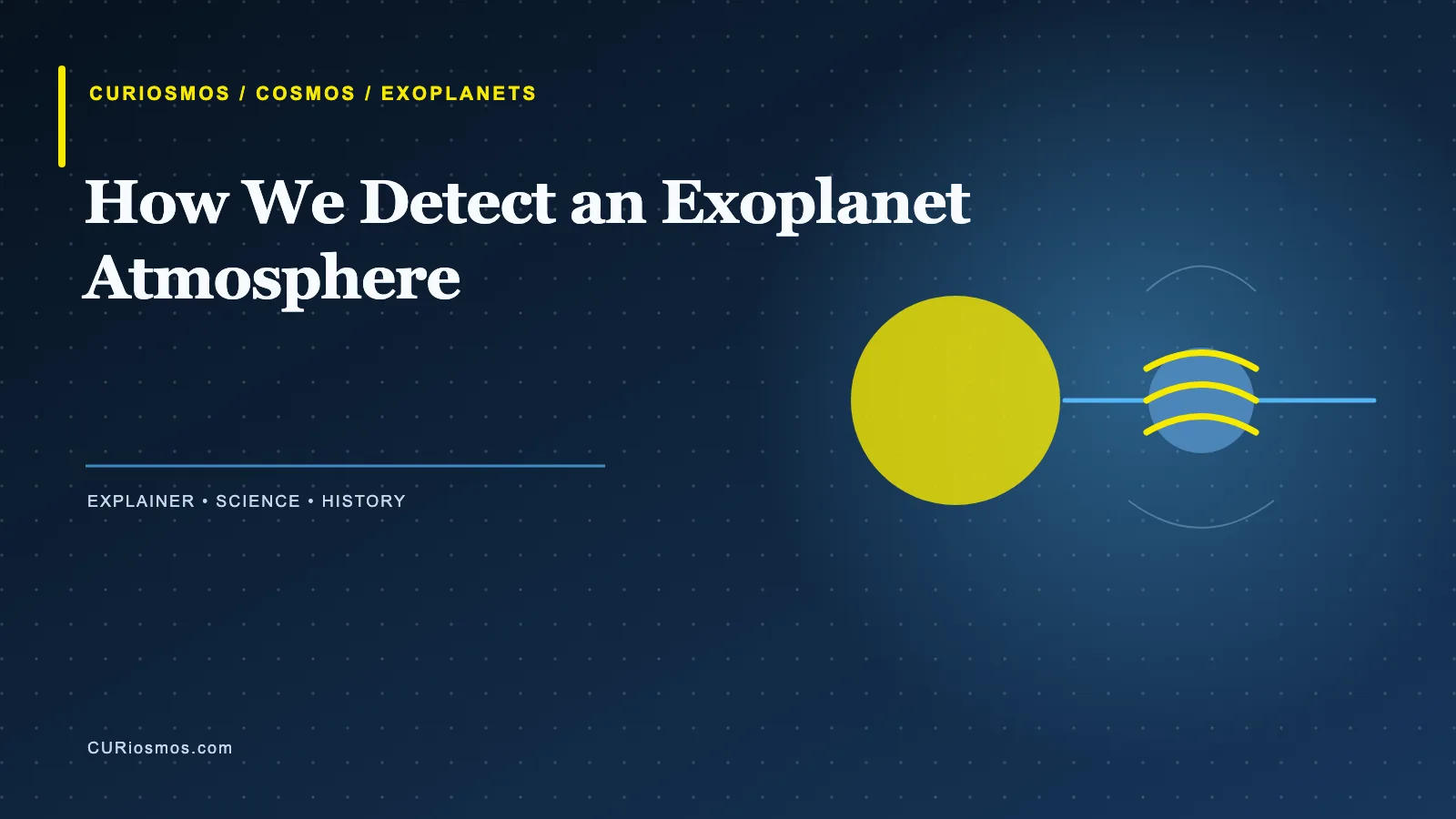
How do astronomers know an exoplanet has an atmosphere? They usually do not see the atmosphere as a separate blue shell. Instead, they measure the way the planet changes the light from its star. When the planet crosses in front of the star, some starlight passes through the atmosphere first. The molecules in that thin layer absorb particular wavelengths, leaving a pattern that a spectrograph can record.
The signal is extraordinarily small. The star may be thousands or millions of times brighter than the planet, and the atmosphere is only a narrow rim around a moving world. Astronomers observe repeated transits, calibrate the telescope and compare the result with models of gases, clouds and temperature.
Transit spectroscopy separates a planet from its star
A transit makes a star appear slightly dimmer because the planet blocks part of its surface. If the planet had no atmosphere, the dimming would be nearly the same at every wavelength. With an atmosphere, the planet can look slightly larger in colours absorbed by a gas. Hydrogen, water vapour, methane, carbon dioxide and other molecules each interact with light in different ways.
Keep exploring
Continue with Curiosmos
The difference may amount to a few parts per million. It is not enough for an ordinary visual image, but it can appear after many observations are combined. The result is a spectrum: a graph showing how the starlight changed as the planet passed across the star.
Secondary eclipses provide another view
Sometimes astronomers measure a planet as it passes behind its star. This is called a secondary eclipse. Before the eclipse, the telescope receives light from both objects. During the eclipse, it receives the star’s light alone. Subtracting the two measurements leaves an estimate of the planet’s own emitted and reflected light.
Infrared observations can reveal the planet’s temperature and the way heat moves through its atmosphere. A hot Jupiter may show the signatures of clouds, sodium or water vapour. A smaller, cooler world is far harder to study, and the absence of a clear signal does not prove that its atmosphere is empty.
Clouds can hide the chemistry
A planet’s atmosphere is not a transparent laboratory jar. High clouds and hazes can flatten the spectral features beneath them. Photochemical reactions may create particles that absorb light across a broad range of wavelengths. The host star can also vary, producing changes that resemble or obscure a planetary signal.
Astronomers therefore test several models rather than announcing a gas from one suggestive bump. They compare instruments, observe different transits and examine whether the chemistry makes sense alongside the planet’s temperature, gravity and distance from its star.
Three kinds of light carry the evidence
Transmission spectroscopy studies starlight that filters through an atmosphere during a transit. Emission spectroscopy looks at heat radiated by the planet, often during a secondary eclipse. Reflected-light measurements examine the starlight bounced back toward the telescope. Each method samples a different part of the atmosphere and brings its own blind spots.
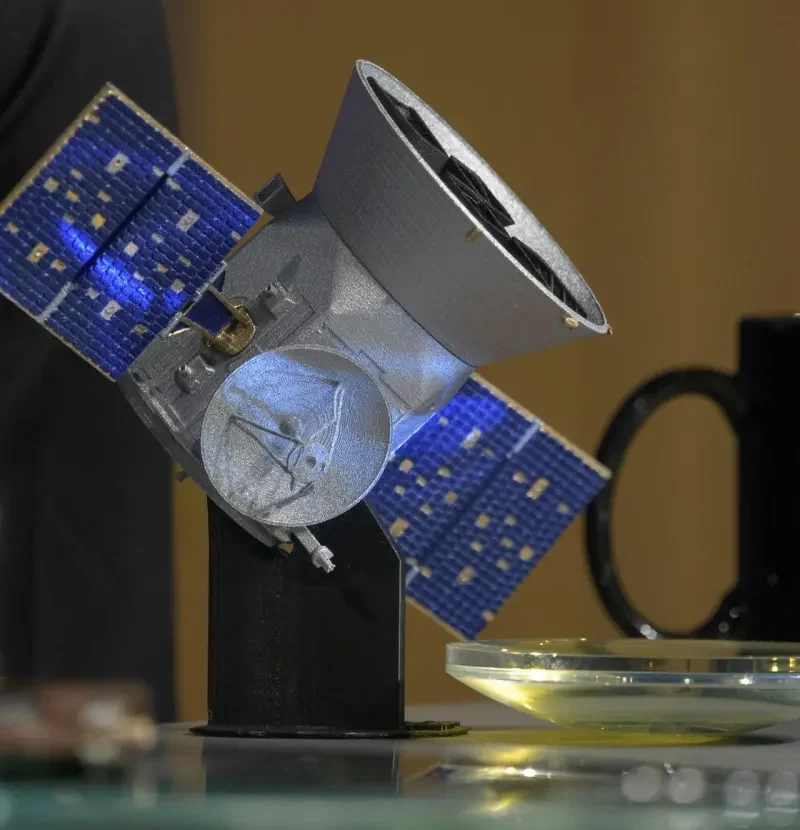
The James Webb Space Telescope has made these measurements for several large exoplanets, while future observatories are being designed to study smaller worlds. The work is demanding because the planet’s signal is tiny compared with the light from its star. Stellar spots and flares can imitate a chemical feature, so researchers monitor the star itself and repeat observations whenever possible.
Atmospheric chemistry also changes with altitude. A gas may be visible high above a cloud deck while remaining hidden below it, and the same molecule can behave differently under intense ultraviolet radiation. This is why an atmospheric spectrum is interpreted with models of temperature, pressure and circulation rather than read as a simple ingredient list.
What a detection really tells us
Finding an atmosphere does not mean finding a second Earth. A thick envelope of hydrogen, a cloud deck over a hot gas giant and a thin carbon-dioxide atmosphere are all atmospheres, but they support very different environments. Even the detection of water vapour is not proof of an ocean or life.
The scientific value comes from putting the result in context. Atmospheric measurements can show how planets form, how they lose gas, and how a distant world differs from the planets around our Sun. Future observatories will push the technique toward smaller rocky planets, but every claim will depend on the same patient work: collecting faint light, checking the instrument and letting the spectrum set the limits.
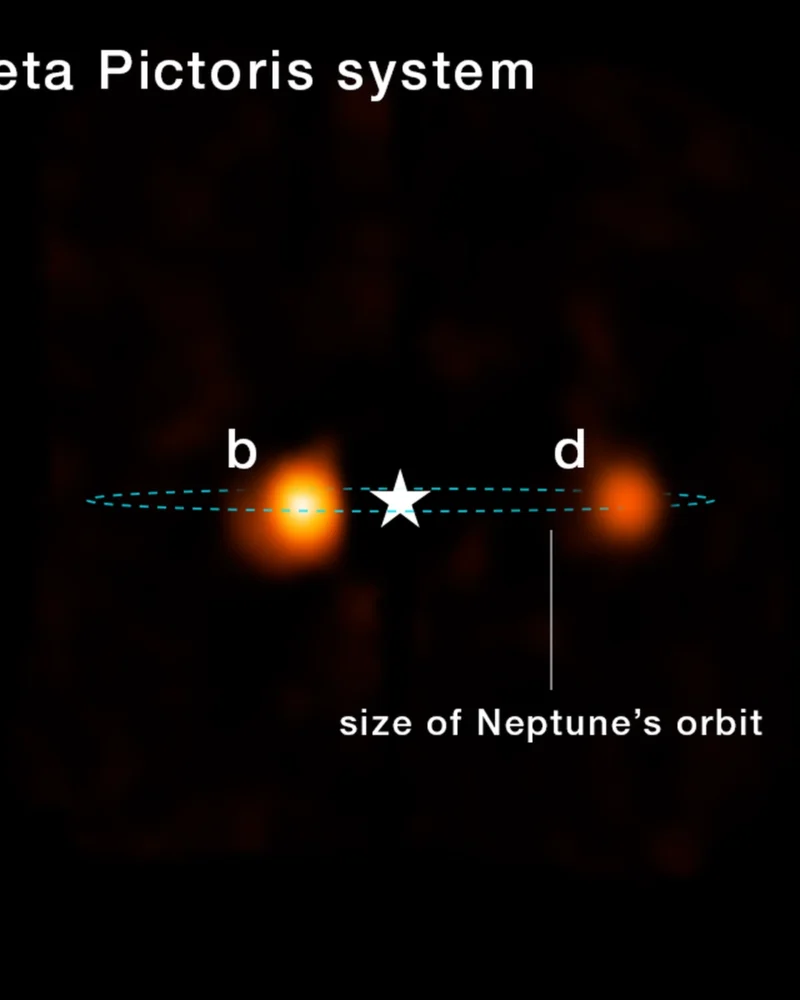
Our report on Webb’s hidden planet in Beta Pictoris shows how a detection becomes a story only after the atmosphere, orbit and host star are considered together.
Sources and further reading: NASA Science: Exoplanets; NASA: An exoplanet atmosphere explained.