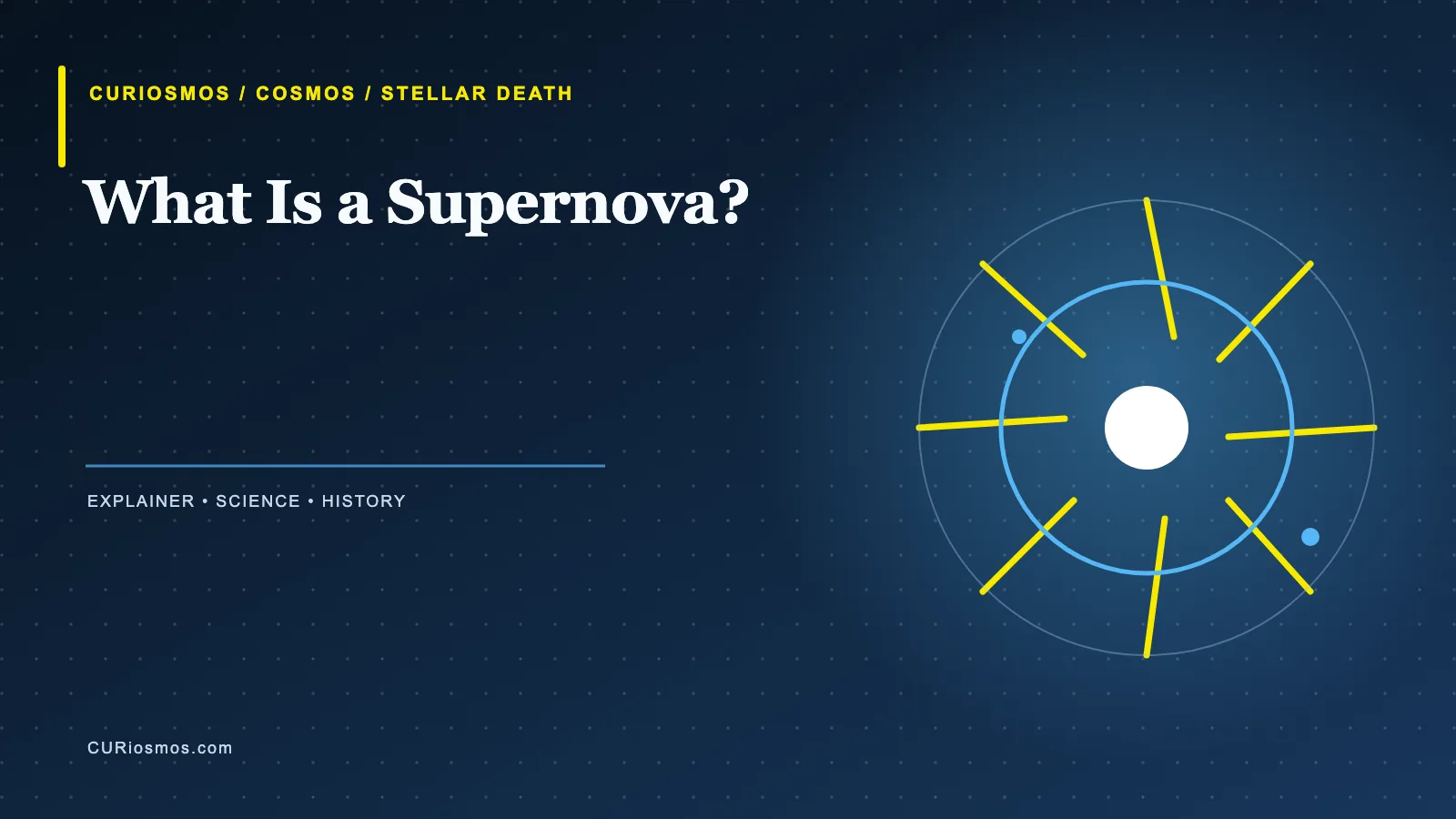
What is a supernova? It is a stellar explosion powerful enough to briefly outshine an entire galaxy. Some supernovae mark the collapse of massive stars. Others happen when a dense white dwarf in a binary system accumulates too much material or merges with another white dwarf. The two routes are different, but both release an extraordinary amount of energy and enrich space with material from the star.
The explosion is not simply a large firework at the surface. In a massive star, the core has been building heavier elements through nuclear fusion. When the core reaches iron, fusion can no longer provide the energy needed to support the star against its own gravity. The core collapses in seconds, while the outer layers are thrown outward.
Core collapse leaves a compact remnant
As the core collapses, protons and electrons are forced together and form a dense mixture dominated by neutrons. The collapsing material rebounds and launches a shock wave through the star. The details are complicated, and the shock can stall before neutrinos and other processes help revive it. When the explosion succeeds, the star’s outer layers race into space.
Keep exploring
Continue with Curiosmos
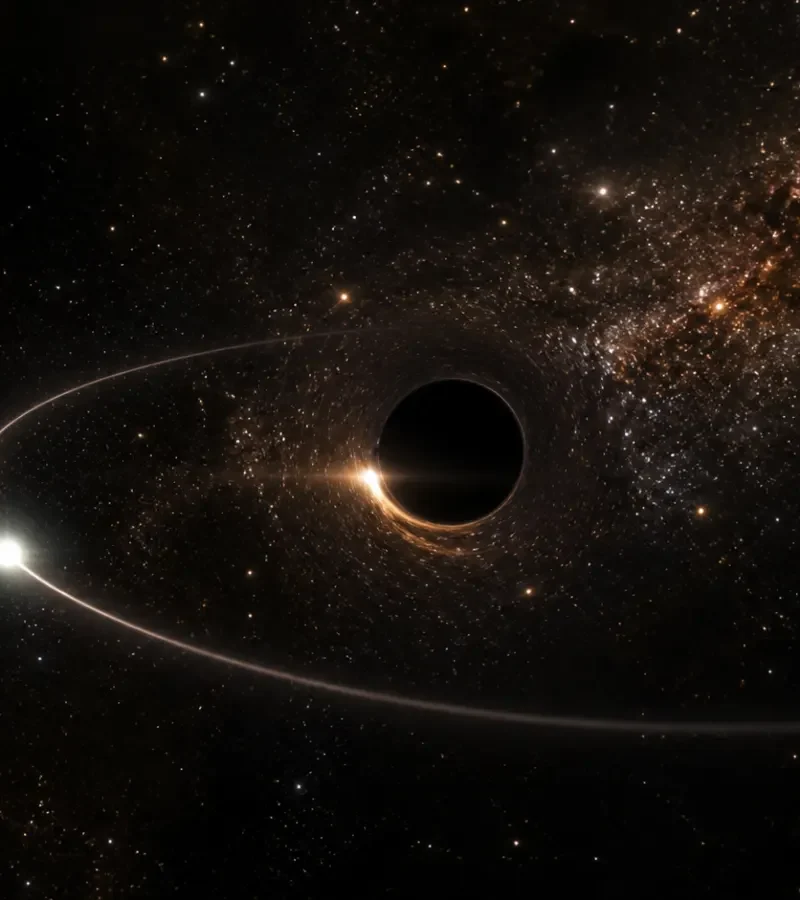
The remnant depends on the mass left in the core. A neutron star can remain behind, packed into a sphere roughly the size of a city. If the core is heavy enough, it may collapse further into a black hole. The remnant can power radiation, winds and jets that shape the expanding debris around it.
White dwarfs can produce a different kind of blast
A Sun-like star ends its life as a white dwarf, the hot, dense core left after its outer layers have been shed. In a binary system, the white dwarf can pull material from a companion. If enough mass accumulates, the conditions inside the white dwarf can trigger a runaway thermonuclear reaction. Two white dwarfs can also merge and produce a Type Ia supernova.
Type Ia explosions are useful to astronomers because their peak brightness follows a relationship that can be calibrated. They help measure distances to galaxies and investigate the expansion of the universe. They do not leave the same kind of neutron-star remnant as a core-collapse event.
The remnant keeps expanding
After the flash fades, the story continues. The expelled gas forms a supernova remnant, a growing shell of shock-heated material. It sweeps up interstellar gas and can accelerate cosmic rays. The remnant may remain visible for thousands of years, giving astronomers a record of the original explosion and the environment around the star.
The Crab Nebula is a familiar example. Chinese observers recorded the supernova in 1054, and the expanding cloud now surrounds a rapidly rotating neutron star. The remnant’s filaments, magnetic field and pulsar wind show how a compact object can keep shaping space long after the star itself has vanished.
Stars return material to the cosmos
Supernovae forge and distribute many elements. The blast mixes those ingredients into gas that can later become new stars, planets and rocky worlds. Not every element is made in the same way, and some of the heaviest elements require other violent events, but stellar explosions are a major part of the cosmic recycling process.
Two main kinds of stellar explosion
Core-collapse supernovae begin when a massive star can no longer support its own weight. The core falls inward, rebounds through the star’s outer layers and leaves a neutron star or, in some cases, a black hole. Type Ia events begin with a white dwarf in a binary system and are driven by a thermonuclear runaway. Their light curves and spectra allow astronomers to tell the categories apart.
Because light travels at a finite speed, a supernova is also a look into the past. A blast in a galaxy 10 million light-years away happened 10 million years ago from our point of view. Telescopes can study the changing brightness, spectra and expanding remnant, while neutrino detectors may capture an early signal from a nearby core-collapse event.
The first hours and days are especially important. The colour of the light changes as the ejecta expand and cool, and specific spectral lines reveal which elements have reached the surface. Astronomers compare those observations with computer models, but the models are tested against real remnants for decades. A supernova is a brief event that leaves a long scientific record.
A supernova is therefore both an ending and a beginning. It marks the death of a star, but it also changes the material from which future systems may form. When telescopes study a remnant, they are looking at the remains of one star and the raw ingredients of many possible futures.
The same telescope can follow the aftermath in very different wavelengths. Curiosmos has covered how Chandra traces a black-hole jet in X-rays, a useful reminder that cosmic explosions are often understood by combining more than one kind of light.
Sources and further reading: NASA Hubble: Stellar explosions; NASA Space Place: What is a supernova?.