Why do planets orbit the Sun instead of falling into it? The short answer is that gravity pulls the planets inward while their sideways motion carries them forward. The combination produces a curved path. A planet is always falling toward the Sun, but it keeps missing because it is moving across the Solar System fast enough to follow the curve of the space around the star.
Imagine throwing a ball from a high mountain. At an ordinary speed, it lands nearby. Throw it faster and it travels farther. If it could be thrown fast enough, the ground would curve away beneath it at the same rate that gravity pulled it downward. The ball would be in orbit. A planet is doing the same thing on a much larger scale.
The Solar System began with motion already built in
The planets formed from a rotating disk of gas and dust around the young Sun. Collisions and gravity gathered material into larger bodies, but the original disk’s motion did not disappear. As the planets grew, they kept their orbital momentum. The Sun contains most of the Solar System’s mass, so its gravity became the dominant force shaping the paths of the remaining bodies.
Keep exploring
Continue with Curiosmos
Gravity weakens with distance, which is why a planet’s orbit depends on how far it is from the Sun. A world close to the Sun must move faster to remain in orbit. Farther out, the orbital speed is lower and the journey around the Sun takes longer.
Orbits can be circles, ellipses or something else
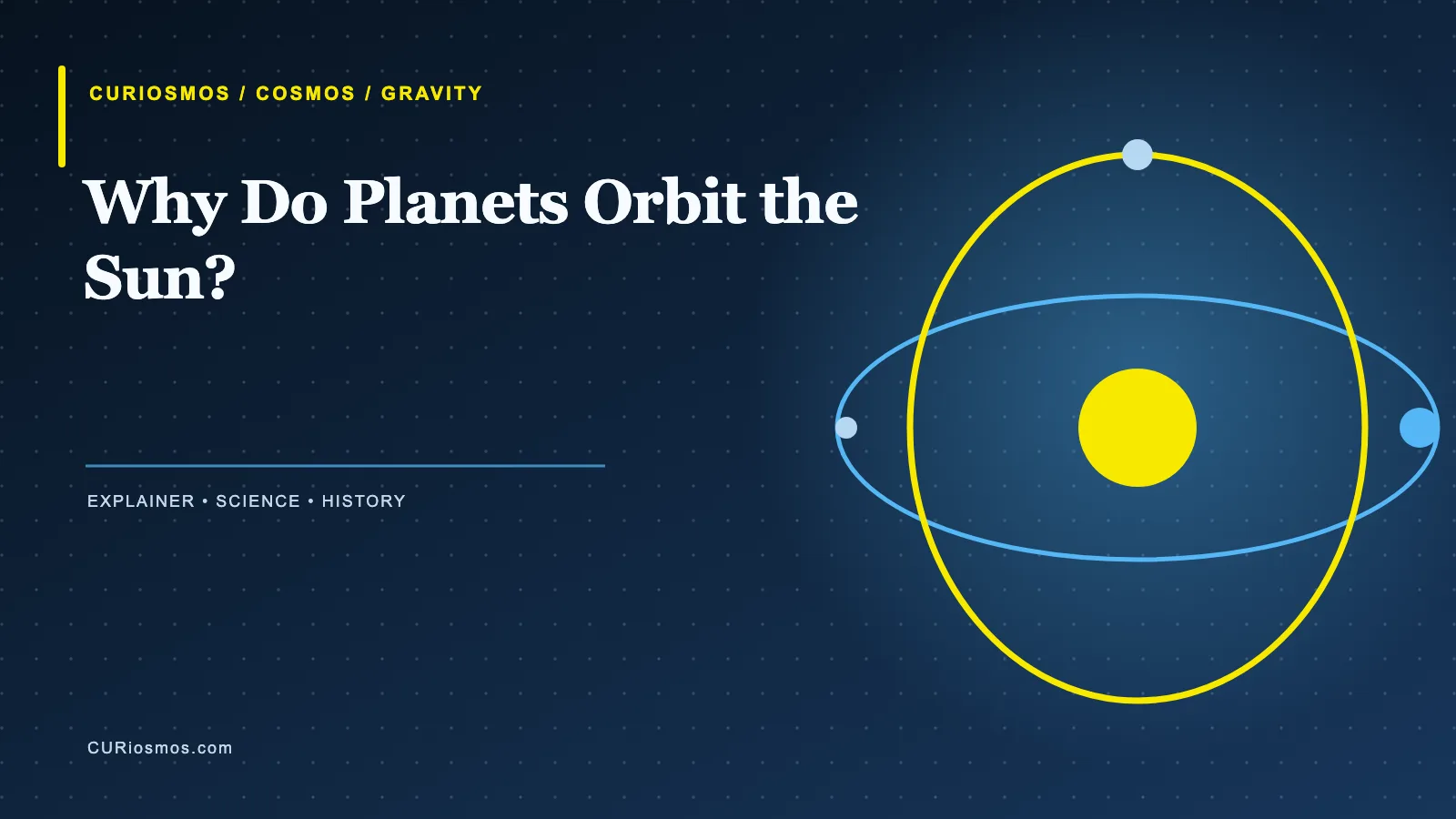
Most planets follow paths that are close to circles, but the precise shape is an ellipse. The Sun sits at one focus of that ellipse rather than exactly at the centre. A planet speeds up when it is closer to the Sun and slows down when it is farther away, while sweeping out equal areas in equal times.
Small changes can alter an orbit. A close encounter with a planet, a collision, pressure from sunlight or the slow influence of many bodies can change a spacecraft or asteroid’s path. The planets’ orbits are stable over enormous periods, but stable does not mean perfectly frozen.
Why the planets do not spiral into the Sun
In empty space, there is very little friction to drain a planet’s orbital energy. The planet does not rub against a thick atmosphere or a solid surface, so its sideways velocity continues. The Sun’s gravity constantly bends the path, but it does not simply pull the planet straight inward.
There are small effects. The solar wind, radiation and the gravity of other planets can change an orbit slightly. Over millions or billions of years, those changes matter to the architecture of the Solar System. They are not enough to make Earth suddenly drop into the Sun.
What an orbit really is
An orbit is not a track or a force that pushes a planet around. It is the result of motion through a gravitational field. The planet’s velocity and the Sun’s pull create a path that can repeat for a very long time. If the planet lost enough sideways speed, it would fall inward. If it gained enough, it could move into a wider orbit or escape.
This balance is why spacecraft can travel between worlds. Mission planners change a probe’s speed and direction with rockets, then let gravity carry it along a new path. The Solar System is full of curved routes, not straight lines, and every planet follows one of them.
The Sun and planets orbit a shared centre
The Sun does not remain perfectly still. Every planet pulls on it, so both bodies orbit a shared centre of mass called the barycentre. For Jupiter and the Sun, that point can lie just outside the Sun’s surface; for Earth it remains deep inside the Sun. The effect is small in the sky, but it is part of the same gravitational exchange that keeps the system together.
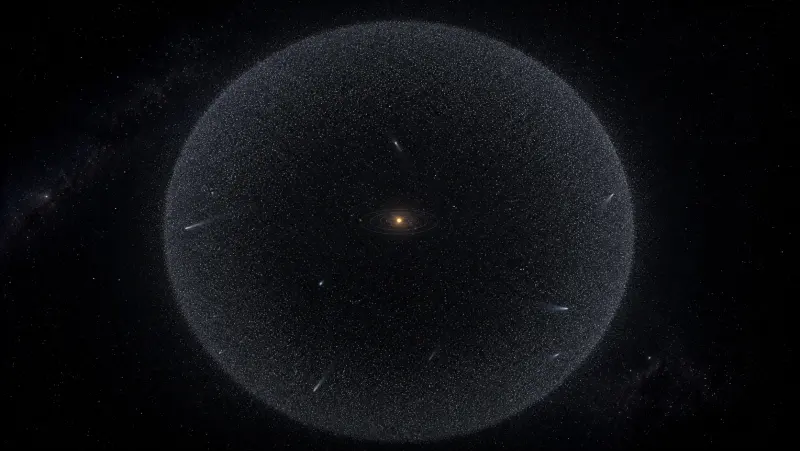
Planets also tug on one another. Those perturbations create small changes in eccentricity and orientation over time. Asteroids and comets feel the same nudges much more dramatically, especially near a giant planet. A close encounter can send a small body toward the inner Solar System, out toward the Oort Cloud or onto a new orbit altogether.
Kepler’s laws describe the pattern, while Newton’s gravity explains why it occurs. The same equations can predict an eclipse, guide a spacecraft and show when a comet will return. They do not make the Solar System static; they let researchers calculate how its moving parts interact and where a small change could matter.
The same gravitational rules explain why a spacecraft can change its path with a carefully timed flyby. Our guide to testing hardware for a Mars aircraft shows the practical side of navigating that moving system.
Sources and further reading: NASA Science: The Solar System; NASA: Basics of spaceflight.