In the ruins of a deliberately sealed building in southwestern Spain, archaeologists have uncovered a bronze chariot unlike any previously found on the Iberian Peninsula. The object was recovered at the Casas del Turuñuelo site in Guareña, Badajoz, during the latest excavation campaign led by the Institute of Archaeology of Mérida, the CSIC, and the Junta of Extremadura.
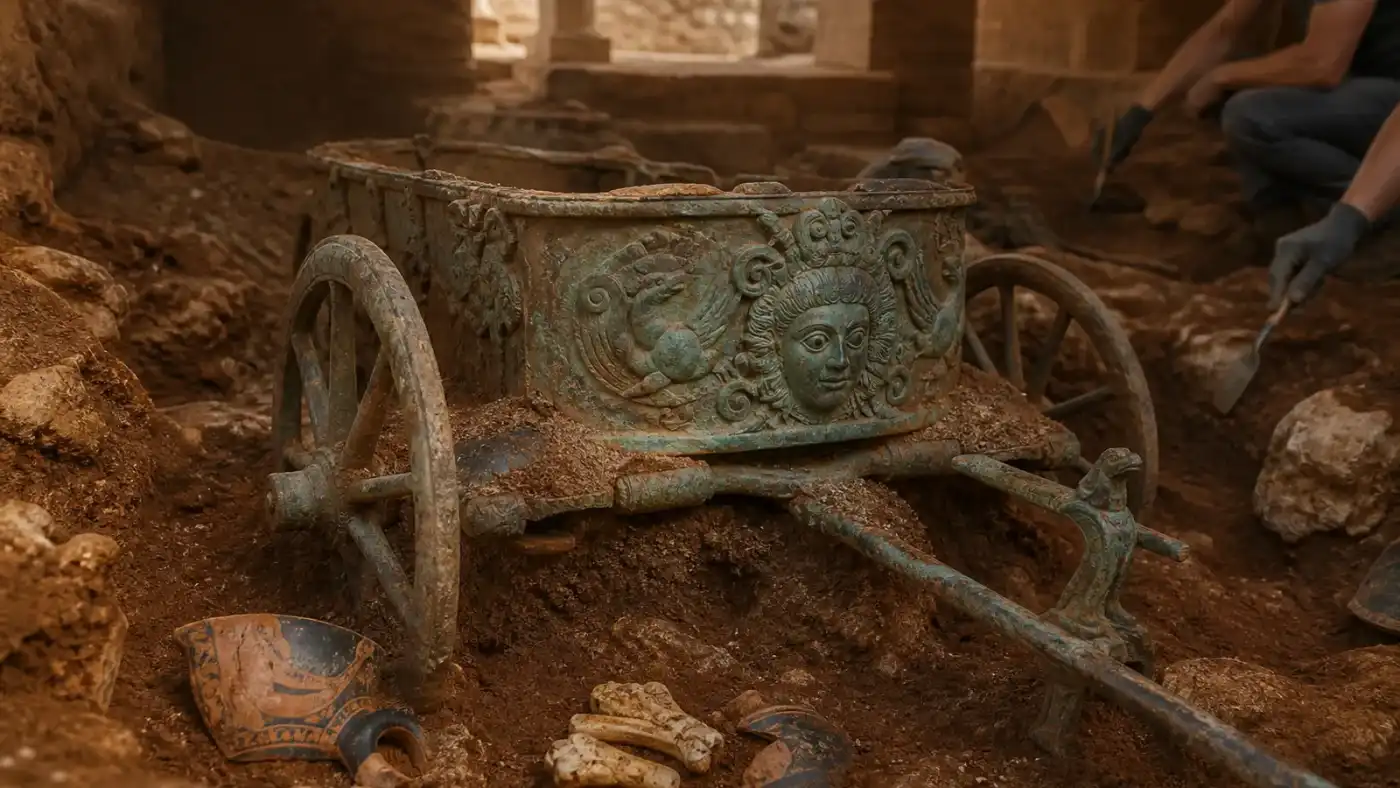
The chariot is not a plain vehicle. Its bronze box carries a rich figurative decoration. On the front is a representation of Achelous, the river deity known from the ancient Mediterranean. The sides show two griffins—mythical creatures with the head of an eagle and the body of a lion. At the ends, human figures with raised arms appear to support the structure, which rests on two decorated wheels.
The announcement describes the find as exceptional because the combination of structure and decoration has not been seen before in Iberia. The closest known parallels come from ancient Etruria in central Italy, raising the possibility that the chariot travelled west through the trade networks that connected Tartessos with the wider Mediterranean.
Keep exploring
Continue with Curiosmos
A vehicle, a ritual object, or both?
Archaeologists have not yet settled the chariot’s function. Its location offers an important clue. It was found beside a room known as the banqueting chamber, associated with the final feast held by the community before the building was closed. The excavation team has suggested that the object may have played a role in ritual activity linked to banquets, although conservation and analysis are still underway.
That uncertainty is not a weakness in the discovery. Archaeological interpretation often begins with a well-preserved object and a set of competing possibilities. The chariot may have been used in a procession, displayed during ceremonies, or brought into the building as a prestigious object whose meaning mattered more than its practical use.
The ancient owners seem to have treated the building’s final closure as a significant event. The main structure was intentionally sealed beneath a large tumulus at the end of the fifth century BC. The monument measures about 90 metres across and six metres high, and its protected remains have preserved an unusual concentration of architecture and artefacts.
What the imports reveal
The chariot was found alongside objects that make the site’s international connections visible. Excavators recovered pottery from the Attica region of Greece, an Egyptian alabaster vessel, and carved ivories decorated with warriors, animals, and plant motifs. These materials are not proof that every object was made abroad, but together they show that the community at Turuñuelo participated in a Mediterranean world of exchange.
Tartessos is known from ancient references and from archaeology in the western Iberian Peninsula. The culture flourished in the first millennium BC, drawing on local traditions while maintaining contacts with Phoenician and Greek traders and with communities farther east. Casas del Turuñuelo is helping archaeologists move beyond the broad label of “Tartessian” by exposing how buildings were used and how objects moved through the region.
The bronze chariot is especially valuable because it links several kinds of evidence. Its decoration points toward a shared visual language. Its materials and construction may reveal where it was made. Its location may explain how it was used. The imported pottery, alabaster, and ivory place the whole discovery inside a network rather than treating it as an isolated treasure.
A site that keeps changing the picture
Casas del Turuñuelo has been excavated since 2015, and each campaign has added a new layer to the story. Earlier work revealed evidence of an enormous animal sacrifice, human representations, an engraved slate with a southern Palaeohispanic alphabet, and what researchers described as the oldest Greek marble altar in the western Mediterranean.
The new chariot does not replace those discoveries. It connects them. A wealthy community capable of importing luxury objects, staging large feasts, and closing an important building in a carefully planned ceremony had access to resources and ideas moving across the sea.
Much of the work now begins after the soil is removed. Conservators must stabilise the bronze, document every fragment, and compare the decoration with Etruscan examples. Archaeologists will also study the building’s rooms, circulation routes, and deposits to work out whether the chariot was used before the final ceremony or placed there specifically as part of the closure.
The answers may change how scholars understand Tartessian identity. Rather than a culture cut off at the western edge of Europe, Tartessos appears increasingly connected to the same commercial and symbolic currents that shaped the central Mediterranean.
Curiosmos has previously looked at the engineering and cultural meaning of the world’s great stone monuments and what the Pyramid Texts reveal about ancient Egyptian religious practice. Casas del Turuñuelo offers a different kind of evidence: not a royal monument designed to last forever, but a building whose final ceremony was preserved because the people who used it chose to bury it.
Sources
- Junta de Extremadura, “El hallazgo en el Yacimiento Casas del Turuñuelo de un carro de bronce único en la Península…,” June 24, 2026: https://www.juntaex.es/w/20260624-el-hallazgo-en-el-yacimiento-casas-del-turunuelo-de-un-carro-de-bronce-unico
- CSIC/Construyendo Tarteso project materials linked from the official release.