Göbekli Tepe excavations have uncovered rectangular buildings that may have been homes. The find adds an everyday setting to a place long known for its monumental pillars and enclosures, giving researchers new evidence about how people used the site. How do these rooms fit alongside the grinding stones, water channels and other traces of daily life? Our explainer on whether people lived at Göbekli Tepe brings that evidence together.
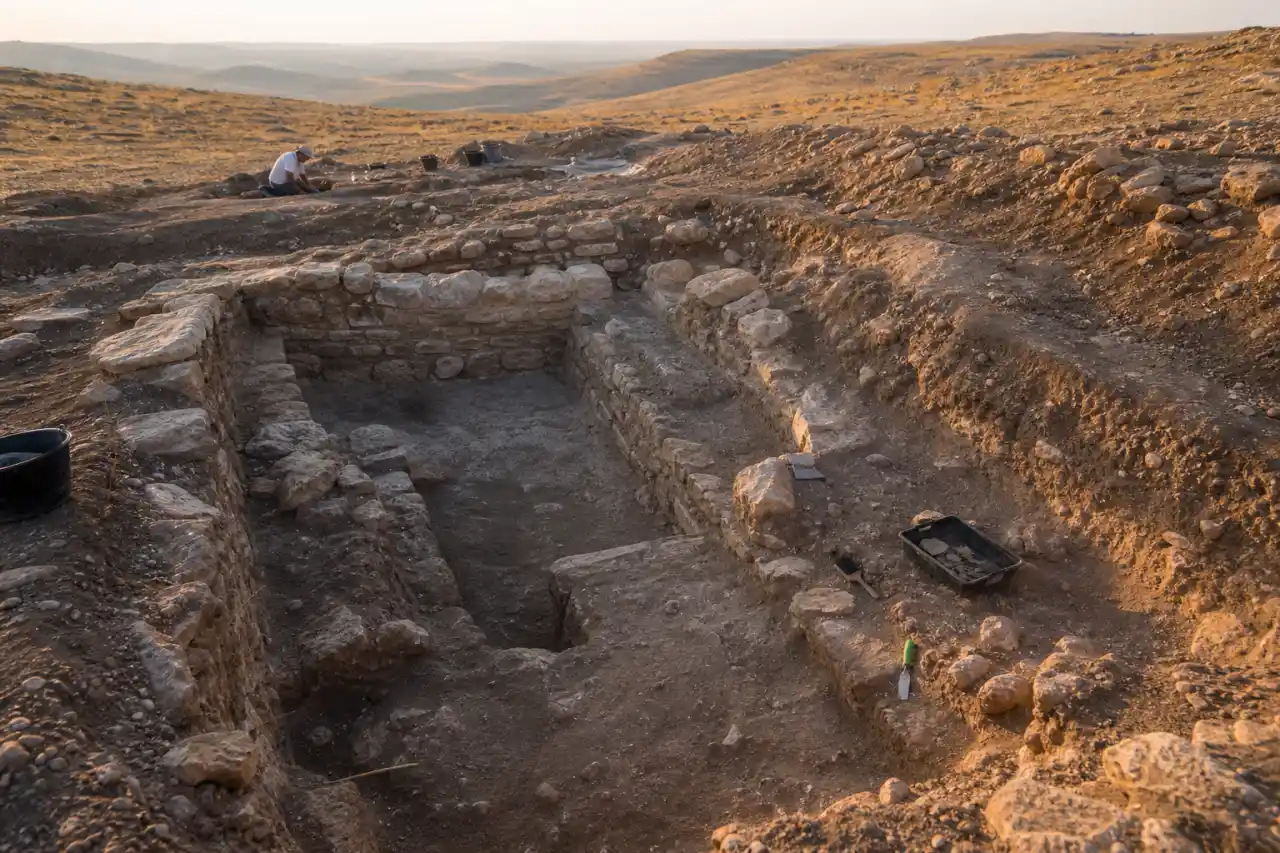
The discovery was reported on August 13 by Arkeonews, which cited information from the excavation team and Anadolu Agency. The buildings were found in a newly opened area north of the site’s main protected zone. They belong to what researchers describe as Göbekli Tepe’s second phase of occupation and were lying close to the modern surface, where erosion had removed much of the upper part of the ancient walls.
A new part of the mound is being opened
The excavation covers roughly 1,500 square metres. Olive trees that had grown across the area were carefully relocated, allowing the team to work across a broad strip of ground rather than opening a few small trenches. Archaeologists are moving horizontally through the upper deposits first so they can record how the buildings were arranged in relation to one another.
That approach has already produced results. Rectangular plans appeared almost immediately below the surface, and in some places the team has reached the floors of the buildings. Their shallow position does not mean the structures were recently built. It reflects the long erosion of the mound, which wore away the higher parts of the walls and left the surviving architecture close to the present ground level.
The early plan is important because it gives researchers a chance to study more than a single spectacular monument. A wide excavation can show whether the buildings were isolated, grouped into a neighbourhood or arranged around larger communal spaces.
Why archaeologists are considering houses
The newly exposed buildings contain fewer large stone pillars than the monumental enclosures for which Göbekli Tepe is known. Their interior arrangements also appear more compatible with ordinary activities than with the highly formal spaces at the centre of the mound.
That is why the excavation team is considering a domestic interpretation. The buildings may have been places where people slept, prepared food, stored materials and carried out the less visible work of maintaining a community. The conclusion is not final. Walls and floor plans can suggest how a space was used, but they cannot prove its function on their own.
The decisive evidence may come from the floors. Researchers plan to examine soil and sediment samples for tiny traces of plant material, food preparation, ash, animal remains and other residues left behind by human activity. Microscopic evidence can reveal what happened inside a room even when the larger objects have disappeared.
Göbekli Tepe was not only a place of monuments
The possibility of more homes does not erase Göbekli Tepe’s monumental character. It makes the site more complicated—and more useful for understanding the people who built it.
For years, public discussions often presented the site as an isolated ritual centre raised by mobile hunter-gatherers. Archaeological work has steadily made that picture harder to maintain. Smaller domestic structures were already known at Göbekli Tepe, and researchers working across the wider Taş Tepeler region have documented settlements containing both communal buildings and spaces connected with daily life.
Curiosmos has previously examined what Göbekli Tepe tells us about the origins of civilization and the way memory was carved into its stone. The new excavation adds a practical dimension to those questions. Monumental architecture requires planning, labour and shared beliefs, but it also requires people to eat, sleep, repair tools and raise children somewhere nearby.
If the rectangular buildings prove to be residences, they would help place those activities within the same landscape as the famous enclosures. Göbekli Tepe would look less like a site visited only for ceremonies and more like a settlement in which different kinds of buildings served different purposes at the same time.
The shape of the buildings reflects a changing society
Architecture at Göbekli Tepe changed over the centuries. Earlier monumental buildings are generally round or oval, with tall T-shaped pillars and elaborate animal imagery. Later structures are smaller and more rectangular, and the pillars inside them are fewer and shorter.
That change is not simply a matter of design. Rectangular rooms can be divided, connected and used more efficiently than circular spaces. They can support storage areas, work surfaces and repeated household routines. A shift in building form may therefore record a shift in how groups organized their time and their relationships.
Nearby Karahantepe and the other Taş Tepeler sites show why the wider region matters. No single mound contains the complete story. Together, the sites reveal communities experimenting with new ways to gather, build, remember and remain in one place.
What the excavation still has to establish
The newly uncovered buildings are at an early stage of investigation. The team still needs to expose their full outlines, document entrances and internal features, and study the sediments sealed within the floors. Dating evidence will also be important, especially if the buildings can be tied to a particular phase of Göbekli Tepe’s long occupation.
Researchers will also have to distinguish domestic spaces from communal or specialised buildings. A rectangular plan and a small number of pillars are clues, not proof. A building used for food processing, craft work or gatherings could share some of the same features as a house.
That caution does not make the discovery less significant. It is precisely because the interpretation is still open that the excavation can teach us something. The floors and deposits may show whether people cooked, slept, stored food, worked stone or carried out activities that have not yet been imagined.
A fuller picture of the people behind the pillars
Göbekli Tepe changed archaeology because it showed that large-scale construction and complex symbolic traditions existed before the cities and states usually associated with civilization. The new rectangular buildings add a quieter but equally important question: where did the builders live while that work was taking place?
The answer may be emerging just beneath the surface north of the main enclosures. If further excavation and analysis confirm that these were homes, the site will no longer be understood only through its monumental stone. It will also be read through the rooms where people carried out the ordinary routines that made monumental projects possible.
That is the real importance of the discovery. It does not replace the story of Göbekli Tepe’s pillars. It gives that story a human setting.