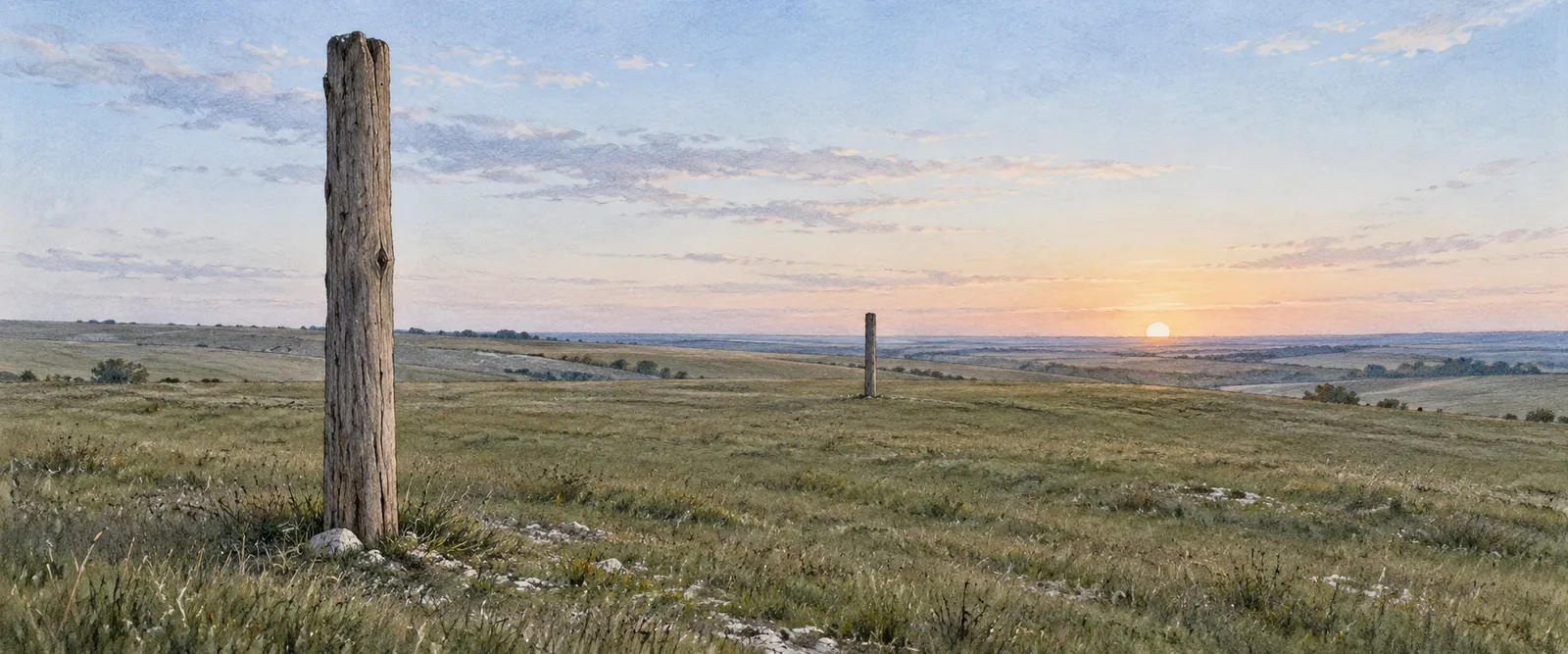
The wooden posts have gone. What survived at Bulford, near Stonehenge, were the holes dug to hold them and the traces left around them. By reconstructing the sky and horizon, researchers have proposed that two posts about 120 metres apart marked the Sun at the turning points of the year.
Wessex Archaeology reported the Bulford solstice alignment in June 2026, drawing on excavations carried out from 2015 to 2017. The team associates the features with activity around 2950 BC. This places them roughly alongside Stonehenge’s earliest earthworks, well before its famous stone setting.
Two poles on open ground might seem modest beside a monument built from immense stones. Picture them as markers for a gathering, though, and their purpose becomes easier to imagine. A person looking along the line could watch a sunrise appear at an anticipated point on the horizon.
One axis, two turning points
The excavation recorded 48 pits. Wessex Archaeology describes an alignment of two wooden poles with midsummer sunrise and, in the opposite direction, midwinter sunset. Researcher Fabio Silva reconstructed the ancient sky and landscape; the reported alignment falls within about one degree.
Those are opposite views along one axis. They need not represent two separate observing instruments. The same line can be followed towards the rising summer Sun and towards the setting winter Sun from different ends.
The report also describes pottery, animal bone, worked flint and charcoal in the surrounding pits, interpreted as traces of gatherings. A disc-shaped flint knife has been considered in relation to possible solar symbolism. The researchers propose a solar connection for the knife, although its shape leaves room for other interpretations.
How can a hole preserve a view of the Sun?
An archaeological alignment begins with positions on the ground. Once two features have been surveyed, their relative locations establish a direction. The next question is whether that direction matches an astronomical event as it would have appeared from the site.
The horizon is part of the calculation. A hill can delay the first appearance of the Sun; a lower horizon gives a different view. Looking up a modern compass bearing for sunrise is therefore less informative than reconstructing the local skyline.
Time enters the calculation too. The geometry of Earth’s rotation and orbit changes slowly, so a reconstruction for the third millennium BC has to use the ancient sky rather than simply project today’s solstice position backwards.
The reported one-degree agreement gives a scale for the result, but its interpretation still depends on the archaeological context. With numerous pits available, the choice of which features form the proposed line matters. Dating and the relationship between the post settings help determine whether they belonged to the same arrangement.
Before the stones, people were already watching
English Heritage’s account of Stonehenge explains how the monument’s main axis relates to the solstices. The winter setting Sun was directed towards its largest trilithon, giving the midwinter view a particularly imposing frame.
The wider landscape around Stonehenge helps place a find like Bulford in context. Bulford offers a possible earlier expression of that interest using wood. It should not be described as older than every part of Stonehenge: the distinction is between the early earthworks and the later, celebrated stone arrangement.
Nor does an alignment by itself establish what a gathering meant. The solstice could matter through seasonal rhythms, communal observance or beliefs that archaeology can only partly recover. Pottery and food remains help connect the proposed solar alignment with people gathering at the site.
Imagine waiting beside the posts for the midsummer Sun to rise along that line. If the alignment was deliberate, two pieces of timber could have marked a shared moment in the year. The wood has disappeared; the postholes preserve the direction researchers are now investigating.