A prayer can disappear as soon as it is spoken. An ear carved in limestone can remain for thousands of years.
Ancient Egyptian worshippers left stones covered with ears at temples, turning the wish to be heard into something a deity could be shown. Some are small and roughly worked. Others carry a donor’s name and an inscription identifying the god or goddess who was expected to listen.
These Egyptian ear stelae preserve requests made by individuals, far from the scale of royal monuments. What if the divine was listening, but needed to be reminded where to direct its attention?
Four ears for a goddess
One particularly clear example survives in Turin’s Museo Egizio. The stela dedicated by Usersatet is just 14 centimetres by 17.5 centimetres, with a depth of five centimetres. It is limestone, dates to the New Kingdom and comes from Deir el-Medina, near ancient Thebes.
Two pairs of ears accompany an inscription naming Nebethetepet. The museum translates the description as “she who hears prayers, lady of the sky.” The goddess’s ability to hear is central to the dedication.
The four ears need not be an anatomical portrait. Repetition can make a request emphatic: listen, and keep listening. That is an interpretation of how the image works, rather than a translation of a hidden message. The surviving words identify the intended listener; they do not tell us precisely what Usersatet asked her to do.
That missing request leaves room for curiosity. Was the offering made in hope, in thanks, or as part of a longer relationship with the goddess? The object record cannot choose between those possibilities.
A temple where Ptah heard prayers
A second object takes us to Memphis. The Global Egyptian Museum’s record for a votive stela to Ptah describes a man making an offering, an inscription naming the god and the hearing-ear motif.
It belonged to a group of votive deposits excavated beneath a Ramesside building in the temple precinct. This setting supplies information that a loose object could not: several offerings were connected with the same place of worship.
A deposit is still only one stage in an object’s history. Its location when excavated does not necessarily tell us where it first stood, how long it remained visible or when it was gathered with other offerings. Those distinctions affect how we imagine worshippers encountering it.
What the group does show is that the ear motif was repeated in a communal religious setting. The request for divine attention had a recognisable visual form.
The ear that became the whole offering
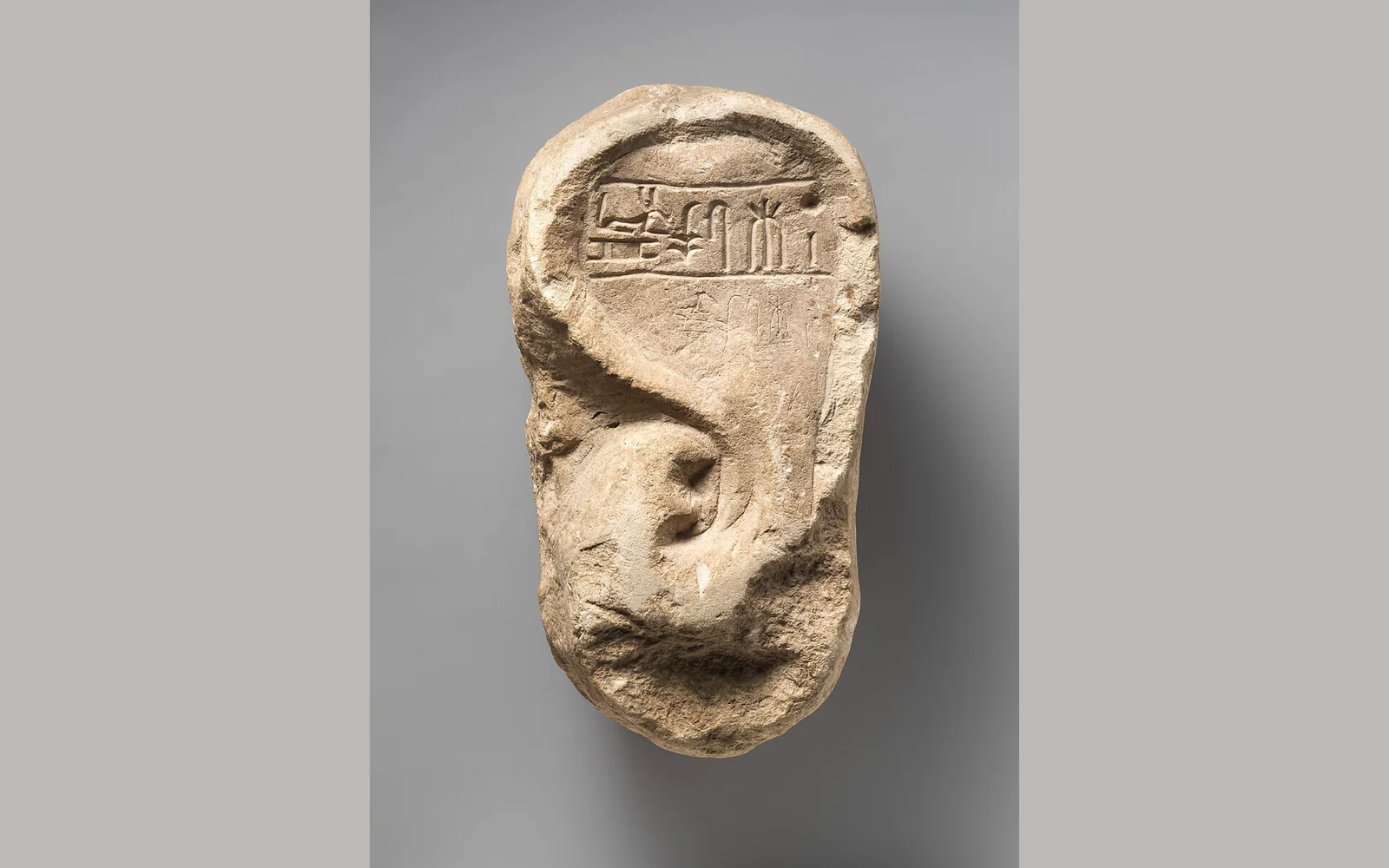
The Metropolitan Museum of Art holds a different version: an oversized model ear bearing Ramessumerysutekh’s name, dated to about 1300–1200 BCE. The stone object is nearly 30 centimetres high and weighs 5.9 kilograms.
The Met links these models with ear stelae and interprets them as expressions of access to the divine. Ptah was one recipient, but the practice also involved other deities. A variety of workmanship, including rough and uninscribed offerings, suggests participation beyond a narrow circle of wealthy donors.
That does not allow us to read someone’s income directly from a carving. A rough finish might reflect resources, skill, intention or circumstances we cannot recover. It does, however, warn against imagining ancient Egyptian religion entirely through the most expensive objects.
Nor should a stone ear automatically be treated as a request to cure deafness. The Met notes that the represented body parts suggest a connection with the divine, rather than simply an ailment affecting that particular organ.
A prayer beyond the royal tombs
Royal tombs dominate many accounts of Egypt, including the story of Tutankhamun’s burial. Ear offerings open a different window: a named person directing a request towards a named deity.
We cannot hear the words spoken when these stones were left. But we can compare their inscriptions, materials and findspots. Together, they preserve the shape of a relationship. The worshipper offered something lasting; the god was asked to pay attention.
For all their unfamiliar appearance, the ears make that exchange remarkably easy to recognise. Someone wanted a voice to reach beyond the person speaking.