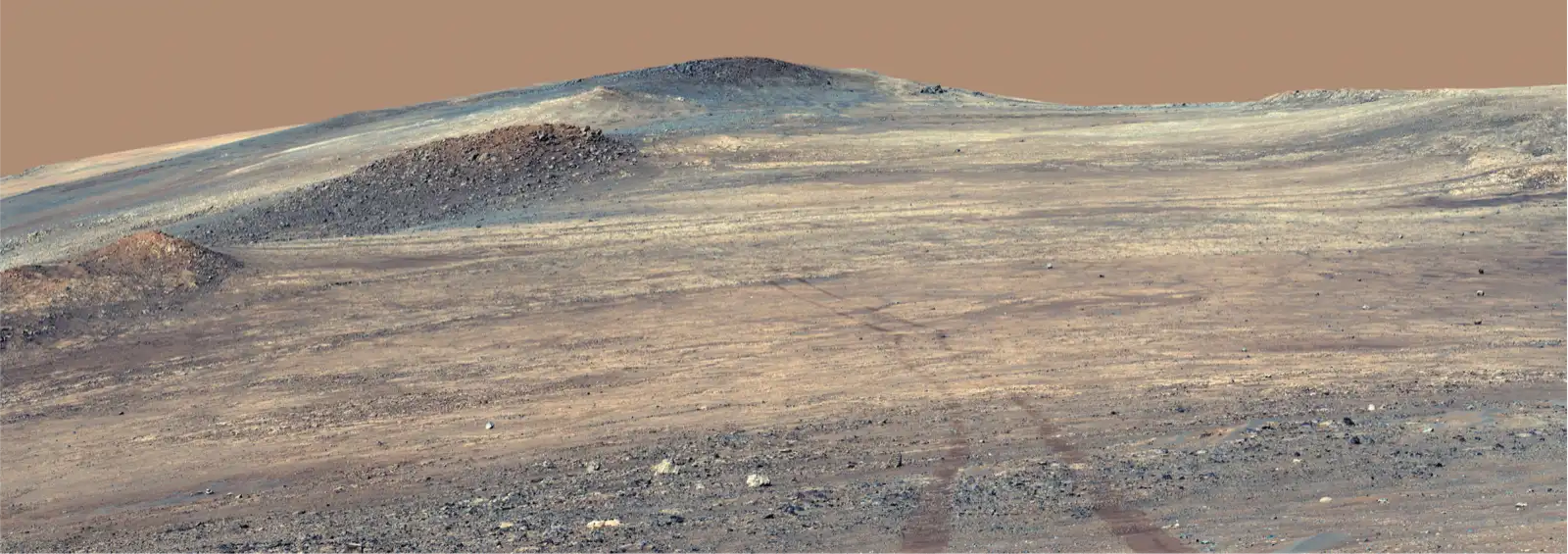
NASA’s Perseverance rover has detected corundum in pale rocks near the rim of Jezero Crater. Corundum is the mineral that becomes ruby when chromium colours it red and sapphire when other elements produce different colours.
Mars has not suddenly revealed a field of gemstones. The rover identified tiny mineral grains inside loose rocks, and there is no evidence that those grains are transparent, gem-quality, or red. Their scientific value lies in something less decorative and far more useful: corundum forms under a narrow range of chemical conditions, yet these Martian rocks do not appear to fit those conditions neatly.
The discovery may preserve evidence of violent impacts, intense heat and pressure, and later alteration by fluids. It also adds another piece to the complicated geological history Perseverance is reading as it explores some of the oldest terrain encountered by a rover.
SuperCam recognised the mineral from a distance
Perseverance carries an instrument suite called SuperCam on top of its mast. It can fire a laser at a rock, vaporise a pinhead-sized amount of material, and read the light produced by the resulting plasma. That light reveals which elements are present. SuperCam also uses other spectroscopic techniques and high-resolution imaging to examine minerals and textures without requiring the rover to drill every target.
The corundum-bearing targets were small, pale rocks transported from somewhere else. They were not fixed bedrock in the place where the rover examined them. That distinction creates the first mystery: scientists know what the rocks contain, but not yet where their parent outcrop lies.
According to the study by A. M. Ollila and colleagues, published in Geophysical Research Letters, the spectral signature points to small grains of corundum. Finding one unusual mineral is never enough on its own. The researchers compared several observations, considered other possible minerals, and examined the surrounding chemistry before reaching that identification.
Why corundum is difficult to make
Pure corundum is aluminium oxide, Al2O3. It tends to form where aluminium is abundant but silica is scarce. If plenty of silica is available, aluminium usually combines with silicon and oxygen to form minerals such as feldspar, mica, or clay instead.
The Martian rocks complicate that simple expectation because they also appear rich in silica. Corundum and silica are not impossible neighbours, but their coexistence demands an unusual history. Something must have separated elements, driven chemical reactions far from equilibrium, or preserved minerals formed under very different conditions inside the same rock.
On Earth, corundum can form during high-grade metamorphism, when rocks are heated and compressed deep in the crust. It also appears in some igneous settings and in rocks altered by hot fluids. None of those processes can be copied directly onto Mars without evidence. Mars has a different crust, a different water history, and no known modern system of moving tectonic plates like Earth’s.
The research team therefore considered a process Mars has experienced repeatedly: large impacts.
A meteorite impact may have made the grains
An asteroid striking Mars releases enormous energy in seconds. Rock can melt, vaporise, fracture, and transform under extreme pressure. Material thrown outward may cool into new mixtures before later erosion breaks it apart and carries it elsewhere.
The rim of Jezero Crater sits inside a landscape built by impacts on several scales. Jezero itself formed when a large object excavated a basin roughly 45 kilometres wide. The crater lies near the edge of the much larger Isidis impact basin. NASA’s recent work at the Broom Point formation suggests some ancient layers were assembled and tilted during repeated collisions, including the events that formed Isidis and Jezero.
Ollila’s team proposes that shock heating could have helped produce corundum, while later fluids changed the chemistry around it. Water moving through fractured rock can remove some elements, concentrate others, and leave a mineral assemblage that no single event explains.
This is a working explanation, not a settled origin story. Because the measured rocks were loose and transported, researchers need to find their geological source. A bedrock exposure would show which layers contain corundum, what minerals surround it, and whether impact textures are actually present.
The mineral is not evidence of Martian jewellery
Headlines about “rubies on Mars” are irresistible, but they blur the finding.
Ruby and sapphire are varieties of corundum, not synonyms for every piece of it. A crystal becomes ruby only when trace chromium produces the familiar red colour. Sapphire includes several other colours, commonly blue, created by different impurities. Many corundum grains are opaque, dull, and unsuitable as gemstones.
Perseverance detected the mineral family. It did not photograph a red crystal and has not established the trace-element chemistry needed to call the grains rubies.
The distinction does not make the discovery less interesting. A gemstone would attract attention because of its appearance. These grains matter because of what they demand from Mars’s geology.
The rocks could connect impacts and water
Jezero Crater was chosen as Perseverance’s landing site because a river once flowed into it and built a delta. The rover has since found volcanic rocks, lake sediments, minerals altered by water, and deposits transformed by impacts. It is becoming increasingly difficult to describe the crater with a single simple chapter.
The corundum-bearing rocks may join two of those stories. An impact could have supplied heat and pressure. Water or other fluids could later have moved through fractures and changed the surrounding material. Erosion then released fragments and transported them to the places where SuperCam encountered them.
That sequence would make the grains markers of several events rather than one. It would also explain why a mineral associated with aluminium-rich, silica-poor conditions appears inside rocks that seem silica-rich today.
Curiosmos has followed Perseverance as the rover watched Earth disappear behind the Martian moon Phobos and as NASA considered new ways to explore terrain that rovers cannot easily reach, including the proposed Skyfall aircraft for Mars. The corundum result shows why close ground measurements still matter. An orbital image can map a region; a laser spectrum can find a mineral grain that changes how scientists read its history.
Finding the parent rock is now the important step
Loose stones are geological messengers, but they do not provide a return address.
The rover team can compare their shape, texture, and composition with nearby outcrops. Orbital maps may reveal layers with matching spectral properties. Perseverance can also encounter more fragments as it drives, allowing researchers to trace a trail toward the source.
If the rover reaches corundum-bearing bedrock, the next questions become testable. Are the grains concentrated along veins? Do they sit inside melted impact rock? Are they surrounded by minerals that form through water-driven alteration? Did one event create them, or were older minerals swept into younger rock?
Samples would offer the clearest answer. Perseverance has sealed carefully selected pieces of Martian rock in tubes for a possible future return to Earth. Laboratory instruments could resolve grains far smaller than SuperCam can characterise remotely and measure their ages, trace elements, and internal structure.
Until then, the safest description is also the most interesting one. Perseverance found corundum, the mineral behind rubies and sapphires, in rocks whose chemistry is not straightforward. The grains may have survived an impact, fluids, erosion, and transport before a laser on a rover finally recognised them.