Astronomers often treat the thin streams of stars around the Milky Way as sensitive tracers of dark matter. A new University of Washington simulation shows why that evidence needs to be read carefully: the visible structure of a galaxy can create many of the same bends, gaps, and kinks without any dark-matter clump being present.
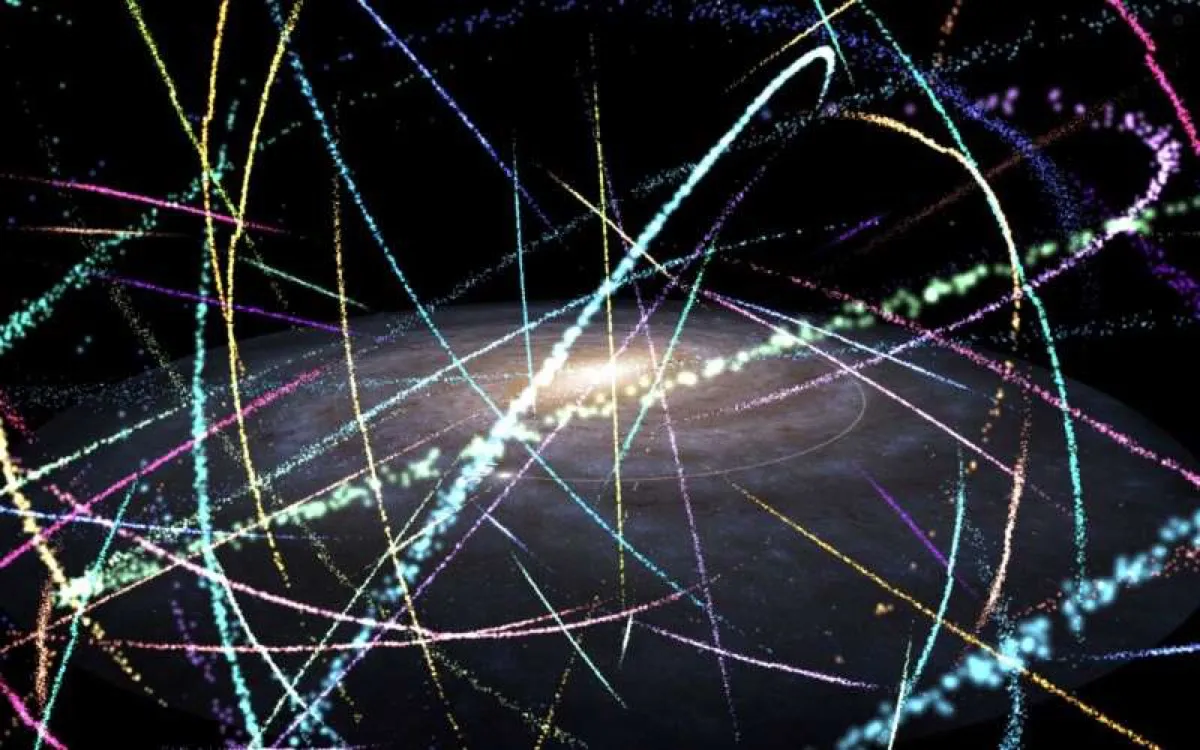
Stellar streams form when a compact group of stars, such as a globular cluster, is pulled apart by a galaxy’s gravity. The stars continue along a shared orbit, leaving a long ribbon that records the forces it has experienced. In the Milky Way, those ribbons are among the best nearby laboratories for studying the galaxy’s mass.
The usual idea is that a small clump of dark matter passing through a stream could tug stars away from the ribbon. A gap or sharp bend might therefore reveal a subhalo—an invisible concentration of dark matter orbiting inside the larger halo around the galaxy.
Keep exploring
Continue with Curiosmos
The new study tested how much of that structure could be produced by the host galaxy alone. The team built four Milky Way-sized galaxies without dark-matter clumps and placed roughly 15,000 simulated stellar streams around them. After five billion simulated years, irregularities appeared in nearly every stream. Only 70 remained perfectly smooth.
The cause was the uneven mass of the model galaxies. Stars were distributed in denser and thinner regions across each disk, producing a rough gravitational landscape. As streams crossed those regions, they developed wiggles, branches, gaps, and kinks. Streams closer to the galactic centre were disturbed more often because they passed through denser parts of the galaxy.
The result does not remove dark matter from the picture. It gives astronomers a way to estimate the ordinary gravitational effects first. Once those effects are modelled, any remaining pattern can be tested as a possible signature of dark-matter substructure rather than being assigned to dark matter by default.
That separation will become more important as the Vera C. Rubin Observatory begins finding many more stellar streams. A larger sample will allow researchers to classify the different shapes produced by a galaxy’s disk, bulge, and other visible structures. The next simulations can then add dark-matter clumps and ask whether they leave a recognisable extra signal.
The study shows why a useful dark-matter measurement may begin with an apparently ordinary explanation. The streams are still valuable, but their shapes must be compared with a realistic model of the galaxy that is carrying them through space. It also adds context to the evidence astronomers use to study dark matter.