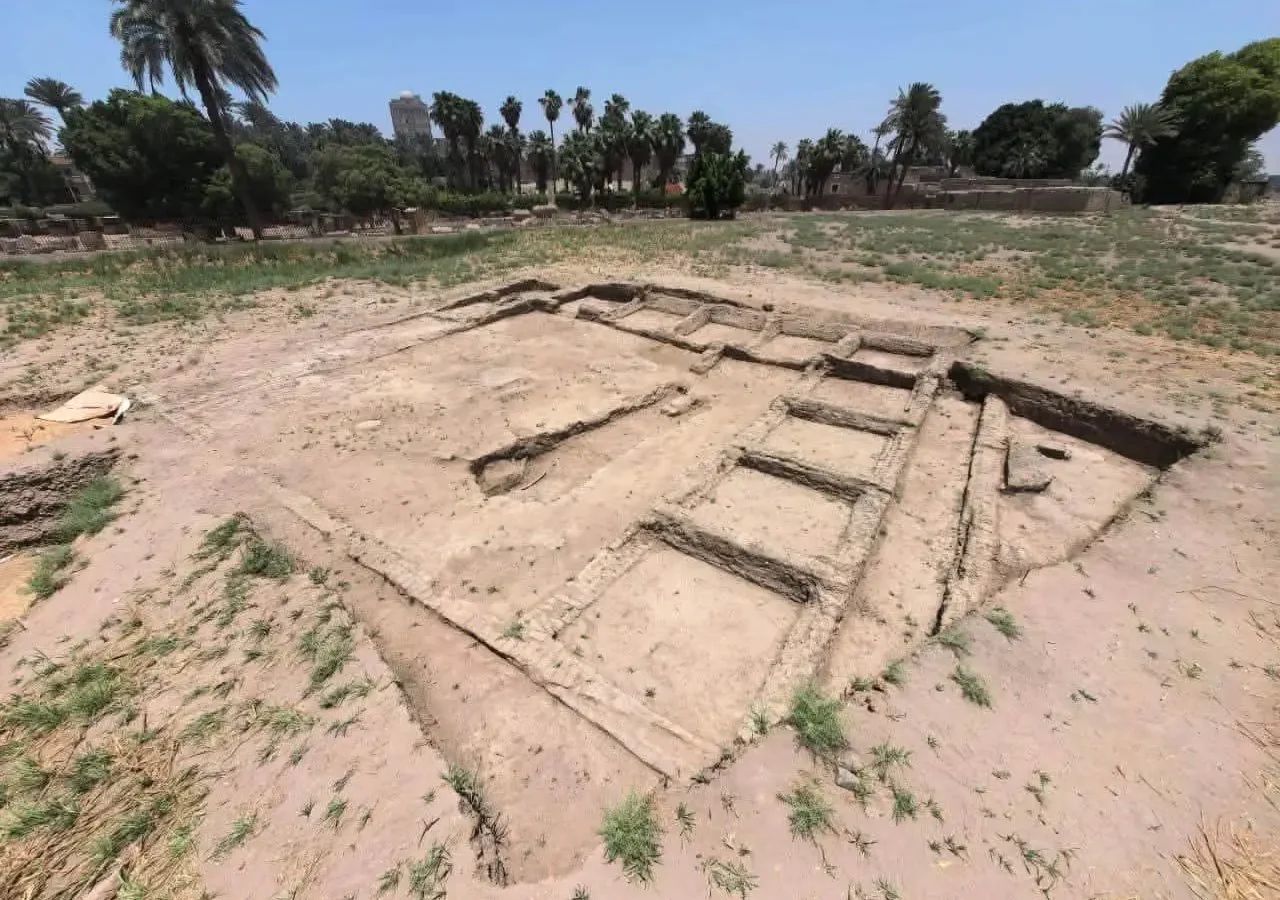
A joint Egyptian-Chinese archaeological mission has uncovered a mud-brick housing complex and a stone installation that may have been used as a wine press beside the Temple of Sekhmet at Mit Rahina, the site of ancient Memphis. The finds move the story beyond the temple itself, offering evidence for the people who lived and worked around it.
The mission is working under Egypt’s Supreme Council of Antiquities with the Shanghai Museum. Researchers first cleaned and recorded the temple before excavating the surrounding area, where they also recovered stone blocks, statue fragments, pottery, faience amulets, small terracotta and limestone figures, ostraca and votive plaques.
Homes beside a major temple
The housing complex was built from mud brick and lies close to the Temple of Sekhmet. Several nearby blocks and statue fragments may have come from the Great Temple of Ptah, the principal sanctuary of ancient Memphis, of which the Sekhmet temple formed a part.
Keep exploring
Continue with Curiosmos
Residential remains are especially useful because temples are often studied through monuments and inscriptions, while ordinary homes preserve the routines that supported those institutions. The rooms and associated objects can help archaeologists ask who used the area, how it was organised and how its role changed after the temple’s religious importance declined.
That wider setting matters for the history of Memphis, just as the evidence around Egypt’s lost city of Mesen matters for understanding how royal projects fit into working communities.
A possible wine press
East of the temple, the team found a limestone structure with an upper basin that slopes toward a central opening. A second basin sits below it, and each basin has an opening designed to hold amphorae for collecting liquid.
Grape seeds found inside the structure support the interpretation that it was used to process grapes. The archaeologists describe it as a possible wine press, not a proven one: the shape and plant remains fit that explanation, but the installation must still be studied alongside the rest of the site.
The discovery also adds a practical detail to the picture of temple life. Processing grapes required storage, containers and people who handled the harvest, linking the ritual centre to the food and drink economy of the surrounding settlement.
A neighbourhood used for centuries
The objects found around the temple span several periods. Many stone blocks and statue pieces date to the New Kingdom, including the reign of Ramesses II, while the wider evidence shows human activity from the Third Intermediate and Late Periods through the Ptolemaic and Greco-Roman eras.
By later periods, the area had become a residential neighbourhood within ancient Memphis even though the temple no longer functioned as the same kind of major religious centre. The succession of uses is one reason the excavation is important: the site records change rather than a single frozen moment.
The first excavation in decades
The Temple of Sekhmet was found during construction work in 1959 and excavated in 1961 and 1962. The current mission is the first excavation of the temple and its surroundings since then.
Researchers led by Reham Zaki of Egypt’s Supreme Council of Antiquities and Chen Jie of the Shanghai Museum plan to document the architecture and continue work around the temple. Future seasons should help establish how the buildings were arranged and how residents adapted the neighbourhood over time.
The new remains do not turn the temple into a mystery story. They provide something more concrete: a residential and production landscape that shows how daily life continued around one of Memphis’s religious monuments long after its original purpose had changed.