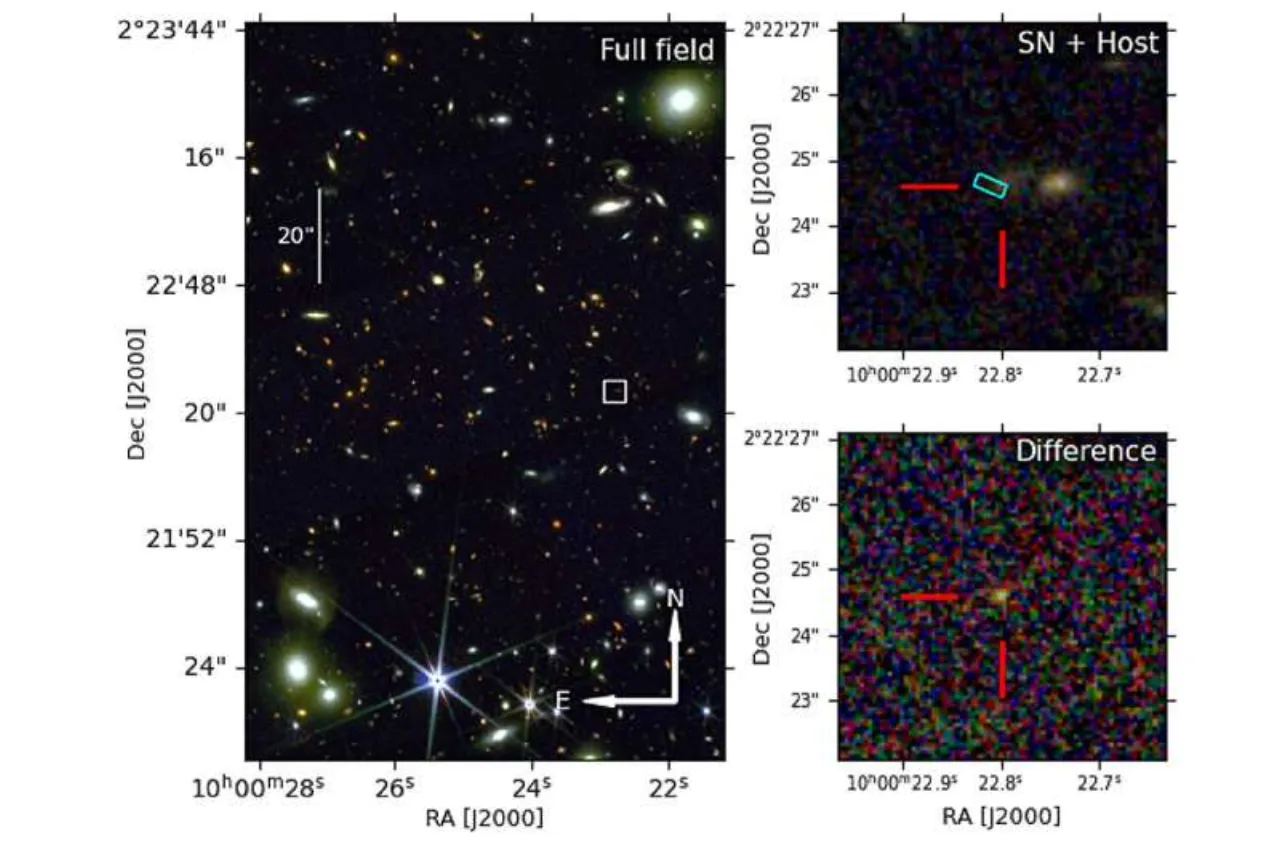
Astronomers using the James Webb Space Telescope have identified a likely Type II supernova that exploded when the universe was only about two billion years old. The event, called SN 2023aeaf, has a measured redshift of 3.195, meaning its light has travelled for roughly 11.7 billion years before reaching Earth.
Most detailed observations of dying stars come from the nearby universe, where telescopes can follow an explosion repeatedly. SN 2023aeaf is faint enough to be difficult even for Webb, but it offers a rare test of whether massive stars in the early, metal-poor cosmos died in the same broad way as stars closer to home.
How the explosion was classified
The team compared the supernova’s changing brightness, known as its light curve, and its colours with models of different kinds of stellar explosions. The result was a Type II classification with a reported probability of 97.2 per cent.
Keep exploring
Continue with Curiosmos
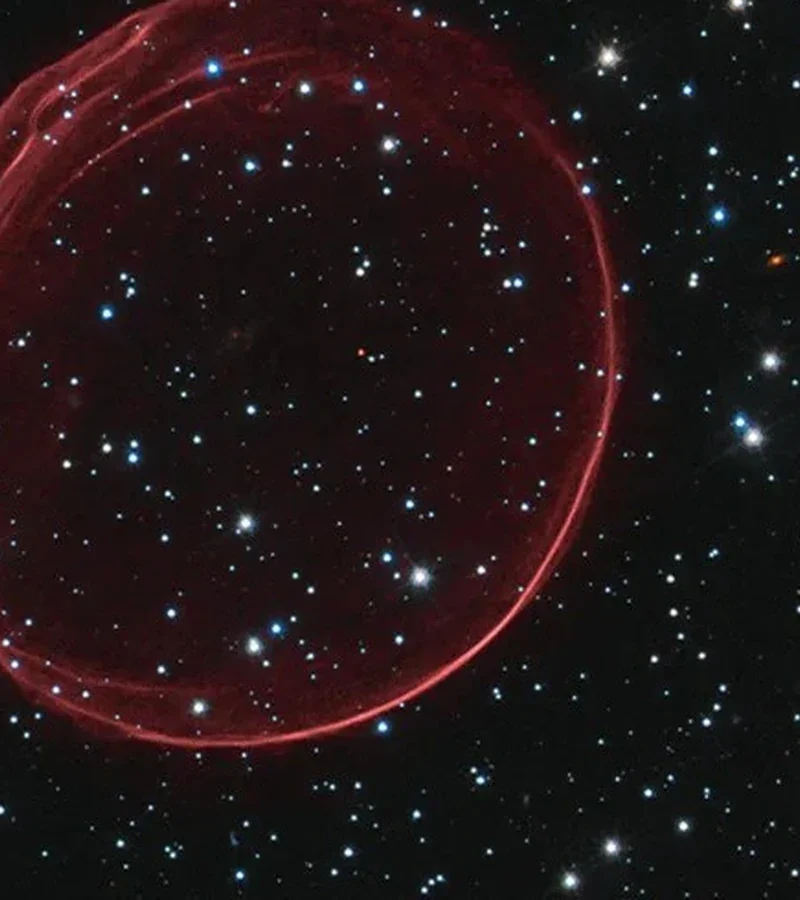
Type II supernovae form when a massive star runs out of usable nuclear fuel and its core collapses. The star’s hydrogen-rich outer layers remain around the explosion, leaving hydrogen lines in the spectrum and helping distinguish this class from supernovae that have already lost those layers.
Webb also allowed the researchers to examine the galaxy that hosted the blast. It is a young, actively star-forming dwarf galaxy with relatively little of the heavier elements that accumulated over later cosmic history.
A hot beginning
Models of the explosion suggest that SN 2023aeaf began unusually hot and blue. The best explanation in the study is that the blast wave struck a compact shell of gas the star had shed shortly before it died. Once that interaction faded, the supernova cooled toward the plateau phase typical of many Type II explosions.
The available observations do not allow a precise reconstruction of the progenitor star. They are most consistent with a star about 12 times the mass of the Sun, surrounded by roughly half a solar mass of material, but the researchers stress that the data are limited.
That limitation matters because one distant supernova cannot define the whole population. Astronomers need a larger sample to determine how common these events were and to use them as a check on the history of star formation in the early universe.
SN 2023aeaf therefore adds a particularly useful case to Webb’s growing record of distant stellar explosions. It connects the study of how astronomers measure motion and distance across the universe with the much more violent question of how the first generations of massive stars ended their lives.