Einstein’s theory of general relativity has survived another demanding test. Researchers used clouds of ultracold atoms aboard China’s space station to compare how two forms of rubidium respond to gravity, and found no measurable difference between them.
The result supports the weak equivalence principle, the idea that gravity accelerates objects in the same way regardless of what they are made of. A stone, a ball of gas and an atom should all follow the same rules when no other force interferes. That simple statement is one of the foundations of general relativity, but physicists continue to test it because a tiny failure could point toward a theory that joins gravity with quantum mechanics.
How the orbital test worked
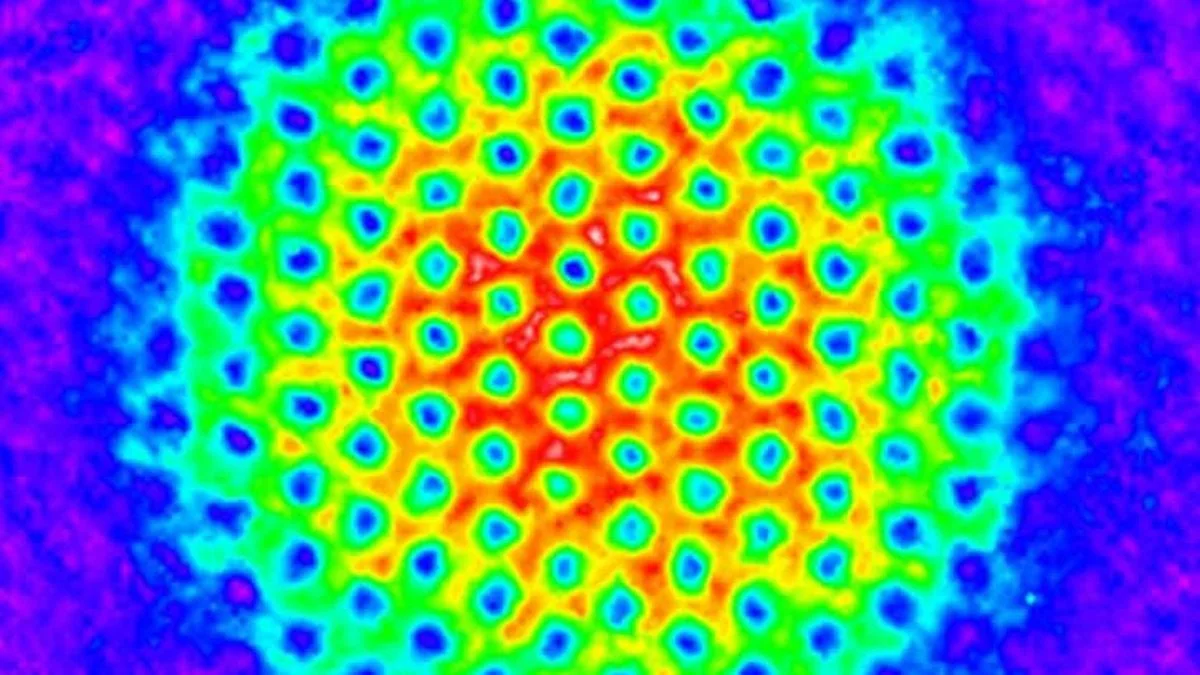
The experiment was led by Ming-Sheng Zhan of the Wuhan Institute of Physics and Mathematics. The team cooled two rubidium isotopes to temperatures close to absolute zero, then released the atom clouds inside an interferometer. Laser pulses split each cloud into two quantum paths before bringing the paths back together, allowing the researchers to compare the atoms’ accelerations with extraordinary sensitivity.
Keep exploring
Continue with Curiosmos
Orbit gave the experiment a useful advantage. The space station and everything inside it are in continuous free fall around Earth, so the atoms could be observed for much longer than in a laboratory on the ground. The researchers collected measurements over 280 days while the station moved through orbit.
A tighter limit on new physics
The two isotopes accelerated identically to within about five parts in 100 million. That is roughly three orders of magnitude more precise than previous atom-based tests performed in microgravity. The measurement does not reveal a violation of Einstein’s principle, but it narrows the room in which any new effect could be hiding.
Physicists are especially interested in the quantum scale. Some proposed theories of quantum gravity predict that the equivalence principle might eventually fail for different particles or under extreme conditions. So far, every improvement in precision has pushed that possibility farther away. The new result extends the same pattern into a long-duration orbital experiment.
The researchers say the next advances will require even longer free-fall times, quieter platforms and more sensitive detectors. Those improvements could test the principle at a level where subtle effects from unknown physics might become visible. For now, the atoms have given general relativity another clean pass.
Source: Phys.org; Dan-Fang Zhang et al., Science Advances, DOI 10.1126/sciadv.aeh4502.