


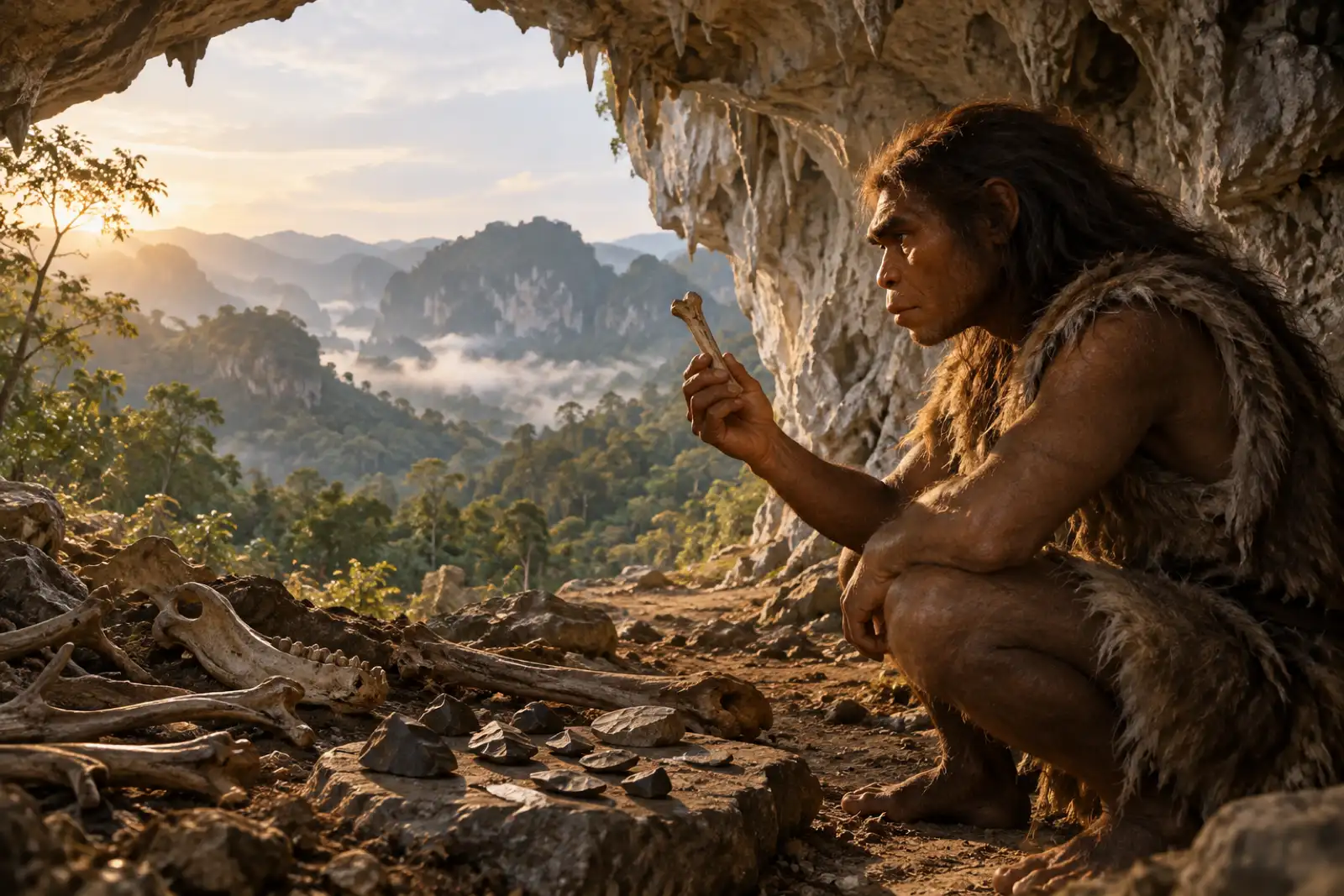
For years, the Denisovans were known more through traces than through bodies. A finger bone from Siberia revealed their existence, ancient DNA connected them to people living across Asia and Oceania, and a handful of teeth and fragments slowly widened the picture. But one basic question remained difficult to answer: what did a Denisovan arm actually look like?
A new discovery from Bianfu Cave in Yunnan, southwestern China, gives researchers their first confirmed Denisovan radius—the long bone that runs from the elbow to the wrist. It is only a partial bone, yet it may be one of the most useful Denisovan fossils found outside Siberia because it adds a part of the skeleton that has been almost entirely missing from the record.
The research team identified the bone through ancient proteins rather than recoverable DNA. In a study published in Nature, the researchers report that five hominin specimens from the cave carry a Denisovan-specific collagen variant, COL1A2 R996K. The group includes two small pieces of parietal bone, the partial radius and two teeth. The result matters because the fossils can be assigned to Denisovans through molecular evidence while still allowing the team to study their physical form.
Keep exploring
Continue with Curiosmos
A bone with a mixed signal
The radius, labelled BFD771, does not fit neatly into a simple comparison with one modern or archaic human group. Its upper end is large, and the likely orientation of the radial tuberosity resembles features seen in Neanderthal radii. Yet the overall external shape and the geometry of its mid-shaft are closer to modern humans.
That combination is more interesting than a label such as “Neanderthal-like” or “modern-human-like.” It suggests that Denisovan anatomy was assembled through its own evolutionary history. A feature shared with Neanderthals may reflect a common inheritance, while a different shaft shape could record separate adaptations or simply the normal variation within a population we have barely sampled.
What the bone cannot do is identify a single activity with certainty. Researchers can discuss biomechanical demands suggested by its shape, but a radius by itself does not tell us whether its owner hunted, climbed, crafted tools or performed some other task. The value of the find is that it turns those questions from speculation into testable comparisons.
A cave occupied across deep time
The radius was recovered from a site with an unusually long archaeological sequence. The hominin fossils date to about 167,000–134,000 years ago, while the cultural layers at Bianfu Cave extend from roughly 190,000 to 70,000 years ago. That is a span of around 120,000 years—long enough for environments, prey and technology to change repeatedly.
The researchers studied more than 60,000 bone fragments using a strategy designed to avoid testing every specimen with expensive molecular methods. They first used morphology to select promising fragments and then applied ZooMS, a mass-spectrometry method that reads collagen peptides. This combination helped identify rare hominin remains in a large assemblage where the great majority of fragments came from animals.
The cave also preserves evidence about the landscape around its occupants. Faunal and pollen records point to a conifer-dominated forest or forest-steppe environment through several glacial stages. The picture is not of a frozen wasteland occupied briefly by desperate visitors. It is a changing mountain environment in which Denisovans returned, found prey and made use of the materials around them.
What were the Denisovans doing there?
A companion Nature study examined the tools and animal remains from the same sequence. It describes specialized hunting of medium- and large-bodied prey, along with expedient stone-core reduction and widespread use of unmodified bone. In other words, the cave assemblage does not show a single “Denisovan technology” frozen in place. It shows people selecting workable objects and using them for particular needs.
That detail is easy to overlook. Ancient tools often attract attention because of how carefully they were shaped, but a useful bone that required no elaborate preparation can tell us something too. It may point to a practical strategy in which the properties of an object mattered more than turning every object into a formal tool. The evidence does not prove that Denisovans were technologically simple; it shows that sophistication can also mean knowing when extra work is unnecessary.
The first Denisovan radius therefore opens more than an anatomical chapter. It connects a rare body part to a long record of hunting, landscapes and everyday decisions. What if the Denisovans were not a small, isolated branch that briefly appeared in a few caves, but a diverse population repeatedly adapting to different parts of Asia? Bianfu Cave cannot answer that question alone, but it gives researchers a stronger place to begin.
Why this discovery matters
Only a small number of places have yielded Denisovan fossils that can be identified securely. Bianfu Cave now has the richest Denisovan fossil record known outside Denisova Cave, and the new radius fills a geographical gap in the southwest of China.
The result is not a complete portrait. It is one partial forearm bone, two skull fragments, teeth and an archaeological record shaped by thousands of years of preservation and excavation. For context, Curiosmos has previously covered Denisovan evidence from Baishiya Karst Cave and new evidence for interaction among archaic humans at Üçağızlı II Cave. But that is precisely why the discovery is valuable. Each new specimen tests the assumptions built from the few Denisovan remains already known—and sometimes reveals that the human family tree was more varied than the surviving bones made it appear.
Sources and further reading
- Q. Fu and colleagues, “Ancient proteins identify various Denisovan remains from Southwest China,” Nature (9 September 2026): https://doi.org/10.1038/s41586-026-10976-9
- Q. Ruan and colleagues, “Denisovans from southwestern China and their subsistence strategies,” Nature (9 September 2026): https://doi.org/10.1038/s41586-026-10997-4
- Chinese Academy of Sciences, “Denisovan Radius Discovered for First Time in Southwest China” (10 September 2026): https://english.cas.cn/newsroom/research-news/202609/t20260906_1192641.shtml


