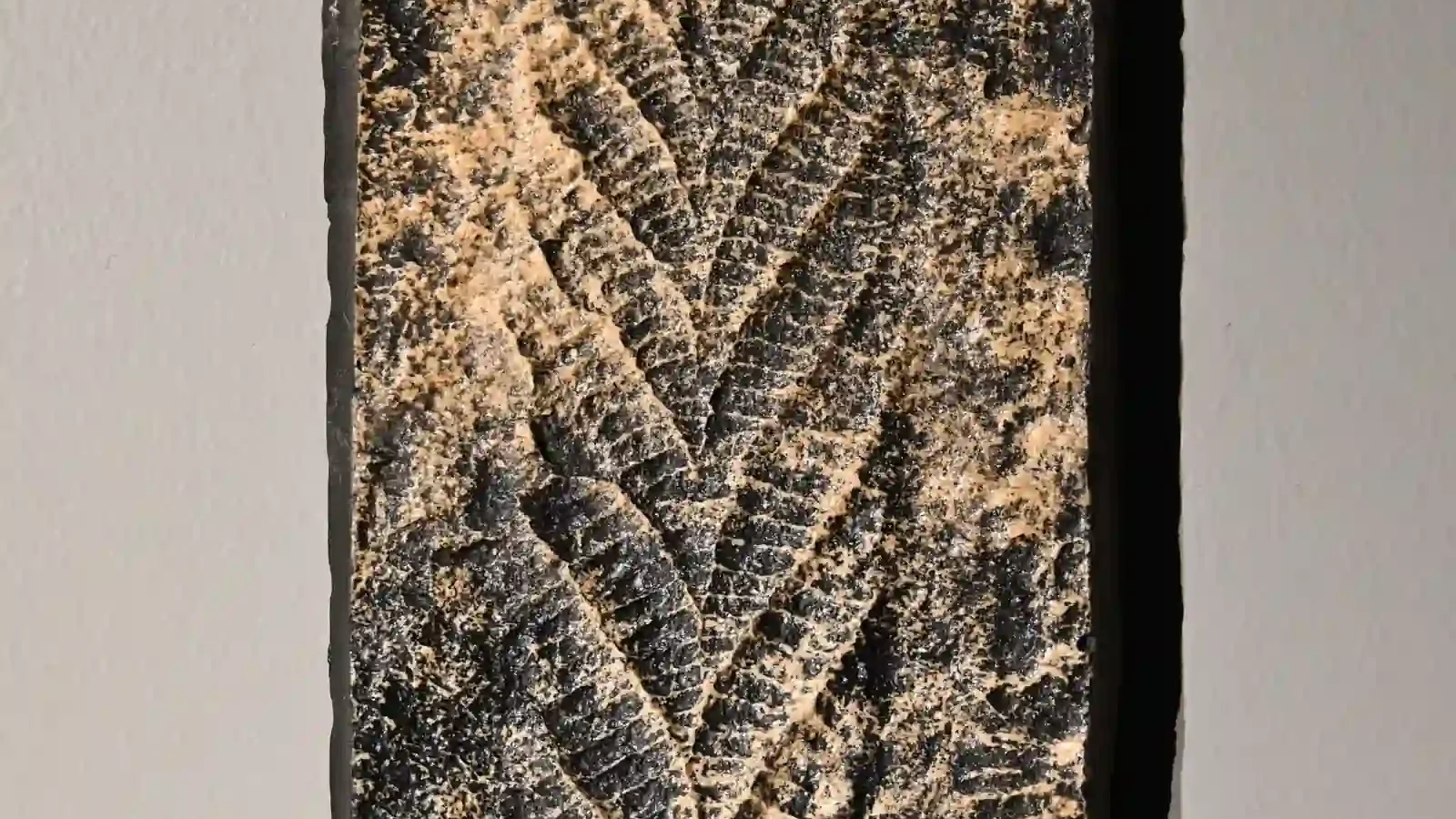
A Charnia fossil from Norway was hidden in a rock that fell from a cliff and split open in a sheep field in Finnmark. It preserves a rare view of an Ediacaran organism that lived about 560 million years ago: raised ridges along some of its branches.
The find is the first confirmed Charnia from Scandinavia. In an open-access paper published in Palaeontology, researchers led by Yorick Veenma describe it alongside several other fossils. The study places the finds in the late Ediacaran Indreelva Member of Finnmark’s Vestertana Group. The University of Cambridge’s report dates the discovery to about 560 million years ago; the paper notes that the unit’s age is inferred from its geological position and fossil assemblage rather than a direct date.
What did researchers find in the Norwegian rocks?
The team describes two partial Charnia fronds, one from Blåberget and one from Kommagnes. The larger Blåberget specimen is about 12 centimetres long and 5 centimetres wide, but appears as a very low-relief impression. The smaller Kommagnes fossil is about 7 centimetres long and 2 centimetres wide. Its raised form reaches roughly 5 millimetres, giving researchers a rare chance to inspect the shape across the branches.
Keep exploring
Continue with Curiosmos
On seven of the ten first-order branches that could be examined, the Kommagnes specimen has an angular cross-section that forms a central ridge, or keel. More familiar Charnia fossils tend to have rounder, swollen-looking branches. The ridge adds a feature researchers had not previously recognized in flattened specimens. It does not yet define a new species: both Norwegian fossils are incomplete, and the authors say their features do not allow a confident assignment to an already named Charnia species. Neither specimen preserves an observable stem or holdfast.
How did one fossil keep its three-dimensional shape?
The answer lies partly in the rock around it. The high-relief specimen is embedded within a bed of siltstone and clay-rich sediment. Its fossil-bearing surface cuts across the bed’s internal layers, rather than sitting on a bedding plane as a flattened impression would. The authors interpret this as evidence that the organism was carried inside the sediment before burial.
The surrounding layers record a sediment gravity flow: material moved downslope beneath an ancient sea. Their structure suggests a transitional current with both turbulent and cohesive properties. The fossil’s alignment with the inferred flow, and the nearby presence of fossil holdfasts, led the researchers to suggest that it travelled only a short distance from where it grew. The paper proposes that the current’s continuing tail flow may have filled and buried the organism quickly enough to preserve its raised form. That sequence is a geological interpretation of the rock, rather than a direct observation of the animal’s final moments.
Here, three-dimensional preservation describes the fossil’s raised form in the rock, not soft tissue surviving intact. The British Geological Survey’s guide to fossil preservation explains how impressions, moulds and casts can preserve different kinds of information about an organism. In Finnmark, the raised fossil lets researchers examine the cross-section of branches, while a flat impression mainly records their outline.
What else may be hidden in the same rock layers?
Charnia was only part of the discovery. At the Blåberget and Kommagnes localities, the researchers also report examples of Palaeopascichnus, Aspidella-type holdfasts, possible scratch circles and two additional body fossils that remain unidentified. The Palaeopascichnus material includes two species and more than one preservation style, a reminder that fossils from a single layer can record small differences in burial and preservation.
The new locality matters because Ediacaran fossils are known from a limited number of exposed rock belts. Adding Finnmark to that record helps researchers compare life from regions that have received different amounts of study. It also shows why the shape of a fossil cannot be separated from the history of the sediment that preserved it.
Was the keel a regular feature of Charnia’s branches, or something seen only in the Kommagnes specimen? More fossils from the same layers could tell us. For now, this single raised example makes the ridge visible, but not common.