Astronomers have found 84 objects in nearby galaxies that do not behave like the familiar X-ray sources catalogued over the past six decades. They are bright at the lowest X-ray energies, yet they disappear when researchers look at higher-energy X-rays. The team calls them hypersoft X-ray sources.
What if an important part of the cosmic energy budget has been hiding in the band our telescopes find hardest to see? The new discovery does not answer that question yet. It does, however, point to a population of objects that could help explain how some of the Universe’s most useful explosions begin—and why gas between the stars loses its electrons.
What makes a hypersoft X-ray source unusual?
Typical X-ray binaries shine mostly above 0.3 kiloelectronvolts (keV). The newly identified sources are strongest below that range, around 0.15–0.3 keV, where X-rays sit next to extreme ultraviolet radiation on the electromagnetic spectrum. In practical terms, they look bright in the softest Chandra images and then fade from the harder-energy images.
Keep exploring
Continue with Curiosmos
That pattern is more than a colour change. The low-energy X-rays imply that these objects may be producing an intense amount of ultraviolet light. The sources are point-like and lie outside the centres of their host galaxies, so they are not simply the glare of a galaxy’s central black hole.
How did Chandra find 84 of them?
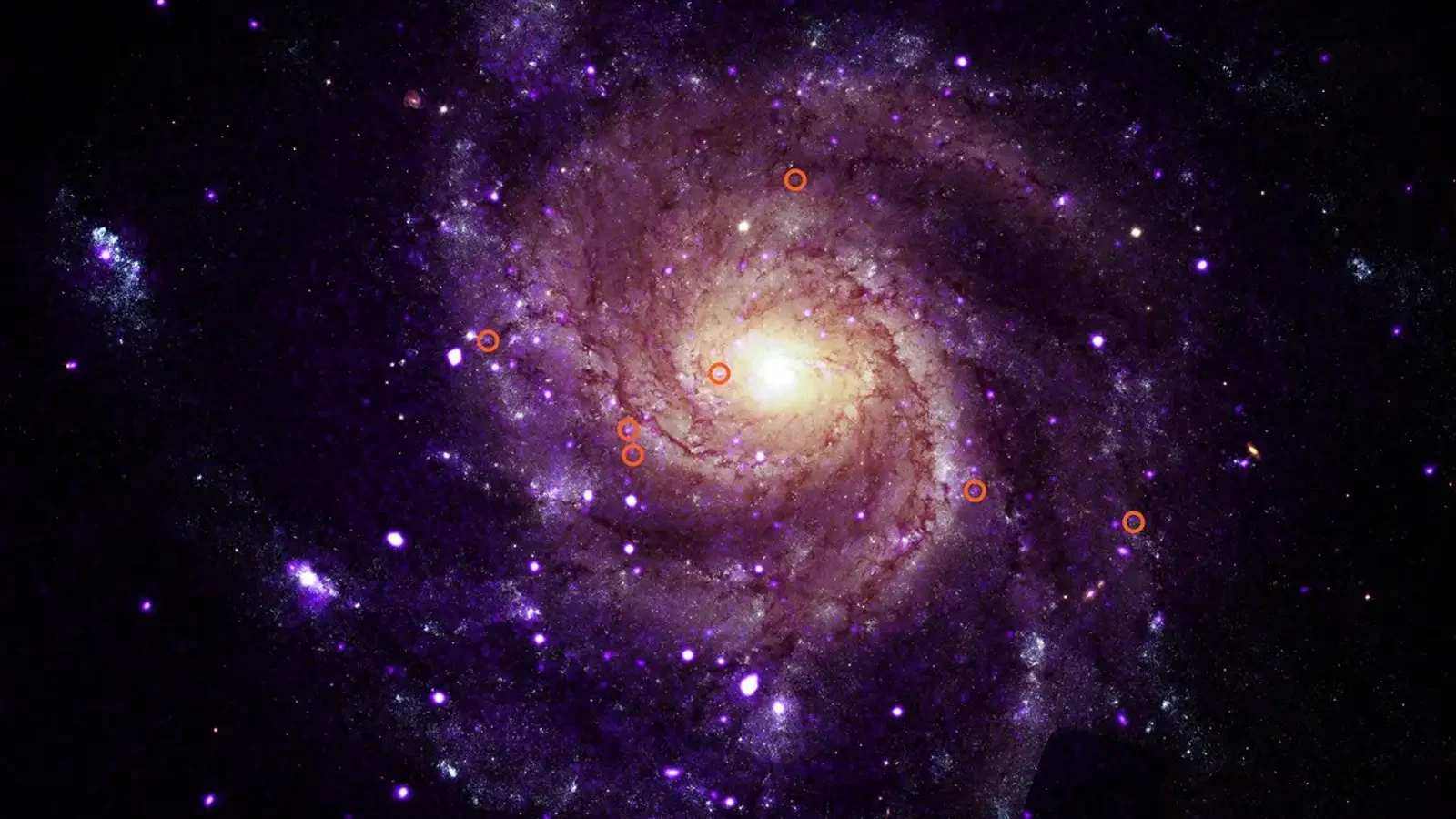
The researchers searched public observations in the Chandra archive rather than waiting for a new telescope campaign. They examined six galaxies: the spiral galaxies M31, also known as Andromeda, and M101, the Pinwheel Galaxy, together with four elliptical galaxies. The same signature appeared in places containing young stars and in regions dominated by older stellar populations.
In M101 alone, the survey image marks seven of the sources as tiny points of light. They look almost identical to the other stars and binaries scattered across the galaxy. Their difference appears only when the X-ray data are separated by energy.
Why were they missed for so long?
Low-energy X-rays are difficult to detect from Earth and from orbit. Hydrogen and helium between the stars absorb much of the extreme ultraviolet and soft X-ray light before it can reach a telescope. A source can therefore be intrinsically powerful while leaving a very faint signal in the band observers normally use.
The archive search turned that weakness into a clue. Instead of treating the missing hard X-rays as a lack of activity, the team looked for objects that appeared only in the softest images. That approach revealed an observational blind spot rather than a new instrument.
What could these objects be?
The evidence does not identify one final type of object. The researchers suggest that many may be compact binaries in which a black hole, neutron star or white dwarf pulls gas from a companion star. As the gas falls inward, it forms a hot accretion flow and radiates energy.
These systems have been seen before, but not with this combination of unusually soft X-rays and strong ultraviolet emission. The paper describes the objects as a new class of luminous, non-nuclear X-ray emitters; it does not claim that every member has the same engine. Follow-up observations will have to determine which compact object sits in each system.
Could they explain Type Ia supernovae?
Some white-dwarf binaries may eventually produce Type Ia supernovae, the explosions astronomers use to measure distances across the expanding Universe. Researchers know that a white dwarf can draw material from a close companion, but the precise chain of events that ignites the explosion remains unsettled.
If a hypersoft source is a white dwarf accumulating gas, it could provide a way to find a possible progenitor before the explosion. That would let astronomers compare a system’s properties with the later supernova instead of studying the star only after it has been destroyed. The new work offers a candidate population, not a prediction that any particular source is about to explode.
What does ultraviolet light do between the stars?
The same radiation may matter on a much larger scale. Ultraviolet photons can strip electrons from interstellar gas. Hot, massive stars contribute to that process, but their numbers do not appear to explain all of the ionisation seen in some galaxies.
Hypersoft sources could fill part of that gap. Their ultraviolet output may influence how quickly gas cools, how stars form and how the material between stars changes over time. The idea still needs tests: the team has measured the unusual X-ray signature, while the ultraviolet light is inferred from the energy range and the physical models.
What remains unknown?
The 84 sources are a beginning. Astronomers still need spectra, repeated observations and measurements at other wavelengths to establish the nature of individual systems. Some may be white-dwarf binaries; others may involve neutron stars or black holes. The host galaxies also differ, which means the population may not have one single history.
That uncertainty is the interesting part. A telescope archive has exposed objects that were not absent from the Universe; they were hidden by the way we searched. The next question is not whether the sources are mysterious in the popular sense. It is whether the faintest X-rays are showing us a missing chapter in the lives of stars and galaxies.