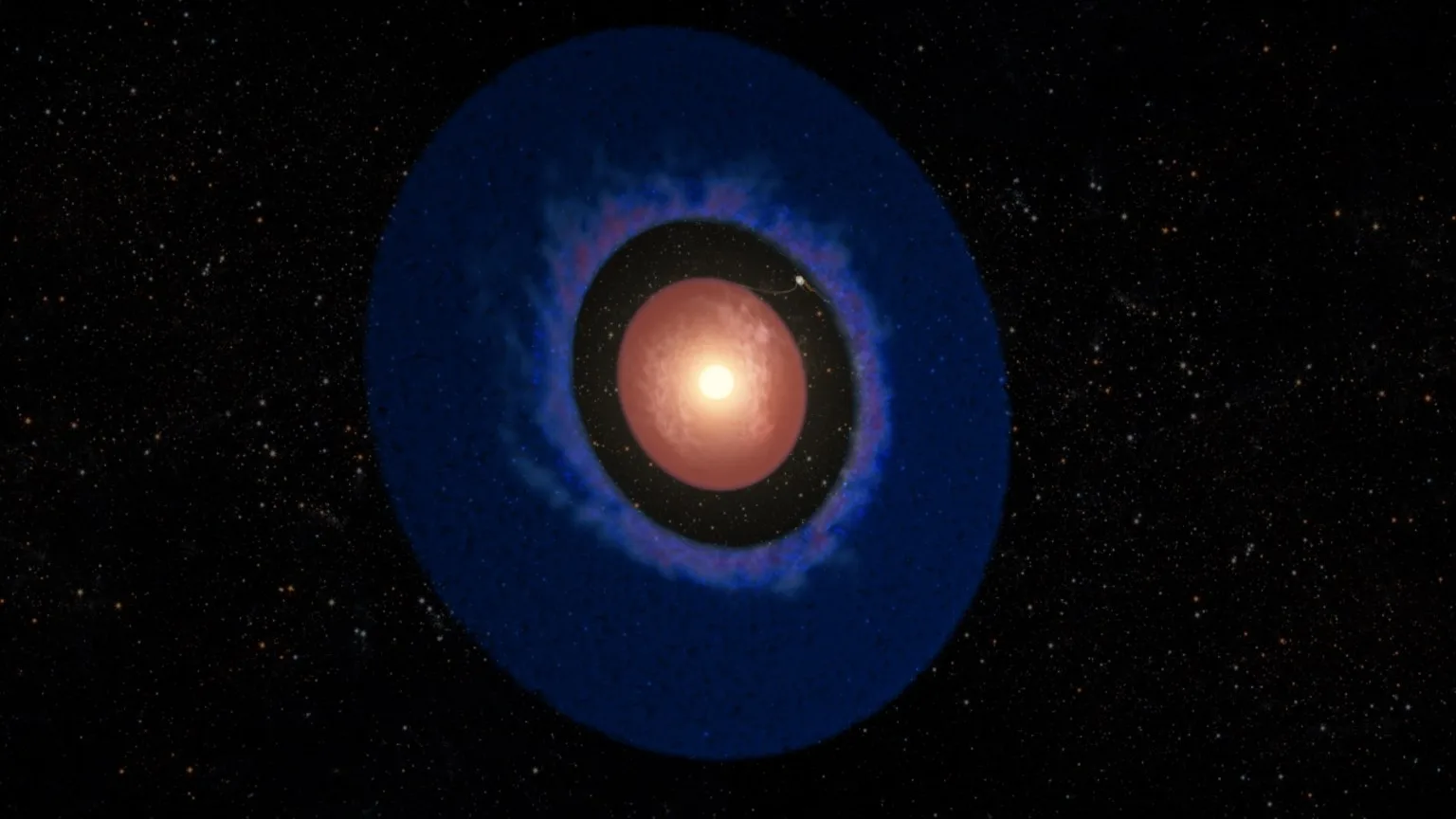
Elias 2-24 b is less than a million years old, still embedded in the disk that made it, and forcing astronomers to ask how quickly a Jupiter-sized world can take shape.
How young can a planet be and still be seen at all? Astronomers have now confirmed a world that is less than a million years old, a mere beginning compared with the billions of years separating us from the planets in our own Solar System. The object, called Elias 2-24 b, is still circling inside the gas-and-dust disk from which it is forming.
That makes this more than a new name in the exoplanet catalogue. It is a rare look at a planetary system while construction is still under way. The result also presses on a question that sounds simple but is remarkably difficult to answer: how fast can a giant planet grow?
Keep exploring
Continue with Curiosmos
A faint point of light in a young star’s disk
Elias 2-24 b orbits a young star about 450 light-years away. The star is surrounded by a broad disk of gas, dust, ice and rock. Such disks are the raw material left over after a star is born, and astronomers expect planets to gather from them. The trouble is that a newborn planet is almost drowned out by the much brighter star and by the disk itself.
In this case, earlier observations offered a tantalising clue. Radio observations with the Atacama Large Millimeter/submillimeter Array revealed a prominent gap in the disk. The European Southern Observatory’s Very Large Telescope later detected a faint point of light in that gap. A gap can form when a growing planet clears material from part of its orbit, but a single image cannot prove that interpretation. The point might have been a background star, an imaging artefact or something else entirely.
The new study, published in The Astrophysical Journal Letters, used the W. M. Keck Observatory’s archive to look for the same source in older observations. The team led by Andrea Bernardi found it again in images from 2018 and 2020. Its movement matched what the researchers expected from a planet orbiting Elias 2-24, strengthening the case that the faint object is real and bound to the star.
Why the age changes the story
NASA describes Elias 2-24 b as roughly Jupiter-mass, although the study gives an inferred range rather than a single exact number. The planet sits about 55 times farther from its star than Earth sits from the Sun. That combination—large mass, wide separation and an age below one million years—does not fit comfortably inside the slowest versions of planet-formation theory.
Some models have suggested that building a Jupiter-sized planet at a comparable distance could take around five million years or longer. Yet the young system already appears to contain a planet in the middle of a disk gap. The observation does not erase every uncertainty, and it does not show that all giant planets form in the same way. It does show that at least one system can produce a world of this scale much earlier than many models expected.
That is the useful tension in this discovery. The planet is not a finished, frozen object. Material may still be falling onto it, and its mass and age are estimates tied to models of the star and the disk. But the observations are strong enough to turn a suspected dot into a test case for how planetary systems grow.
How astronomers confirmed a planet they could barely see
The confirmation depended on several telescopes playing different roles. ALMA mapped the cold material in the disk. The VLT recorded the original point of light. Keck’s NIRC2 camera, used with a vortex coronagraph, blocked much of the star’s glare so that the nearby object could be examined. By combining observations separated by years, the team could test whether the point moved with the star instead of staying fixed like a distant background source.
This is why the finding is more convincing than a single dramatic image. The evidence is a chain: a disk with a gap, a faint object inside that gap, and motion measured in independent archival observations. Each link narrows the alternatives.
What could the Roman Space Telescope add?
Elias 2-24 b is close to the limit of what current instruments can detect. NASA’s Nancy Grace Roman Space Telescope, launched in August 2026, carries a more capable coronagraph designed to suppress starlight. Similar observations could reveal younger planets in smaller orbits, including worlds that remain hidden in the glare of their stars.
That prospect gives this discovery a second importance. It is not only a record-holder; it is a demonstration of the kind of evidence Roman may gather routinely. Astronomers could eventually compare many forming planets rather than trying to reconstruct planet birth from a handful of mature systems. Our existing guides to how exoplanets are found and how Roman will see distant worlds explain the methods behind that search.
For now, one young planet leaves us with an appealing question. If a Jupiter-sized world can appear inside a disk before its star has even reached its first million years, how many other planets are already taking shape in the dark—and waiting for the right archive, telescope or curious eye to find them?