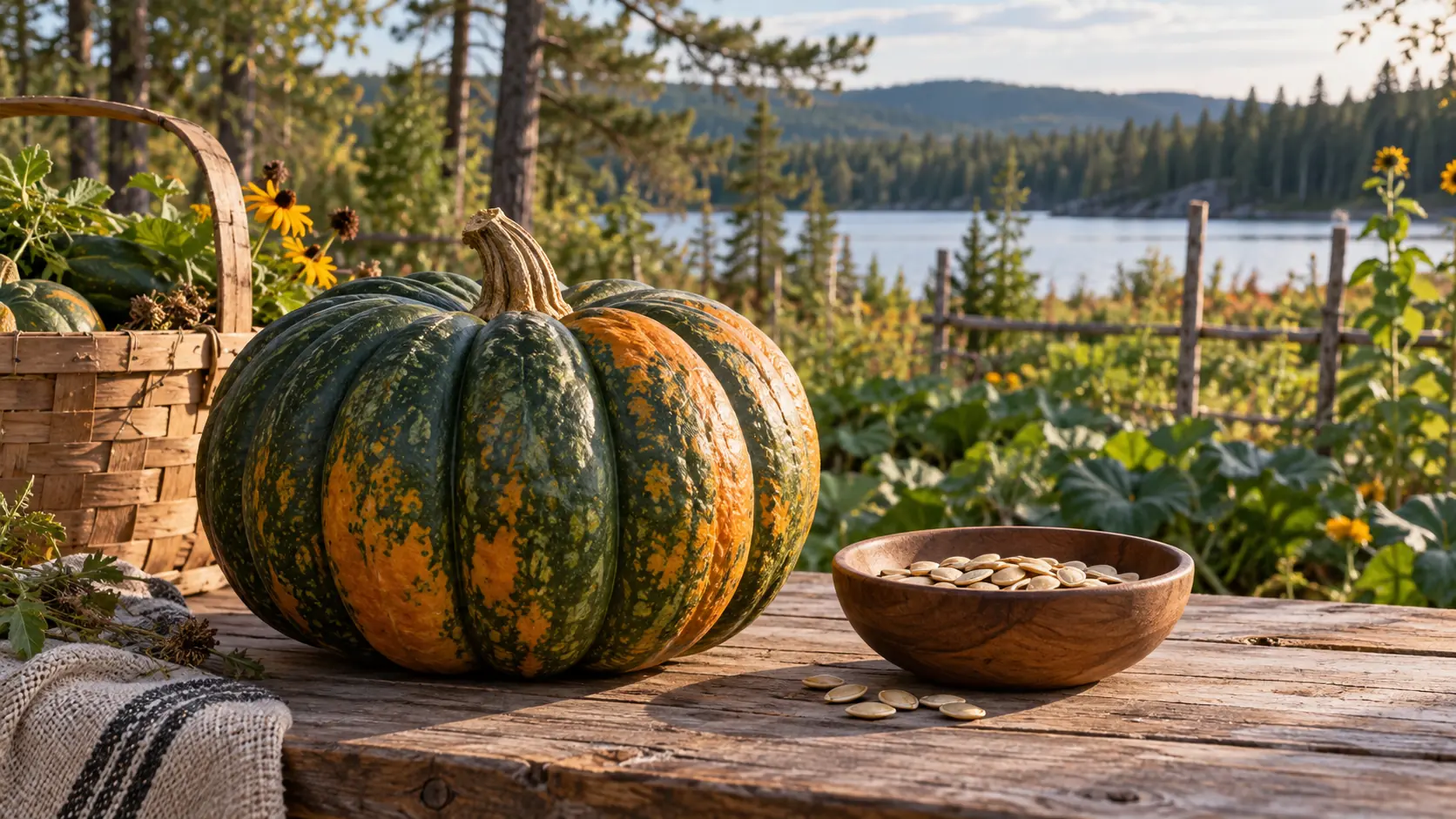
Some Gete Okosomin squash grow large enough to weigh more than 30 pounds. Their orange flesh and striped skins have travelled through gardens and seed exchanges across North America. The story often travelling with them is even more striking: seeds supposedly revived after 800 years inside a clay vessel.
The people who traced the squash through its growers found a different history. Miami gardeners in Indiana had kept it in cultivation and shared its seeds. Following that history takes us into flowers, pollination and the decisions that keep a variety recognisable from one harvest to the next.
From an Indiana garden to other growers
In Alysa Landry’s reporting for ICT, first published in December 2015, elderly Miami gardeners gave seeds to University of Wisconsin professor emeritus David Wrone in 1995. He grew them and passed seed from the following generation to neighbours. It eventually reached growers including the White Earth Seed Library.
Wrone told ICT that the gardeners hand-pollinated the squash to preserve its characteristics. Seed keeper Zachary Paige described the variety spreading through exchanges while its origin story became embellished. He did not know where the clay-ball version began.
What saving a squash actually involves
Why bother hand-pollinating a plant if bees will do the work? Because a grower saving seed is choosing the next crop as well as harvesting this one.
University of Maryland Extension explains that varieties of the same squash species can cross-pollinate. A seed collected from one variety can then produce a plant combining traits from two parents. Keeping the plants apart, screening flowers from insects or controlling pollination helps avoid an unwanted cross.
The surprise appears in the next generation. University of Minnesota Extension notes that cross-pollination does not change the quality of the squash already growing on the parent plant. Its seeds, however, can produce different fruit when planted.
A grower could harvest a familiar-looking squash and still find that its saved seeds produce something different next year. The Miami gardeners’ attention to pollination therefore had a practical purpose. They were keeping a crop going through repeated seasons.
Wrone recalled two different seed lots
Michelle Johnson’s later Baker Creek account, drawing on Wrone’s recollections and a memo, describes two kinds of squash given to him during the 1995 visit. One had been grown by the Miami gardeners across generations. The other came with a story that its seeds had been found on a ledge inside a Kentucky cave.
Wrone recalled growing both. He preferred the cultivated variety and shared its seed; he said he did not distribute the less satisfactory squash from the purported cave lot. The account traces Gete Okosomin to the variety the gardeners had maintained.
His recollection offers one possible route by which two seed histories became confused. It leaves the cave claim dependent on a remembered account, with no excavation report identified here. It also cannot establish exactly how a Kentucky cave story became the widely repeated tale of a clay vessel from a Wisconsin dig.
An old variety is renewed with new seeds
The Bureau of Indian Education’s middle-school guide credits Miami seed keeping rather than the clay-ball account. The variety’s recent travels can be followed through growers, their interviews and exchanges; a precise age for its beginnings would require separate evidence.
This is different from the physical record discussed in our guide to reconstructing ancient diets. An excavated seed comes from a particular deposit. A living variety passes through fresh seed produced by successive plants. Those histories answer different questions about the past.
For the next grower, keeping Gete Okosomin going starts when the flowers open. The choice of pollen helps decide what next year’s seeds will become. Generations of gardeners faced that choice before the squash reached today’s seed exchanges.
Sources
- Alysa Landry, ICT: The Real Story of That Giant Squash, originally published December 3, 2015.
- Michelle Johnson, Baker Creek: Gete Okosomin, The Story of the “Cool Old Squash”, interview-based account.
- University of Maryland Extension: Vegetables Not True to Type, updated February 20, 2023.
- Jill MacKenzie and Michelle Grabowski, University of Minnesota Extension: Saving vegetable seeds, reviewed in 2024.
- Bureau of Indian Education: Harvest of the Month, Squash, grades 6–8 guide.