A few rushes, folded and woven together, can make an object that generations of Irish households placed above a door. St Brigid’s cross is small and usually made from ordinary material, yet it opens a much larger story about protection, the farming year and a sacred figure with both Christian and pre-Christian associations.
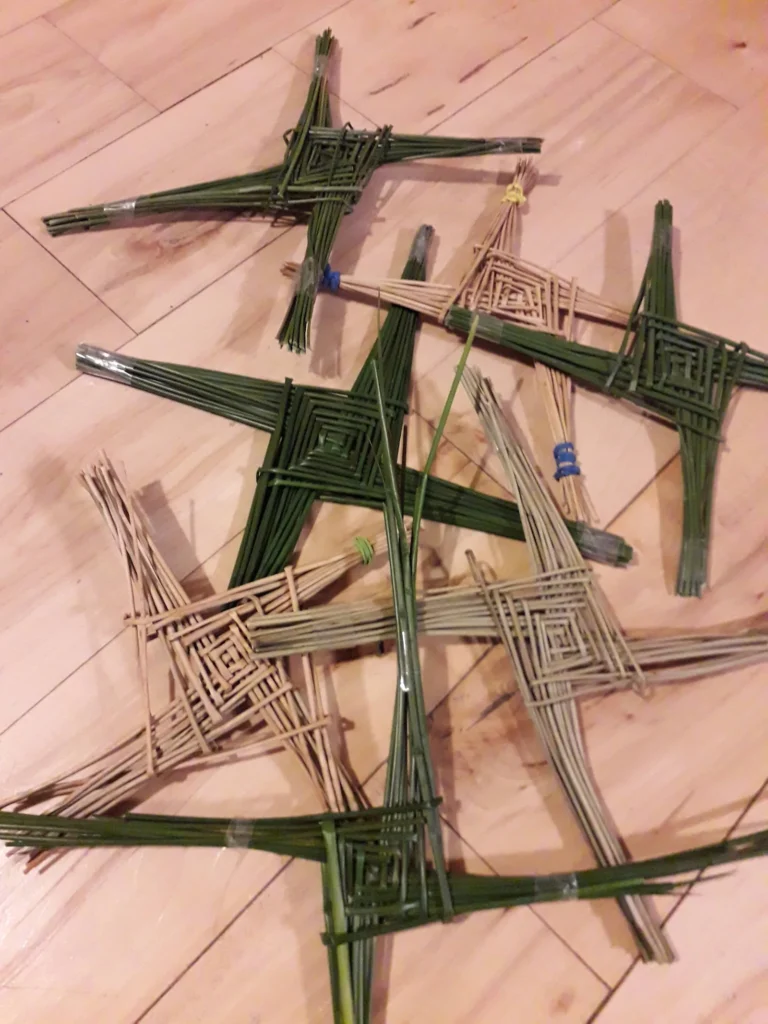
The four-armed version is familiar today: a woven centre with arms turning outward. Older crosses took several other shapes. Some households kept them in the rafters year after year, allowing the roof to become a record of repeated observance.
What can those crosses tell us about the people who made them? A handwritten account from County Meath preserves the practical details: sticks, straw, a kitchen door and crosses left in the rafters. Museum collections reveal how differently the same custom could look from one region to another.
A cross for the house and the animals
St Brigid’s Day falls on 1 February. The National Museum of Ireland’s guide to community life places it among the traditional quarter days, marking spring, with Bealtaine, Lúnasa and Samhain marking the other seasons.
Within that agricultural calendar, the cross had an immediate purpose. Families sought a blessing for themselves, their animals and the coming crops. The objects were hung in homes and farm buildings, where the protection was believed to be needed.
The material makes sense in that setting. Rushes and straw were close at hand. A household could prepare a new object without commissioning a metalworker or acquiring an expensive devotional image. The act of making it also brought the observance into the home.
Other cultures expressed hopes for protection through objects that could be worn or kept nearby, including the Thor’s hammer pendants found in Viking contexts. A pendant travels with its wearer. A cross above a doorway places that hope at the entrance to a home.
The handwritten account from Moynalty
A record from Moynalty in County Meath gives the custom a local voice. In the Schools’ Collection, Michael Reilly recorded an account from Patrick Reilly describing crosses made on St Brigid’s Eve.
The maker joined two sticks, then plaited straw diagonally from the centre. Completed crosses were placed over kitchen and front doors, with others attached to rafters. The account says old houses could contain rows of them, since these roof crosses were left in place.
It also records what people expected of them: protection against sickness and evil spirits. Cord could be used instead of straw. This was a recognisable practice with room for local materials and choices.
The Schools’ Collection grew from a folklore-gathering scheme launched in 1937, in which schoolchildren recorded accounts from older people in their communities. A page like this is evidence of a custom being described in that period, often through memories of earlier life.
The account leaves us with a striking picture of the roof. Each new cross joined earlier ones, so a visitor looking up could see years of household observance collected among the rafters.
Television helped make one shape familiar
The National Museum’s curator Clodagh Doyle describes considerable regional variation. Crosses could be diamond-shaped, interlaced or wheel-shaped, with two, three or four arms. Materials ranged beyond rushes to wood, wire and fabric.
Galway City Museum explains a change many people might not expect. The diamond or lozenge form was once the most common variety. The four-armed rush cross became more widely recognised after Telefís Éireann adopted it as a television emblem in the 1960s.
An object associated with an old feast entered a new medium. A television image could travel to households far beyond the region where that particular shape had been favoured.
This is one way a tradition changes without disappearing. When we recognise only the most familiar form, we risk overlooking the choices once made in different communities. A museum case containing several shapes restores some of that variety.
Where the goddess and saint meet
The name Brigit also appears in accounts of an earlier goddess. University College Cork’s Department of Early and Medieval Irish describes her associations with poetry, metalworking and healing, alongside the extensive tradition surrounding the saint of Kildare.
Its discussion draws attention to the British goddess Brigantia, identified with the Roman goddess Victoria in inscriptions. Early hymns linking Brigit with victory may preserve a meaningful relationship between traditions. UCC presents that connection as an argument drawn from names, language and surviving sources.
Could an older sacred figure have helped shape devotion to the saint? There is good reason to explore the possibility. The names and hymns offer clues to religious continuity. Dating the woven cross itself is harder: the folklore accounts describe its place in household life centuries later.
The crosses bring us back to a scale we can examine closely: hands folding rushes, a doorway selected for protection, another cross left beside those from earlier years. Their history includes religious change, regional craft and even broadcasting. Following those details gives the familiar object a much fuller life.