

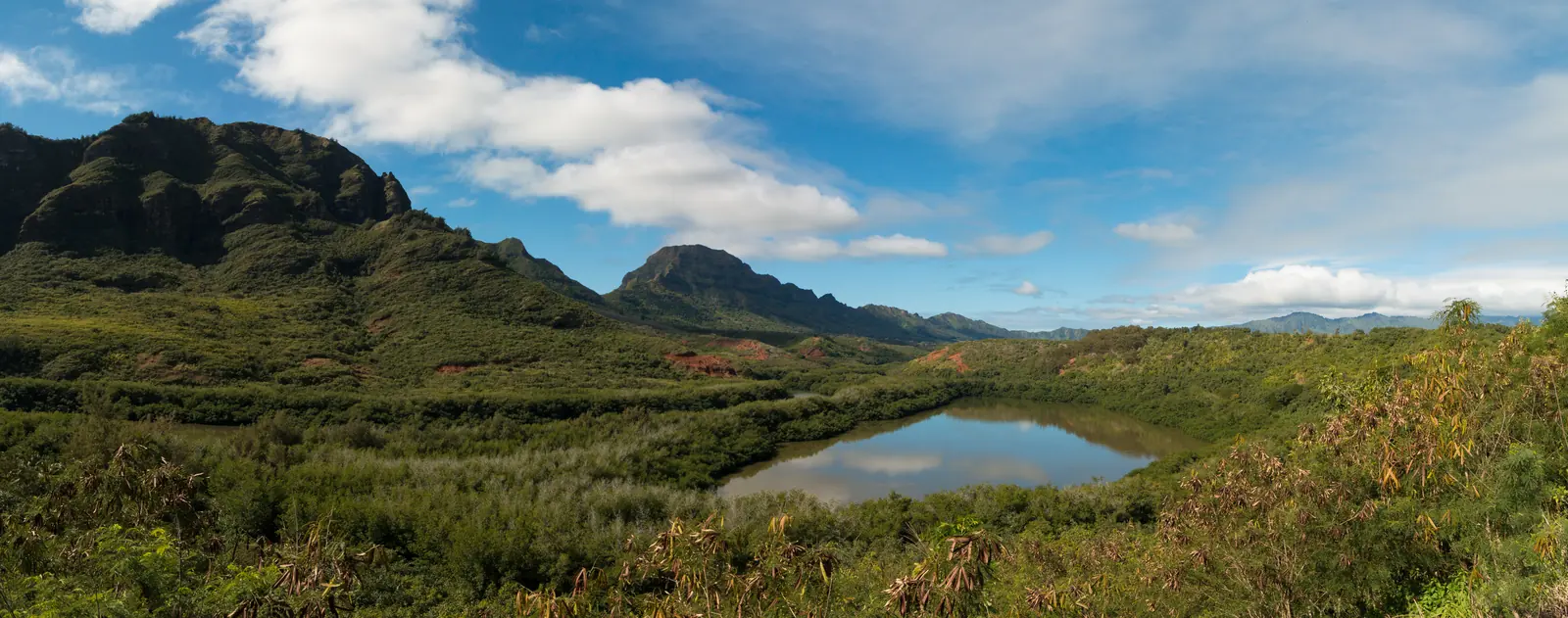
A long stone wall follows a bend in Kauaʻi’s Hulēʻia River. On one side is the river; on the other, a fishpond. The structure is large enough to invite an obvious question: how many hands did it take to build?
A famous Hawaiian tradition gives an extraordinary answer. The Menehune, skilled builders who worked at night, passed stones along a line and completed the pond in a single night. That story helped make Alakoko, also widely called ʻAlekoko or the Menehune Fishpond, one of Kauaʻi’s best-known places.
Behind the legend lies an ingenious food system. Its long wall controls water without sealing the pond off from the river. Sediment offers clues to when it was built, while restoration records show what it takes to keep it working.
The wall turns a river bend into a pond
Alakoko lies near Līhuʻe, upstream from Nāwiliwili Harbor. It occupies an old bend in the river, where a wall separates a roughly 40-acre pond from the flowing channel.
A Hawaiʻi conservation permit dated May 10, 2024 describes a stone-faced earth wall more than 2,700 feet long, or about 820 metres. The water is brackish: freshwater and saltwater meet here, and the tide affects its level.
The same document identifies two sluice gates, called mākāhā, which allow water to move between the river and pond. One is near the downstream end of the wall; a larger one is closer to the centre. The wall encloses an area without cutting it off completely from the surrounding water.
The gates allow the enclosed pond to exchange water with the tidal river. The wall holds a boundary while the water keeps moving through it.
Stone on one side, earth on the other
From a distance, the kuapā, or fishpond wall, can look like a long line of stones. Its two sides were built differently.
Mālama Hulēʻia, the organization caring for Alakoko, describes a rock face toward the river and an earthen bank on the pond side. That is unlike the two-faced stone walls found at many other fishponds. The earthen portion has its own Hawaiian name, kuāuna.
Repairing a gap means rebuilding the earthen bank as well as its stone face. Restorers also have to consider the flow of water and the sediment accumulating around it.
Mālama Hulēʻia’s plans therefore connect masonry with freshwater channels and sediment management. The aim is to recover a functioning pond, including the conditions in which fish can live.
Other societies made very different waterworks for the same practical reason: food production depended on controlling where water went. At Angkor, reservoirs, canals and local ponds supported a vast settlement. Alakoko belongs to its own Hawaiian aquaculture tradition, shaped by an estuary rather than a monsoon-fed inland city.
The night the Menehune built
The Hawaiʻi Tourism Authority’s public account describes a line of Menehune passing rocks hand to hand to build the pond overnight. It is a memorable way to picture coordinated work: many builders, a chain of stones and a deadline before morning.
The surviving wall gives the tradition a place in the landscape. A visitor can see something substantial whose construction would have required skill and organization. The scale of the wall gives the account of extraordinary builders an imposing setting.
How many people actually built it, and who were they? The surviving wall gives us no count or list of names.
Its construction leaves plenty to investigate: how the builders moved material, chose stones and raised a wall that would hold beside a tidal river.
How sediment helps date a fishpond
Alakoko is sometimes described as about a thousand years old. Its caretakers offer a more specific interpretation of the available evidence: construction roughly six centuries ago.
In Jan TenBruggencate’s account for Mālama Hulēʻia, a sediment core taken by researcher David Burney in 2002 reached deep deposits with little sign of human activity. Higher in the core, woody debris, grasses and charcoal marked a change. The account places establishment of the pond between about 1390 and 1450.
The date comes from interpreting a change in the deposits. Charcoal points to burning and human activity around the site; the sequence suggests when the pond began to form. The caretakers’ estimate of roughly 600 years allows for that uncertainty. It does not pin construction to a single year.
The mangroves changed the pond
A fishpond can become difficult to recognize when plants and sediment take over. Invasive mangroves spread at Alakoko, occupying water and wetland areas and damaging the wall with their roots.
Hawaiʻi’s Department of Land and Natural Resources reported in 2022 that restoration had included removal of 26 acres of mangroves. The work was part of a wider effort to recover the pond and its surrounding ecosystem.
As the mangroves came down, more of the wall and water became visible. The next tasks included repairing the enclosure and restoring the channels that supply it.
Restoration also reaches into the surrounding wetland. Changes upstream affect the water and sediment entering the pond.
Thousands of hands returned to the stones
On October 21, 2023, volunteers gathered along the wall for a major community workday. DLNR’s report of the event describes an estimated 2,000 participants working in groups on different sections.
They raised and rebuilt sections of the structure as part of a longer restoration. Other breaches and work on the water system remained.
The workday brought a long line of people back to the stones, much as the legend describes. DLNR’s photographs and report document the labour behind this modern repair.
A working place still needs care
Alakoko’s recent history also includes storm damage. In a September 16, 2026 update, Mālama Hulēʻia reported fallen trees, damaged work areas and a destroyed nursery shed after Hurricane Lowell.
The caretakers’ first look at the pond and wall was encouraging. A full assessment was still pending when they posted the update, so the extent of any damage to the enclosure remained uncertain.
After storms, the caretakers return to inspect the wall, clear channels and make repairs. A stone enclosure can survive for centuries and still need regular attention.
The legend gives Alakoko one remarkable night of construction. Its caretakers face a task with no final workday: keeping a centuries-old pond in working order beside a river that keeps changing.
Sources
- Mālama Hulēʻia: How Old is Alakoko Fishpond?
- Mālama Hulēʻia: wall restoration and sediment-management projects.
- DLNR: Ho‘āla Loko I‘a permit KA 24-01, dated May 10, 2024.
- Hawaiʻi Tourism Authority: Alekoko Fishpond and the public Menehune tradition.
- DLNR: restoration report, July 20, 2022.
- DLNR: community wall-restoration event, October 21, 2023.
- Mālama Hulēʻia: Alakoko After Hurricane Lowell, September 16, 2026.



.jpg)