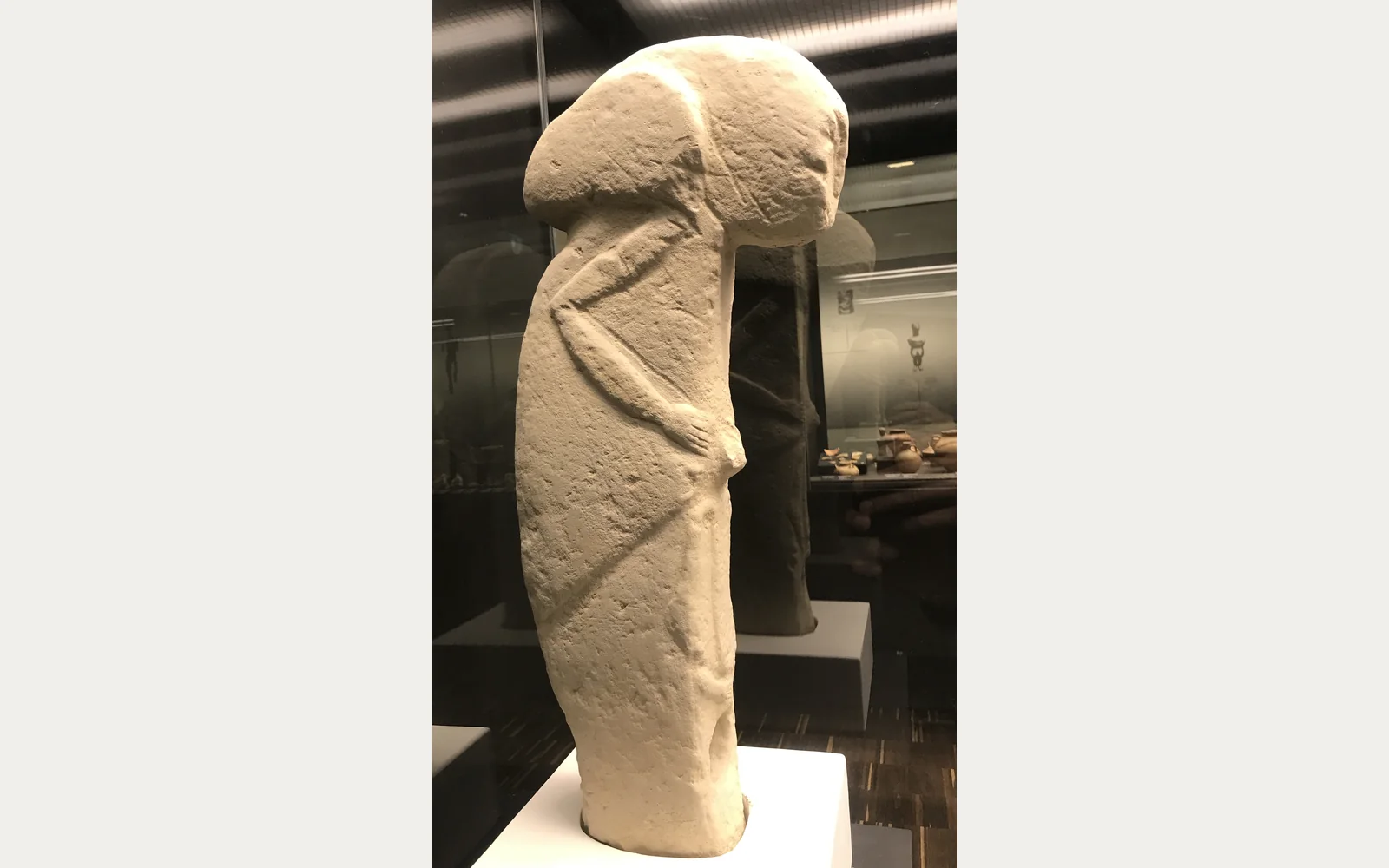
The head is a broad, flat T. Below it, a long nose projects from a narrow face. Arms run down the sides of the limestone body, and the hands meet above what looks like the head of a smaller figure.
The Kilisik sculpture, now associated with the Archaeological Museum in Adıyaman, is an object you can look at for some time before deciding what you are seeing. An embrace? A parent holding a child? A body whose anatomy has been reduced to unfamiliar shapes?
Place it beside other early sculptures from southeastern Turkey, and the T-shaped head starts to look familiar. The same outline appears in stone bodies at excavated sites across the region.
A find with a missing setting
Archaeologist Jens Notroff’s account for the German Archaeological Institute describes a discovery in 1965. A local farmer found the sculpture, which two archaeology students working at Arsameia purchased. It later reached the museum.
The limestone carving is about 80 centimetres tall. Its precise archaeological context remains unresolved. That affects how confidently we can date it and reconstruct its use. The often repeated description of an 11,000-year-old sculpture should be read as a proposed prehistoric placement, rather than an exact date established for this stone.
A carved limestone object cannot simply be radiocarbon-dated like a piece of wood. Researchers would normally seek dated material from a secure associated layer, or other evidence tying the carving to a particular occupation. With that setting missing, comparison has to carry more of the argument.
The family resemblance to T-shaped pillars
The comparison has a substantial foundation. In an account of the region’s excavation history, archaeologist Oliver Dietrich describes how work at Nevalı Çori revealed a special building with T- or Gamma-shaped pillars. Carved arms and hands helped researchers recognise these as highly abstract human bodies.
That discovery changed how Klaus Schmidt approached Göbekli Tepe. When he visited in 1994, experience at Nevalı Çori helped him recognise a worked stone as the head of a similar pillar. Excavations began the following year.
The Kilisik figure’s T-shaped head belongs to a sculptural tradition that appears in excavated buildings, alongside representations of the body. An unfamiliar outline can become legible when another site supplies the missing comparison.
Yet resemblance has limits. Sharing a visual convention does not establish that every object represented the same person, deity or ceremony. Think of how a crown can identify authority across very different portraits while leaving the sitter’s identity unknown.
One body, or two?
Notroff brings together three comparisons: the T-shaped pillars, more naturalistic faces such as Urfa Man’s, and composite carvings that arrange figures above one another. Kilisik appears to combine aspects of all three.
The lower part is especially ambiguous. Earlier interpretations considered whether it depicted parts of a single body; another proposed a mother-and-child scene. A circular hollow near the lower figure introduces a further question, including whether it was part of the initial carving or added later.
Those alternatives change the possible story enormously. A parent holding a child suggests a relationship. A deliberately ambiguous body could convey something about identity or transformation. A composite arrangement could belong to a narrative whose other characters and setting have disappeared.
Our coverage of the Vinča figurines raises a related difficulty: the human form survives more readily than the meaning attached to it. The comparison is about interpretation, not a claim that the two cultures shared a belief.
For Kilisik, the strongest path forward is to find more securely excavated examples with the same gestures and arrangement. Each could make one reading more plausible. For now, the sculpture leaves us with something unusually intimate from a distant world: hands placed around another form, and no surviving explanation of what that contact meant.